• Skip to primary navigation
  • Skip to content
  • Skip to primary sidebar

IZA Newsroom

IZA – Institute of Labor Economics

  • Home
  • Archive
  • Press Lounge
  • DE
  • EN

What explains the unexplained gender pay gap?

September 24, 2020 by Mark Fallak

Across the developed world, women continue to earn substantially less than men. In the U.S. and Germany, for example, the gender pay gap amounts to roughly 20% of men’s average wages. While a substantial part of this gap can be attributed to gender differences in pay-relevant characteristics such as work experience or occupation, non-negligible pay differences between men and women remain unexplained by these factors.

This unexplained gender pay gap is of great importance for both the academic and the public debate as it potentially results from discrimination against women. To some extent, it may also be due to factors usually not included in statistical decompositions of the wage gap – either because they cannot easily be measured, like the importance of the working climate and ethical motives in the choice of workplace, or because theory has overlooked them so far as a determinant of wages.

A recent IZA discussion paper by Dorothée Averkamp, Christian Bredemeier, and Falko Juessen identifies the interaction between the careers of individual family members in multiple-earner households as an important factor in wage differentials between men and women.

Families actively prioritize one member’s career

The authors emphasize that the decisions of a family can contribute to wage differentials between its members. For example, moving to another city can boost the career of one family member but harm that of another. Whether the family makes such a move also depends on whose career is prioritized. If the family bases this decision on already existing differences in earnings prospects or promotion opportunities, then existing wage differences are reinforced because the family actively promotes the career of the member who already earns more, or is expected to do so in the future, at the expense of the other family member’s career.

The analysis of data on U.S. dual-earner couples finds that men’s wages are fostered by families prioritizing their careers. If incentives for households to prioritize men’s careers were smaller, men’s average wages would be up to 10% lower. The results further suggest that a substantial part of the wage gap can be attributed to reinforcement mechanisms within the family. If one accounts for career prioritization when breaking down the pay gap in an explained and an unexplained part, the share of the wage gap that cannot be explained by household characteristics is substantially smaller.

Even low levels of discrimination can create a vicious circle

These results suggest that the extent of discrimination against women in the labor market is smaller than the results of conventional methods would suggest. Still, even low levels of discrimination can cause significant pay gaps because they encourage families to prioritize men’s careers, thus widening pay gaps. This leads to a mutually reinforcing cycle of earnings differentials and family decisions. For the aim of gender equality, this relationship is, on the one hand, a vicious circle. On the other hand, policies that reduce the pay gap can lead to families weighing women’s career opportunities and thus have a double effect on the pay gap.
Filed Under: Research Tagged With: career, choice, discrimination, family, gender pay gap

When is the most productive time of day?

September 23, 2020 by Mark Fallak

The link between time-of-day and productivity on cognitive tasks is crucial to understand workplace efficiency and welfare. A new IZA paper by Alessio Gaggero and Denni Tommasi examines the performance of university students taking at most one exam per day in the final two weeks of the semester. Exams are scheduled at different time-of-day in a quasi-random fashion.

Analyzing data on half a million student-exam level observations, the authors find that peak performance occurs around lunchtime (1.30pm), as compared to morning (9am) or late afternoon (4.30pm). This inverse U-shaped relationship between time-of-day and performance (i) is not driven by stress or fatigue, (ii) is consistent with the idea that cognitive functioning is an important determinant of productivity and (iii) implies that efficiency gains of up to 0.14 standard deviations can be achieved through simple re-arrangements of the time of exams.

While previous research has shown that biological factors influence changes in productivity between day and night shifts, this study establishes that such a relationship is also important within a standard daylight shift.

The study also found that the time-of-day effects varied seasonally, depending on the sunlight-related circadian rhythm: Moving an exam from the morning to lunchtime in January increases a student’s performance twice as much as in June.

A simple back-of-the-envelope calculation applied to an external context that is likely to benefit from these results—elective surgeries—suggests that a different sorting of the cognitive tasks performed by surgeons may lead to an increase in the number of patients saved during surgery.

Read also an article about this paper in MONEY.

Filed Under: Research Tagged With: cognitive task, fatigue, productivity, stress, time

How a second chance in education influences labor market outcomes

September 21, 2020 by Mark Fallak

Across the OECD area, 20-30% of each birth cohort drop out of high school before graduating. An important policy challenge is how to provide a second chance to low-educated workers who face declining labor market prospects and widening earnings gaps relative to college-educated workers in both the United States and Europe.

A recent IZA paper by Patrick Bennett, Richard Blundell, and Kjell G. Salvanes examines how a second chance in the education system—returning to high school as an adult—impacts labor market outcomes as well as other major life decisions such as fertility. Focusing on adult education in Norway, a considerable fraction of high school dropouts return to complete high school after dropping out by age 20. The authors estimate the causal impacts of returning to high school exploiting variation in the exposure to two substantial policy changes which first extended the legal right to adult high school education and subsequently provided unconditional student financing to return to high school.

Returning to education increases labor market prospects

Using detailed Norwegian data and following adults prior to and after the introduction of these reforms, the authors find that those exposed to the policy reforms at younger ages see considerable increases in high school completion and higher education relative to those exposed to the same reforms at even older ages. While women return to education after the two reforms, male education remains unchanged. Such increases in education among women lead to higher earnings and increases in employment. The observed increase in earnings attributed to later life education is driven almost entirely by increasing female employment rather than increasing wages among women. At the same time, increases in education lead to decreases in fertility.

Returning to high school as an adult—either vocational or academic—within the formal education system improves the labor market prospects of high school dropouts. The approach examined requires real investment in human capital by attending courses (day time or evening as well as workplace training for the vocational track) within the formal education system and nationally graded tests externally verified by a third party. In addition, the timing of returning to academic high school, which includes an option for entering higher education, matters for how likely students are to enter and complete college education: early exposed women complete higher education at substantially higher rates than later exposed women.

Reducing the gender earnings gap

The paper also provides evidence that later life human capital accumulation through formal education has the potential to impact the gender earnings gap. As male education is unchanged after the education reforms, later life education improves the labor market conditions of women relative to men. Given the strong relationship which exists between children and employment, a considerable portion of the increase in employment observed among women can operate through the joint decision of fertility and employment. Indeed, previous studies have emphasized the importance of the child wage penalty as a factor behind the gender wage gap.

Understanding why individuals find it optimal to return to levels of education they previously dropped out of is of key importance. The paper suggests that financial constraints are an important factor in decision to return to school, as increases in student financing push women back into education. At the same time, important differences across factors such as gender, socioeconomic status, childbearing, and cognitive ability also matter for both the decision to restart education and the age at which adults return to education.

Filed Under: Research Tagged With: adult education, earnings, education, fertility, gender gap, human capital, labor market prospects

Research reveals ‘climate-change complacency’ across Europe

September 17, 2020 by Mark Fallak

Most European citizens do not particularly care about climate change. That’s the striking finding from a new IZA discussion paper by Adam Nowakowski (Bocconi University) and Andrew J. Oswald (University of Warwick) on the views of 70,000 randomly sampled European men and women.

Only 5% described themselves as ‘extremely worried’ about climate change. The climate and the environment ranked only 5th in people’s overall views about priorities. There was also scepticism that coordinated action, for example to cut personal energy use, would make much difference.

Andrew Oswald, who is special representative of IZA on climate change and labor markets, commented on the findings:

‘There is little point in designing sophisticated economic policies for combating climate change until voters feel that climate change is a deeply disturbing problem. Currently, those voters do not feel that.’

He also pointed out that the so-called desirability bias, which is the tendency for interviewees to feel compelled to shade their answers towards ‘politically correct’ ones, might mean the true level of worry about climate change is lower than indicated in the statistical surveys.

The authors analyzed data from two large-scale sources, the 2016 European Social Survey and the 2019 Eurobarometer survey. They found:

  • Europe’s citizens are more concerned with inward-looking issues seen as closer to home, such as inflation, the general economic situation, health and social security, and unemployment.
  • Europeans do not have a strong belief that joint action by energy users will make a real difference to climate change.
  • Women, young people, university graduates and city-dwellers show higher levels of concern about climate change.
  • People living in warmer European countries had higher levels of concern than those in the cooler North of the continent.

On the way to move forward, Oswald and Nowakowski suggest parallels with the original government campaigns to cut smoking. They argue that it will be necessary to change people’s feelings about the problem of rising global temperatures. Just as education about the risks of smoking went hand-in-hand with graphic warnings and tax increases, governments should consider doing more to educate and alter people’s perceived level of worry about climate change.

Adam Nowakowski commented:

‘We should not conclude that Europe does not care at all about climate change. However, our analysis of the data does suggest that European citizens are not ready for policies which would have strongly negative consequences on their day-to-day lives – not least because we have found a low level of confidence in the usefulness of joint action.’

Filed Under: Research Tagged With: climate change, feelings, global warming, policy interventions, public information

Does economic development deter workers from leaving poor countries?

September 10, 2020 by Mark Fallak

As the world economy recovers from this year’s historic shock, millions of people will once again migrate each year from poorer nations to rich ones. Most come in search of work. Many richer countries seek to reduce the numbers of such migrants by encouraging economic development and opportunity overseas. “I want to use our aid budget [for] creating jobs in poorer countries so as to reduce the pressure for mass migration to Europe,” says British minister Priti Patel.

Will it work? When people in poorer countries get more economic opportunity, are they typically more likely to stay in their home countries? It may seem obvious. But two new IZA Discussion Papers reveal the opposite pattern: As people in poorer countries get richer, they are more likely to emigrate. In poor countries, sudden bursts of migration can be a sign of crisis. But sustained increases in migration are a sign of economic success.

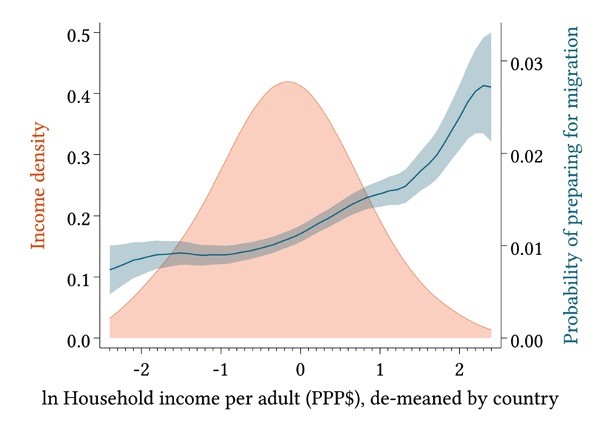
The first paper, by Michael Clemens and Mariapia Mendola, studies this question at the level of households. Using data on 653,613 people in 99 developing countries, they find that people in households with higher income per adult are more and more likely to be making final, costly preparations to permanently emigrate.

The figure below shows, in orange, the distribution of income for 120,420 people in the lowest-income countries of the world (left-hand axis). On top of that, in blue, is the probability that people at each income level are in the final stages of actively preparing to emigrate (right-hand axis).

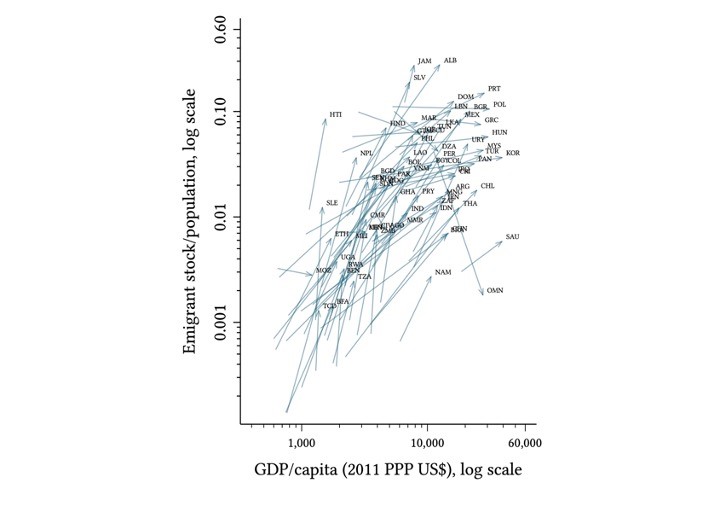
The second paper, by Michael Clemens, studies the same question at the level of nations. As poor countries get richer over time, larger fractions of their populations live outside them. The figure below shows emigration from poor countries to rich countries, on the vertical axis, and average income per capita on the horizontal axis. The arrows show how developing countries moved when they experienced economic growth between 1970 and 2019 (leaving out very small countries). Almost no developing countries have experienced sustained economic growth without a large rise in the emigrant fraction of the population.

These are only sketches of the results, on which the papers carry out numerous tests. For example, the first paper estimates positive self-selection—the greater migration tendency for people with higher earning power—on both observed determinants of earnings (like schooling) and unobserved determinants of earnings (like work ethic). It also checks whether emigration preparations reflect real emigration behavior. The second paper checks whether this pattern arises from differences in country traits that are fixed over time (like geographic location) or global changes that affect all countries (like improved transportation and communications technology).

The quantitative findings of the two papers, despite their different approaches, are strikingly similar. Across households within developing countries, a 100 percent rise in income per adult is associated with about a 30 percent increase in the propensity to be in the final stages of preparing to emigrate. Across developing nations, a 100 percent rise in average income per capita over time is associated with a 35 percent increase in emigration prevalence. In the very long term, economic development may substitute for migration, they find, but for the foreseeable future it is more likely to complement migration.

Why? Certainly it is not the case that workers prefer to stay in countries with less economic opportunity.

The easiest way to grasp the essence of this phenomenon, the authors write, is to think of migration as an investment in human capital. Moving to a new country, like investing in education, brings up-front costs with long-term benefits. Families with more money are more likely, not less likely, to send children to university even though they might have less ‘need’ for the income boost. The things that come along with higher incomes—more and better secondary schooling, and higher career aspirations, among others—produce higher university enrolment by richer families. Related forces are at work in migration. Economic development, too, brings changes of demography, schooling, urbanization, and other structural shifts that facilitate and inspire migration.

From a policy perspective, how should international development agencies engage with these facts? The authors caution against facile interpretation. The emigration of people from Africa is sometimes a sign of short-term crises, but it is simultaneously a sign of long-term economic success. Mass emigration from Scandinavia before 1914 was far from a sign of economic failure, but a sign of that region’s take-off into modern economic growth and the structural changes that came with it. Political debates that view development assistance as a migration deterrent—whether their arguments are pro-aid or anti-aid—may lack a basis in labor-market evidence.

Filed Under: Research Tagged With: aid, Development, migration

Graduating in a pandemic may lead to long-term income losses

August 31, 2020 by Mark Fallak

In 2019, times were rosy for job seekers. Employment reached a record high in Germany since 1990, and the U.S. job market was the strongest in 50 years. Then the coronavirus hit the world and caused the most severe economic crisis in modern times. Jobs disappeared at an unprecedented rate, with U.S. unemployment rising to 14.2 percent in April and only slowly recovering to about 10 percent at the end of July. Even in Germany, which has so far weathered the crisis fairly well, almost 635,000 jobs have been lost year-on-year in July 2020.

For young people unfortunate enough to graduate during the pandemic, this is a bleak outlook. Fewer job opportunities will make school-to-work transitions difficult, possibly imposing large and long-lasting losses. IZA research has repeatedly shown that graduates who leave school in a recession earn substantially less in their first jobs. Although earnings tend to recover after a few years when labor market opportunities improve again, a large gap in lifetime income remains. For example, an earlier IZA paper based on Canadian data from the 1980s and 1990s suggests that a 3-4 percentage points higher unemployment rate at the time of graduation results in average losses of 5 percent in lifetime earnings.

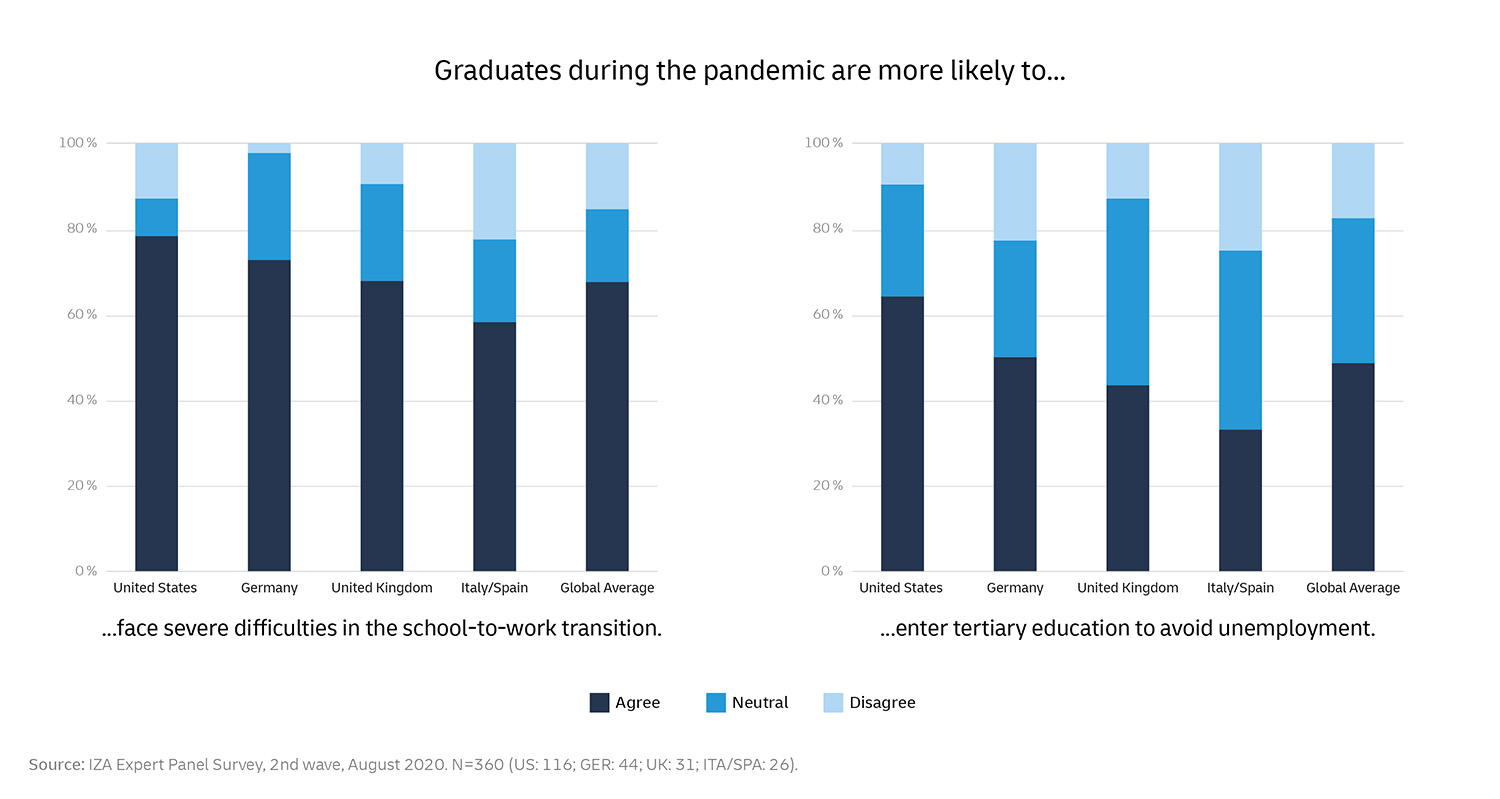
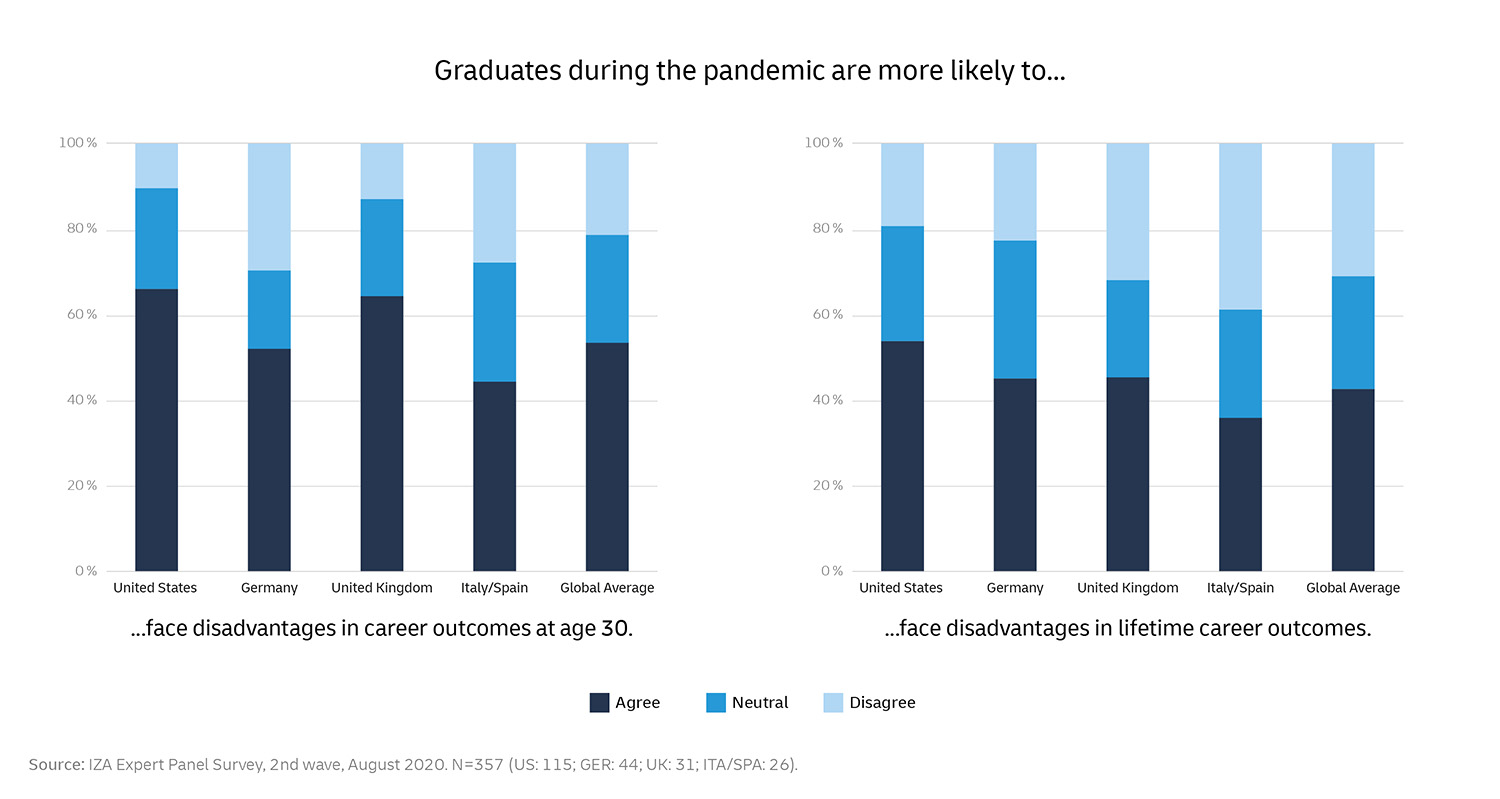
What are the expected effects of the current pandemic on recent graduates? The latest wave of the IZA Expert Panel asked labor economists from about 50 countries how they believe the COVID-19 crisis will affect labor market entrants in their countries.

The analysis shows that more than two-thirds of the experts expect 2020 graduates to have greater difficulties in the important school-to-work transition than previous cohorts. Remarkably, both U.S. and German experts are more pessimistic than the average, whereas labor market researchers in Italy and Spain provide a slightly more optimistic outlook. While the survey does not shed light on the reasons for these country differences, a possible explanation may be that the latter countries had already faced high youth unemployment rates before the crisis. In contrast, U.S. and German job markets for graduates were exceptionally strong in previous years, which could make a larger drop appear more likely.

Moving on to tertiary education is an option for young people to avoid unemployment in a tight job market while at the same time investing in their human capital to improve future earnings prospects. This option seems to be particularly relevant in the UK, where more than 60 percent of the surveyed experts believe that secondary school graduates will be more likely to enter tertiary education.

Regarding the longer-term impact on career outcomes, the experts (particularly those from the US and UK) expect significant disadvantages at age 30 for those who graduate during the recession. These negative effects are expected to fade over time, as reflected in the somewhat more favorable outlook on lifetime career disadvantages. Once again, respondents from Italy and Spain are less likely to expect large negative effects. As suggested above, this may to some extent be due to country differences in pre-crisis labor market conditions.

What can graduates in a pandemic do to make the most out of their situation? IZA Research Fellow Philip Oreopoulos from the University of Toronto provides some advice in a recent IZA World of Labor opinion piece. In addition to staying in education, he suggests volunteering as a way to apply one’s skills and gain experience that may prove useful in future job interviews. Nonetheless, recent graduates will likely need to be more mobile and flexible in their job preferences than previous cohorts.

+++

Read more about previous findings from the IZA Expert Survey:

  • High-skilled workers expected to suffer less from the COVID-19 crisis
  • U.S. experts favor income support to mitigate the COVID-19 labor market crisis

Filed Under: IZA News, Research Tagged With: career, COVID-19, education, graduate, school-to-work, youth unemployment

Does the dream of home ownership rest upon biased beliefs?

August 19, 2020 by Mark Fallak

For many people, home ownership is a long-cherished dream. Particularly in times with low interest rates, many tenants consider buying an apartment or a house. But this decision not only entails a major financial commitment. It also involves many trade-offs with significant long-term consequences, such as foregoing leisure in order to be able to save more, or longer commutes due to reduced mobility. If beliefs about the imagined benefits were biased, this may result in sub-optimal investment decisions.

A new IZA discussion paper by Reto Odermatt and Alois Stutzer assesses whether people correctly predict the well-being benefits of moving from a rented to a privately owned home. They analyze data on predicted and realized life satisfaction of more than 800 prospective home owners in a sample of 25,000 individuals from the German Socio-Economic Panel (GSOEP).

Predicted and realized life satisfaction

In this annual survey, participants are asked about their individual life satisfaction on a scale from 0 (not satisfied at all) to 10 (very satisfied), as well as how satisfied they expect to be in five years’ time on the same scale. Comparing predicted life satisfaction with the actual realizations allows the authors to assess the accuracy of home owners’ prediction of their future well-being.

The analysis provides evidence that is consistent with the idea that home ownership positively contributes to people’s life satisfaction. However, the study also finds that people are overly optimistic about the extent of the positive long-term satisfaction gains. This provides support for the speculation that in the decision-making process people rely on biased beliefs regarding the long-term benefits of home ownership.

Status seekers prone to misprediction

In order to additionally and more directly test the relevance of beliefs for people’s accuracy of their predictions, the authors consider heterogeneity in people’s life goals as a proxy for different underlying beliefs. The results show that individuals who value things like income, success, and the ability to buy goods relatively highly commit significant errors, while the others do not. This suggests that the risk of biased beliefs is particularly high for those who consider buying a home also for status reasons.

Role of beliefs in economics and public policy

The study questions the ancillary role that is ascribed to beliefs in most economic applications as well as in public policy. Importantly for economics, in cases where people’s decisions in life are based on biased beliefs, individual behavior would not reveal true preferences, but rather beliefs about preferences. This would undermine a key tenet of traditional economics, which holds that preferences can be inferred from observed behavior.

From a public policy perspective, the authors argue that the focus should be more on the forces and actors that influence people’s beliefs, for example with regard to images and narratives offered by the media or the advertising industry. If these actors pursue private interests, influence might translate into attempts at manipulation. The researchers thus point at the importance of identifying the conditions under which biased beliefs evolve and influence decision-making processes – an account that economics has not offered so far.

Filed Under: Research Tagged With: behavior, beliefs, bias, happiness, home ownership, life satisfaction

Do refugee classmates affect the educational attainment of native students?

July 20, 2020 by Mark Fallak

With about one million refugees coming to Europe at the height of the refugee immigration in the mid-2010s, European societies faced a range of both opportunities and challenges. A major concern among policymakers and the public was that large shares of refugee children with language barriers in the classroom would put an additional strain on the already scarce time resources of teachers.

A new IZA paper by Colin P. Green and Jon Marius Vaag Iversen examines what happens to the educational attainment of primary school children in Norway when they attend school with more children from a refugee background. Norway provides an interesting setting due to relatively recent dramatic increases in immigration, and historically a very low immigrant base.  For instance, while only 3.5 percent of the total population of Norway in 1990 were immigrants, they now account for 14.7% of the total population. A substantial share of this increase is refugees, who make up roughly one in four recent immigrant arrivals to Norway.

Like other Scandinavian countries, Norway exercises a range of controls on the location decisions of these refugees. In practice, this leads to children from a refugee background being quite spread across Norway, and across Norwegian schools.

Lower math scores among native school children

To identify a causal effect of higher refugee shares in the classroom, the authors compared Norwegian siblings exposed to different shares of refugees at the same time of their educational careers. They find a negative effect of refugee classmates on the math test scores of non-immigrant Norwegian students: An increase in the refugee share by five percentage points reduces the math test scores of each Norwegian student in the school grade by an average amount that is equivalent to three percent of an expected year’s progress. In contrast, the share of economic immigrant students without a refugee background does not affect the educational performance of native students.

Since boys and children from lower educational backgrounds are found to be especially vulnerable, this may exacerbate educational inequality. The authors provide evidence that these negative effects may reflect a lack of compensatory inputs at the school level in terms of class size, instruction hours per student, and student-teacher ratios.

Filed Under: Research Tagged With: education, math, Norway, refugee, schooling

Shorter compulsory schooling can increase the overall time spent in education

July 14, 2020 by Mark Fallak

Investment in human capital is essential for economic growth and escaping poverty, especially in developing countries. Yet, decisions on putting kids in school are often constrained by the high cost that schooling entails for families.

These household constraints are exacerbated by governments’ lack of fiscal resources to increase the supply of schools. In the 1970s and 80s, Egypt witnessed unprecedented population growth. The rapid increase in student enrollment put enormous pressure on the school system, which struggled to accommodate all eligible students. Classes were increasingly run on a daily two- or even three-shift basis. The Ministry of Education reacted with a radical policy change: Beginning in the 1989-1990 school year, the duration of compulsory education was reduced from nine to eight years.

Staggered roll-out

A new IZA discussion paper by Ahmed Elsayed and Olivier Marie evaluates the impact of this policy on educational attainment, as well as on longer-term labor market and marriage outcomes. Given the very sudden announcement of this nationwide policy, very few schools managed to implement it as early as September 1988, while the rest delayed the start for one year or longer. Exploiting this unintended staggered roll-out across schools by comparing children of the same cohort whose schools were affected in different years, the authors were able to control for unobserved factors in order to estimate the causal effect of the policy.

Surprisingly, the study finds that the policy reduced dropout in the compulsory education stage and increased the share of those who stayed in school for three additional years of secondary education. This effect was almost entirely driven by girls, especially from disadvantaged households. Thus, reducing the number of compulsory schooling led to an overall rise in the number of actually completed years of schooling for an especially vulnerable group of students.

Son preference

While this effect may seem counterintuitive at first, it can be easily rationalized with the strong preference for sons, which Egypt shares with many other countries in the Middle East and Asia. As girls bear a disproportional part of household production, child care and household chores, additional years of schooling are perceived as more costly for girls than for boys. Accordingly, the possibility of finishing secondary education by the age of 17  rather than 18 would have had a stronger impact on a family’s investment decision for the average daughter compared with a son, especially for financially constrained households.

The long-term analysis shows that girls from disadvantaged households benefited strongly from the increase in total years of education in terms of better labor market outcomes and higher marriage quality. They were more likely to be employed, had better jobs, and earned higher wages. At the same time, they were less likely to be married as a minor, obtained a higher “bride price” (jewelry received at marriage), and had more intra-household decision-making power as wives.

Thus, the reduction in compulsory schooling unintendedly spurred higher levels of investment in human capital and reduced gender inequalities. The authors emphasize that these positive implications for economic and social empowerment of women are specific to the setting of a developing country with a strong son preference. Previous studies had found for Western countries that more years of compulsory schooling are associated with lower inequality.

Filed Under: Research Tagged With: Developing Countries, education, girls, household, human capital, schooling

Poor air quality increases COVID-19 deaths

July 3, 2020 by Mark Fallak

With already over half a million deaths globally, the COVID-19 crisis has distracted public attention from pressing environmental issues such as climate change and pollution. Yet, there is a striking connection between the health effects of the pandemic and air pollution, according to a new IZA discussion paper by Ingo E. Isphording and Nico Pestel.

The study shows that higher levels of local air pollution increase the number of deaths related to COVID-19. One of the reasons is that air pollution leads to inflammatory reactions and lower immune responses to new infections, which exacerbates the course of the illness. In addition, some studies have argued that higher levels of air pollution prolong the time the virus remains in open air, thus increasing the number of infections.

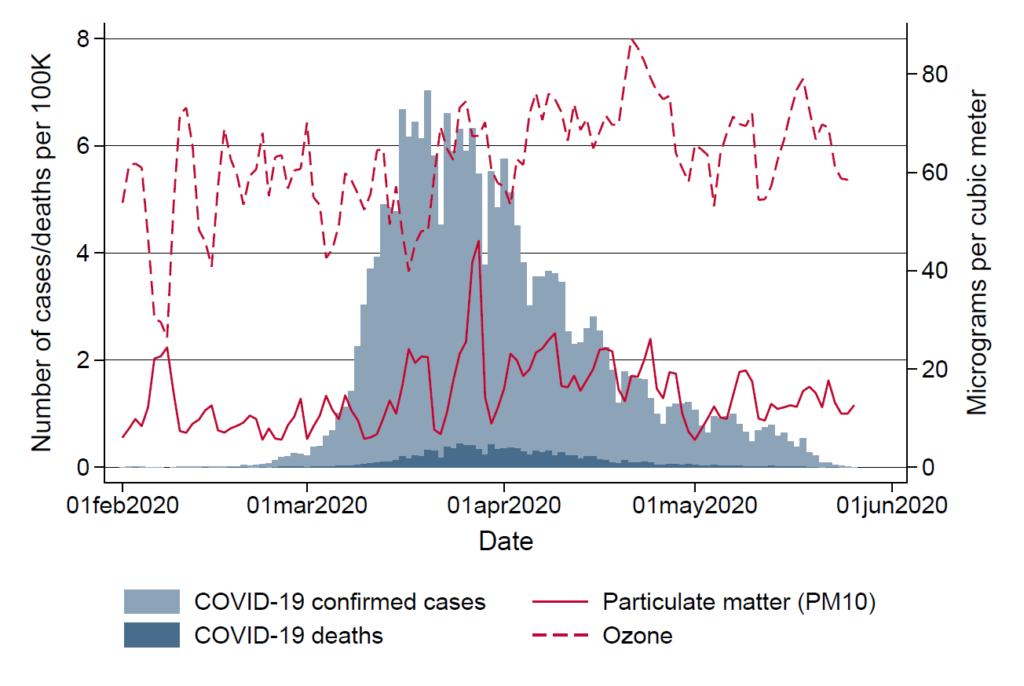
The authors link pollution patterns, measured by particulate matter (PM10), surrounding the day of onset of illnesses to the numbers of deaths and newly confirmed cases of COVID-19 in German counties between early February and late May. By focusing on changes in air pollution within counties rather than cross-sectional correlation between countries in death numbers and pollution, the estimated relationship can be interpreted as a causal effect of air pollution levels on the number of deaths.

Figure 1: Daily variation in new con firmed cases and deaths and mean air pollution

Figure 1 describes the level of pollution across the course of the pandemic in Germany. In contrast to the common perception that air pollution decreased during the lockdown due to lower traffic and economic output, the data shows that air pollution levels actually remained high and even peaked in late March. This can mainly be attributed to weather conditions as the lockdown in Germany happened to coincide with a sudden drop in precipitation and wind speed, which made particulate matter stay in the air longer.

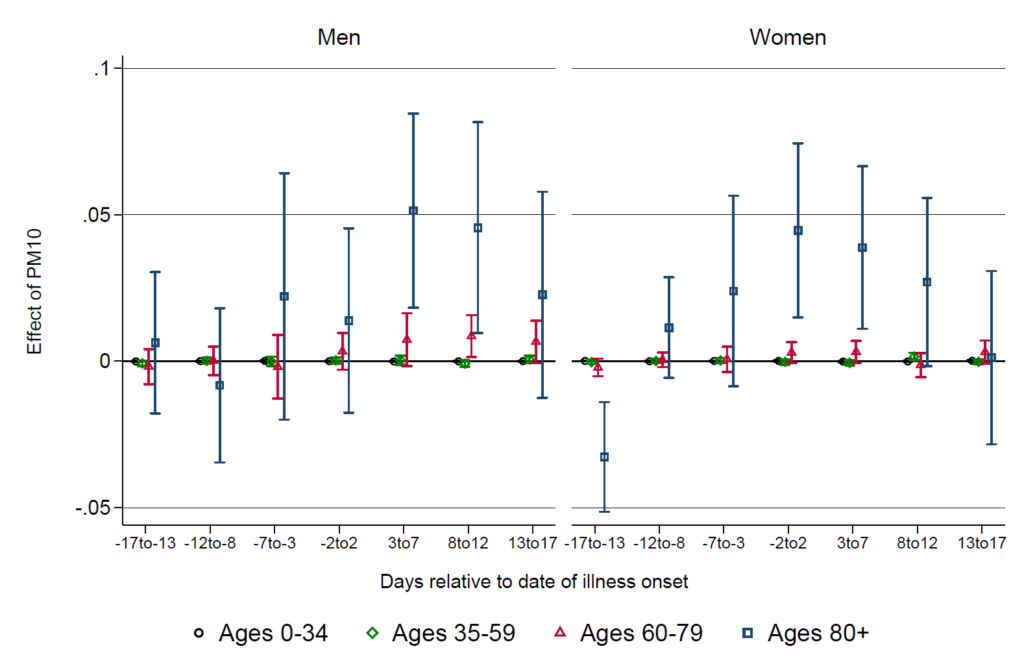
The regression results show significant effects of higher air pollution on the number of deaths by day and county (Figure 2).  Effects are specifically pronounced for patients aged 80 and above. In this age group, a one standard deviation increase in PM10 (6.3 microgram/m3) three to seven days after the onset of illness increases the number of deaths among male patients by 30 percent of the baseline mean, with comparable effects for female patients.

Figure 2: E ffect of PM10 on new deaths from COVID-19

These results imply that moving older patients, who are at higher risk of dying of COVID-19 when being exposed to higher levels of air pollution, to less polluted areas might be a way to reduce the case fatality rate of COVID-19. This could be of particular relevance when the pandemic unfolds in less-developed world regions where air pollution and associated health risks are stronger, e.g., through the more widespread (indoor) use of fossil fuels for cooking and heating, and where supply of high-quality medical care is constrained.

Filed Under: Research Tagged With: COVID-19, death, environment, health, particulate matter, pollution

  • Previous Page
  • Page 1
  • …
  • Page 16
  • Page 17
  • Page 18
  • Page 19
  • Page 20
  • …
  • Page 69
  • Next Page

Primary Sidebar

© 2013–2025 Deutsche Post STIFTUNGImprint | Privacy PolicyIZA