• Skip to primary navigation
  • Skip to content
  • Skip to primary sidebar

IZA Newsroom

IZA – Institute of Labor Economics

  • Home
  • Archive
  • Press Lounge
  • DE
  • EN

Low-income earners suffer most from the COVID-19 crisis

April 17, 2020 by Mark Fallak

Home office at full pay is not an option for all employees hit by the coronavirus crisis. To analyze changes in work arrangements during the pandemic, a team of economists from the University of Bonn, IZA and the University of Tilburg surveyed around 5,500 individuals in the Netherlands from March 20-31. The results show that high-skilled workers spend more time in the home office, while less-skilled workers are more likely to work reduced hours or lose their jobs.

Education plays a key role in terms of being able to work from home, according to new data from the COVID Impact Lab, a joint research project by the University of Bonn’s ECONtribute Cluster of Excellence and IZA. The researchers compared work arrangements at the onset of the crisis and shortly after social-distancing policies were implemented. Their data are the first to show detailed changes in the proportion of telework among different groups of employees.

High-paid workers benefit from the home office option

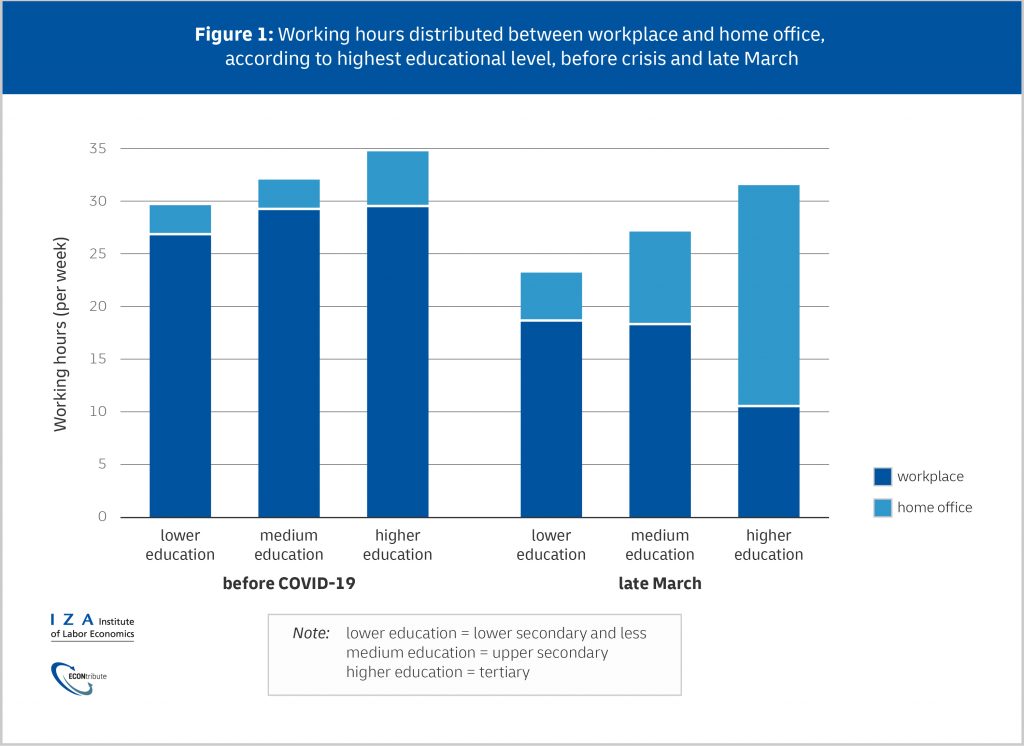
The total share of employees who work from home at least two hours a day has doubled from 27 to 54 percent. This is mainly driven by high-skilled workers (76 percent) while only 31 percent of low-skilled workers report at least two home office hours per week since the beginning of the crisis. For university graduates, switching to telecommuting seems relatively easy: While their share of home office hours increased from 11 to 68 percent, the share among the low-educated is only one-fifth. The latter group, instead, experienced a much larger drop in total hours (see Figure 1).
Double impact of the crisis on low-income earners

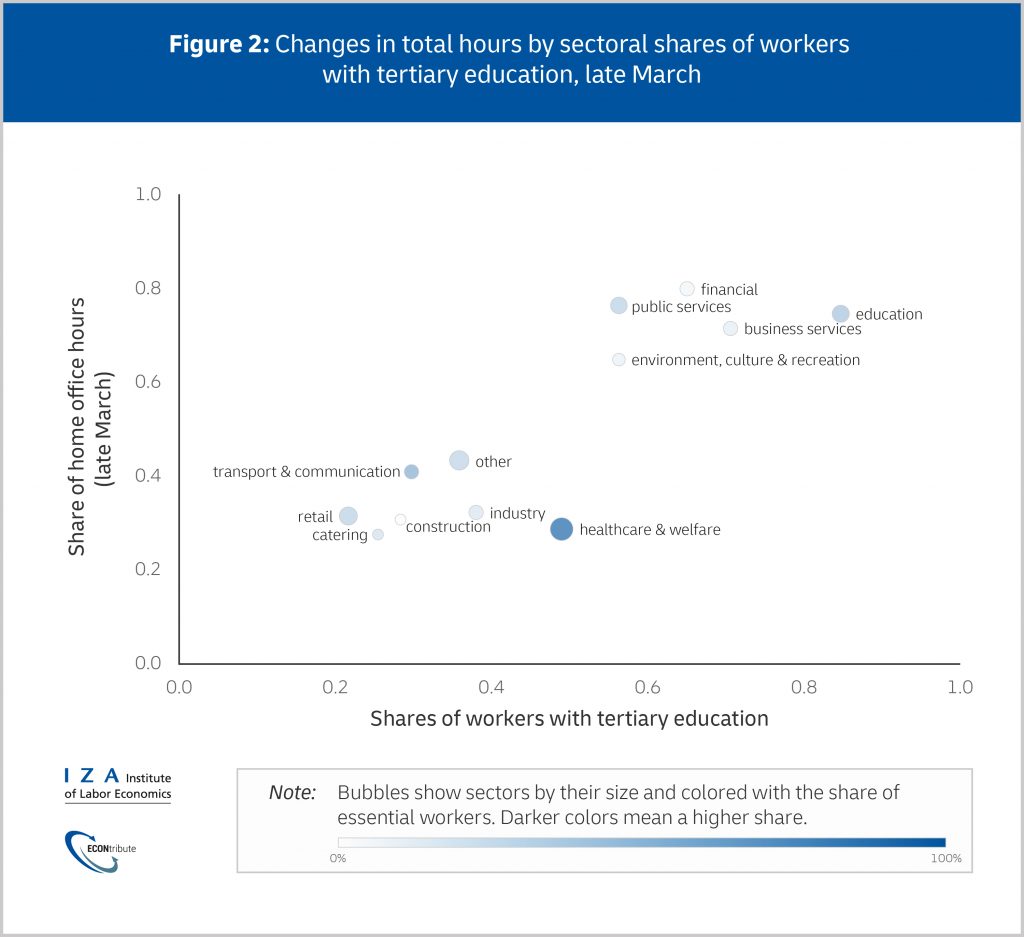
The main reason may be that less qualified workers are more often found in occupations where remote work is impossible, such as transportation, retail, or catering. This makes them more prone to job loss or substantial working hour reductions. At the same time, they are less likely to have savings or assets to compensate for income loss, which makes them particularly vulnerable to the crisis and more in need of government support.

Lower educated workers are also found in essential occupations, such as nursing care or grocery retailing. While their jobs are currently safe, they are at higher risk of infection. Home office workers, on the other hand, are protected against both infection and income loss. This aggravates the labor market segmentation into office jobs, characterized by higher education levels and home office rates, and lower-skilled jobs with no home office option (see Figure 2).
Transferability of the findings to Germany

“The data currently available for Germany are less detailed, but preliminary findings suggest that the situation is very similar. Although the increase in the share of home office hours seems somewhat less pronounced than in the Netherlands, it is clear that workers without higher education are less likely to be able to work from home. Both countries have also implemented similar restrictions on social contacts, which creates a comparable setting,” says IZA research team leader and ECONtribute professor Hans-Martin von Gaudecker.

About the dataset

Data were collected through the Dutch LISS panel (Longitudinal Internet Studies for the Social Sciences) which has been surveying 4,500 households regularly on a variety of topics for over ten years. The households are representative of the Dutch population and answer the questionnaires online. For the current wave of the LISS panel, the research team designed a new module to ask panel members about behaviors, beliefs and expectations during the Corona epidemic. The first wave of this module was fielded between March 20 and March 31 among LISS participants aged 16 and over. The response rate was over 80 percent, which translates into a sample of 5,544 individuals. Comprehensive data are not yet available for Germany, but initial trends can be seen. The German data is also being collected via an online survey through GESIS, the Leibniz Institute for the Social Sciences.
Filed Under: Research Tagged With: COVID-19, home office, telecommuting, telework

Do immigrants integrate differently in new and traditional host countries?

April 16, 2020 by Mark Fallak

In many countries, the formal and informal institutions shaping immigrants’ labor market integration have evolved over decades or even centuries. Immigrants arriving into these traditional destinations can often rely on established ethnic networks and interact with natives who are accustomed to immigrants. However, a large number of people also move to countries that have short, if any, immigration history. Do these “pioneers” adopt different strategies to cope in the labor market than those arriving to the more established destinations?

A new IZA paper by Laura Ansala, Olof Aslund and Matti Sarvimäki examines this question by presenting a careful documentation of how immigrants enter the Finnish and Swedish labor markets. The two countries provide an informative case study because they are similar in many dimensions, but differ starkly in their immigration histories. In 1990, when the analysis period begins, Sweden was already an established host country with almost 10% of the population born abroad. By contrast, Finland had strongly restricted immigration and less than 1% of the population was immigrants.

As a consequence, immigrants arriving to the two countries faced very different circumstances. For example, only 0.3% of jobs in Finland were in establishments that had an immigrant manager while the corresponding figure in Sweden was 7.3%. Furthermore, natives in Finland were much less used to working with foreigners and more likely to hold negative attitudes towards immigrants than natives in Sweden.

Most immigrants start in low-paying jobs

Using detailed data covering the entire of population of the two host countries in 1990–2010, the authors find that despite the differences in immigration histories, immigrants start their careers in a remarkably similar manner in Finland and Sweden. In both countries, they tend to enter the labor market through low-paying establishments, where other workers and managers are disproportionately often immigrants – particularly from the same region of origin as the entrant herself. For example, 8% and 9% of immigrants to Finland and Sweden, respectively, enter the labor market through an establishment where the manager is from the same region of origin as the immigrant herself.

The similarities between Finland and Sweden extend to many details of labor market entry and subsequent careers. However, this does not mean that all immigrants would enter the labor market in the same way. The authors document large heterogeneity in time to first employment and entry job characteristics by region of origin, arrival cohort, gender, age and family structure.

Ethnic segregation and segmentation of the labor market emerge quickly

Importantly, however, the associations between background characteristics and labor market entry are very similar in Finland and Sweden. A case in point is refugees arriving from the former Yugoslavia and Somalia in the early 1990s. In Sweden, there was already a significant community of immigrants from the former Yugoslavia due to labor migration that had started in the 1950s. No such community was present in Finland. Furthermore, there were virtually no earlier immigrants from Somalia in either of the two host countries. Yet, the paper shows that those arriving from Yugoslavia enter the Finnish and Swedish labor markets in a similar way – as do those coming from Somalia.

These results are consistent with the hypothesis that ethnic segregation and segmentation are such fundamental features of the labor market that they emerge quickly even in a country with very limited immigration history. Thus the host country’s immigration history would play only a limited role in shaping the integration process. Of course, a descriptive study of two countries is not sufficient for establishing generality for this conjecture. Given the high social and policy importance of understanding the determinants of immigrant labor market outcomes, documenting these patterns also for other countries would thus be highly valuable.

Filed Under: Research Tagged With: Finland, immigration, Sweden

How expectations affect compliance with COVID-19 social-distancing measures in Italy

March 30, 2020 by Mark Fallak

The coronavirus COVID-19 outbreak has rapidly and drastically affected the livelihoods of millions of people around the world. Several countries began implementing strict self-isolation measures (e.g. school closure, stay-at-home) to slow down contagion. The effectiveness of these measures depends entirely on citizens’ compliance, which may be affected by many factors, such as risk awareness, rules clarity, penalties for transgressions, trust towards public authorities, and the severity of the isolation costs.

In a new IZA discussion paper, Guglielmo Briscese, Nicola Lacetera, Mario Macis, and Mirco Tonin offer evidence of another key factor that influences compliance: people’s expectations on when the isolation measures will end. While countries like China introduced lockdown measures without announcing an end date of the measures, other countries like Italy announced that most measures would be lifted after a specified date.

Representative survey on Italians’ compliance intentions

In a survey on a representative sample of the Italian population, the authors elicit compliance intentions if the stay-at-home measures were extended (i) by a few weeks, (ii) a few months, or (iii) indefinitely (“until deemed necessary”), and control for the respondents’ level of awareness, expectations, and current compliance.

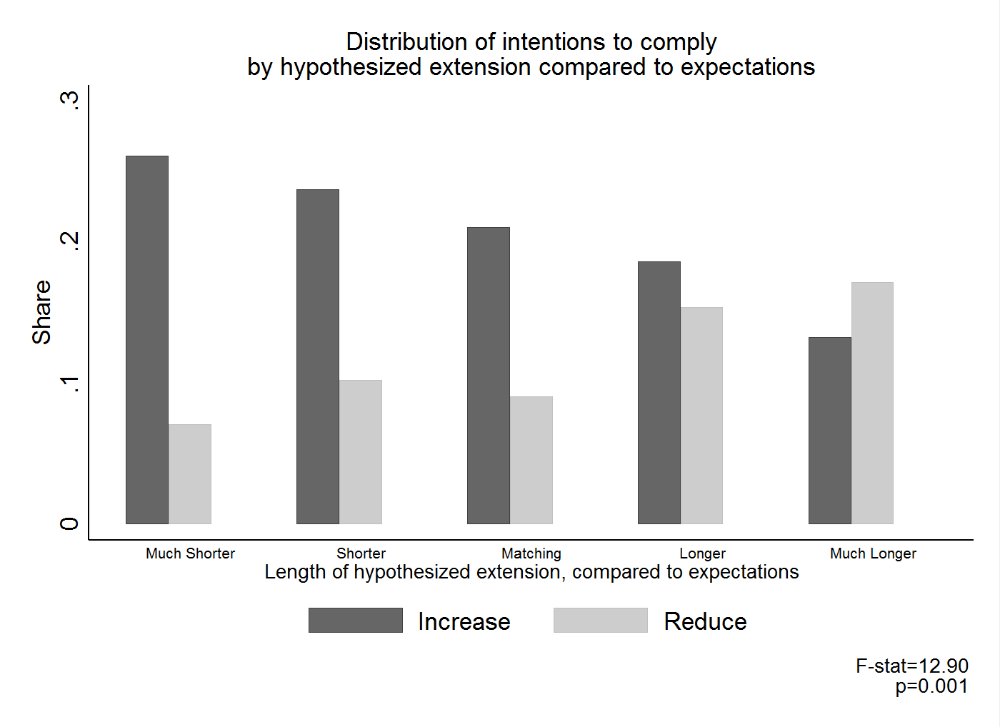
The results show that people’s willingness to comply is related to their expected end date of self-isolation measures. Those who would be positively surprised (i.e. extensions shorter than expected) intend to increase their isolation efforts; those who would be negatively surprised (i.e. extensions are longer than expected) are less willing to maintain or increase their self-isolation efforts (see Figure).

The study also finds that:

  • About 50% of respondents have not yet adopted some of the recommended social distancing measures.
  • Most people are aware of the official end date of social isolation measures (April 3rd), but there is some confusion among the elderly (60+ years old) who report a wrong date about 1/3 of the time.
  • Almost everyone expects that the stay-at-home measures will continue beyond April 3rd. However, expected extensions vary widely: 40% expect the measures to be extended by a few weeks, 20% by a few months, and 40% indefinitely (until necessary). The elderly population is more likely to expect measures to end sooner.
  • In case of an extension, most respondents intend to continue with self-isolation regardless of the duration. More people are willing to increase, rather than decrease, their self-isolation efforts.
  • Respondents who stated to have already adopted most recommended self-isolation measures are more likely to state they would reduce compliance with the restrictions in case of an extension longer than they expect. This might suggest “isolation fatigue” and that the efforts of compliant individuals should not be taken for granted.
  • Respondents who have adopted only some of the recommended isolation measures state they would be more likely to increase their self-isolation if the extension is shorter than they expect and are less likely to increase compliance if the extension is longer than they expect.

Managing the public’s expectations

The authors suggest that to maximize compliance with self-isolation, public authorities must also focus on managing the public’s expectations on the duration of such measures. An unexpectedly long extension might reduce people’s willingness to comply. Therefore, public authorities will need to consider this behavioral response and balance it with potential downside of not announcing an end, which might in turn cause some anxiety to some people.

Considering recent developments, self-isolation measures will likely be extended across most countries, possibly for an indefinite period. The results of the survey show that people’s intentions to comply with time-limited self-isolation norms depend on how authorities communicate their duration, and on the (mis)match between such announcements and individuals’ expectations. As the escalation of policy responses in Italy resembles the one being followed by other countries, the results  have implications for the timing of upcoming policy announcements by other governments around the world.

+++

Note: The survey was implemented in partnership with SWG, a major Italian market research firm, on March 18-20, on a sample of n=894, at a time when the Government of Italy had already introduced stay-at-home measures (on March 9, until April 3) and the closure of most retail stores throughout the country (on March 11, until March 25) and just before the suspension of all non-essential economic activities (on March 22, until April 3). The timing of the survey implementation ensures that responses were in a period when an extension of stay-at-home measures was likely, and indeed discussed in the media, but not yet implemented.

Filed Under: Research Tagged With: compliance, coronavirus, COVID-19, expectations, lockdown, self-isolation

Do women shy away from public speaking?

March 16, 2020 by Mark Fallak

Psychological traits – such as risk aversion, willingness to compete, or aversion to feedback – contribute to explaining gender differences in occupations, wages and careers. Public speaking is generally thought to be relevant for career prospects and leadership positions. The ability to present information publicly, clearly and eloquently creates an important competitive advantage in a variety of job settings.

At the same time, speaking to a public is also a possible source of anxiety and embarrassment. If men and women differ in their willingness to deal with the stress deriving from this type of exposure to judgment, this could in turn cause gender differences in career prospects and access to top positions.

A new IZA paper by Maria De Paola, Rosetta Lombardo, Valeria Pupo and Vincenzo Scoppa examines this question in an incentivized setting at an Italian university. Their field experiment involved more than 500 undergraduate students who were given the chance to gain two extra points for their final exam grade by presenting orally the solutions of a problem set. Students were randomly assigned to present only to the instructor or in front of a large audience (a class of 100 or more).

Social norms play an important role

The researchers find that while women are more willing to present face-to-face to the instructor (participating on average 43%), they are considerably less likely to give a public presentation (25%). In contrast, men tend to participate less in face-to-face presentations (about 39%), but there is no difference in their propensity to participate if they are assigned to the public presentation. This tendency does not depend on gender differences in abilities, risk aversion, self-confidence and self-esteem.

Consistent with previous findings on the relationship between women’s labor market participation and their children’s gender attitudes, the study finds that female aversion to public speaking is much lower for daughters of working women.

From data obtained through an online survey, the authors also show that giving higher incentives for public presentation does not close the gender gap in public speaking aversion. Even when the gains deriving from public speaking are quite high, women are much less likely than men to engage in this type of activity. Moreover, women do not seem to benefit from getting more time to prepare for the task.

These findings suggest that women’s tendency to shy away from public speaking situations is difficult to change, as it is probably the result of deeply embedded social norms. The authors argue that designing work and educational environments in a way to help women overcome their aversion to public speaking may reduce gender differences in access to high-level positions and career prospects.

Filed Under: Research Tagged With: anxiety, career, gender gap, public speaking, university

Male students are more likely to receive favorable grade changes in college

March 12, 2020 by Mark Fallak

Women and men differ across a variety of behaviors, including their tendency to negotiate. The difference in propensity to negotiate has been argued to contribute to the gender gap in the labor market.

In a new IZA discussion paper, Cher Li and Basit Zafar study whether and why there are gender differences in grade changes in college. Since grades serve as productivity signals and many employers require transcripts for entry-level jobs, gender differences in grade changes in college may put equally qualified women at a disadvantage when they compete for the same position.

Men are more likely to ask

Using a unique administrative dataset from a large four-year public university, the authors find that men are 18.6% more likely than women to have their grade changed to a better grade. This gender gap can hardly be explained by the characteristics of the students, instructors, and classes. Although grade changes are infrequent after instructors submitted the final grades, 40% of students reported that they asked their instructor for a better grade at some point during their college life.

Administrative data is limited in what it can tell us about the origins of the gender differences in regrades. For example, they may be a result of at least three distinct scenarios: 1) male students are more likely than female students to ask instructors for grade changes although instructors treat all requests equally; 2) male and female students ask for grade changes at the same rate, but the outcomes are more favorable for males than for females when they ask; and 3) if female students make regrade requests during the semester, it may lower their demand for regrade requests at the end of the semester.

Ask and you shall receive?

To understand the mechanism, the researchers conducted surveys among instructors and students. The surveys support the first scenario and show that men are indeed more likely than women to ask for regrades. Therefore, even if instructors treat all regrade requests equally, we are still more likely to see more men than women getting their grade changed to a better grade. The study did not find evidence supporting the other two scenarios. Conditional on asking, men and women are similarly likely to see their grade changed to a better grade. Furthermore, men are more likely than women to ask not only at the end of the semester, but also during the semester.

To corroborate the results from the surveys, the authors conducted a laboratory experiment to test the gender differences in asking for regrades. In the experiment, participants completed a quiz, and the payoff was tied to the grade they received—the higher their score, the higher their payment. The experimenters picked 3 out of 20 questions to randomly grade them. Therefore, the initial grade could be the participant’s true grade, but it could also be higher or lower than their true grade.

Participants were fully informed of the uncertainty in the grades, and they were giving ten different cost scenarios to decide whether they are willing to pay the cost to get it regraded. If they paid the cost, the true grade was revealed and their payment was adjusted. If they chose not to pay the cost, the initial grade became final and they were paid accordingly. The researchers find that given a positive cost, nearly half of male participants versus slightly over one-third of female participants were willing to pay the cost to get a regrade.

Women are more uncertain about their performance

Why don’t women ask? Women tend to be less confident about their answers and more uncertain about their performance in the quiz. Nearly half of the gender difference in the willingness to pay for a regrade can be explained by the gender differences in the confidence level, uncertainty about the potential outcomes, and personality traits. However, the remaining half of the gender gap remained unexplained. In the survey, female students also reported a relatively high stress level when they have to ask.

The study thus shows that men and women do differ in their tendency to ask, even when they are still in school. The researchers suggest that making an explicit and transparent grading (and regrading) policy for students to follow would take part of the uncertainty out of the equation. They also believe that making clear grading standards could send a strong signal of student’s performance in the class to reduce the gender gap in grade changes. Being aware of the gender difference in asking and addressing the uncertainty in grading policy is likely to reduce the female disadvantage in grade changes and subsequent labor market outcomes, the authors argue.

Filed Under: Research Tagged With: college, education, gender differences, gender gap, grades, negotiation

Internships are more likely to be paid when local unemployment is low

February 28, 2020 by Mark Fallak

Based on ads from an internship-specific website, a recent IZA paper by David Jaeger, John Nunley, Alan Seals, and Eric Wilbrandt shows that internships are less likely to be paid when the local unemployment rate is higher and when minimum wages are higher, indicating a clear link between the regular labor market and the market for interns. Internships more closely associated with a specific occupation are more likely to be paid.

The authors use a résumé audit study with more than 11,500 applications submitted to examine the determinants of success in the internship market. They find that previous internship experience is key to landing another internship, particularly for unpaid internships. Applicants with black-sounding names are less likely to receive a positive response from firms, as are applicants that are located further away from firms.

The results of the audit study suggest that firms consider whether applicants will accept or can afford to take an unpaid internship. If internships play an important role in subsequent labor market success, less advantaged students may suffer by not being able to take internships during college. The authors argue that providing financial support to allow students to take unpaid internships may level the playing field.

Filed Under: Research Tagged With: discrimination, internship, unemployment, work experience

Does it pay to start your career with a job at a larger firm?

February 26, 2020 by Mark Fallak

Young people entering the labor market face difficult decisions under uncertainty when choosing their first job. Workplace experiences can be worlds apart as similar young workers may end up in firms that differ vastly along dimensions such as pay, worker training, technology adoption, and productivity. But will it matter in the long run where a young person lands their first job?

On the one hand, given that young people change jobs relatively often, characteristics of the first employer might not be key from a long-term perspective. On the other hand, first employers could strongly affect career paths because search for ensuing jobs could vary based on first-employer quality, and opportunities to learn useful skills might also differ across firms.

Comparing the employment histories of Spanish workers

In a new IZA discussion paper, Jaime Arellano-Bover uses Spanish social security data to study the long-term effects of landing one’s first job at a large firm versus a small one. The size of a firm could be a very relevant employer attribute for inexperienced workers: large firms offer better training opportunities, pay higher wages and in general offer more productive work environments.

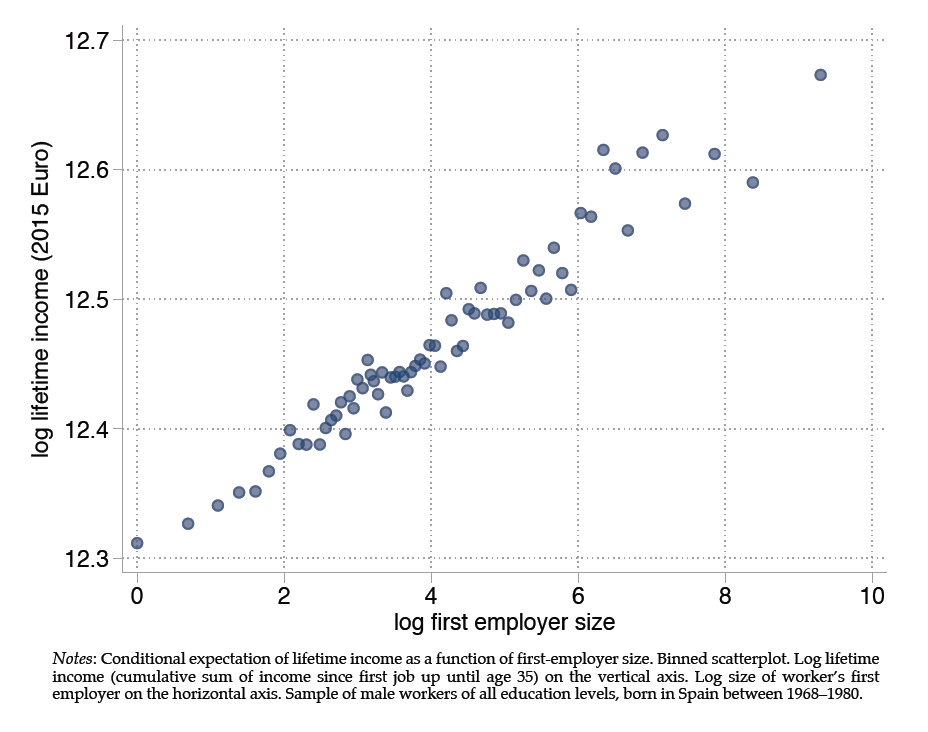
Figure 1 compares the working histories of Spanish workers who started at larger firms with those who started at smaller firms. Those workers who started at larger firms experience a significant bonus in lifetime incomes.

Figure 1: Positive correlation between lifetime income and size of first employer

But do those who start at larger firms fare better because they started at a large firm? Or are they more productive and motivated to begin with? To address this question and uncover a causal relationship between entry job firm size and long-term outcomes, the author bases his estimations on which firms happen to be hiring: graduating students hardly choose but passively encounter a different mix of employers (large vs. small) looking to hire inexperienced workers.

Importantly, this mix varies depending on when and where different young people graduate. The context of the study (1985-2003 Spain) is a particularly good setting for this approach, as after accession to the EU in 1986 strong economic transformations took place.

The results based on this empirical strategy indeed confirm the pattern of Figure 1 as a causal relationship. Initially matching with a larger firm leads to substantial long-run benefits in terms of higher lifetime income, arising from greater daily wages and employment. These effects seem particularly strong for low-educated workers and workers from less urban provinces.

Workers acquire more valuable skills at larger firms

The author shows that these benefits persist even after workers move on to subsequent jobs. Why would the benefits of a first job at a larger firm persist even after switching employers? The study argues that young workers acquire more valuable skills when employed at larger firms, and that these skills pay returns later on. These effects on skills could potentially arise from training schemes, learning from better peers and managers, or working in a generally more productive environment.

Overall, the paper illustrates how early career jobs act as important stepping stones that persistently impact young workers’ trajectories. Young people seem well advised to choose carefully their early career steps, while better informing young people in the school-to-work transition about the long-term consequences of first job choice helps in critical early career decisions.

Filed Under: Research Tagged With: career, entry job, firm size, job search, lifetime income, skills

How cash windfalls affect wages

February 21, 2020 by Mark Fallak

Do firms use an unexpected cash flow to spend the extra money on dividends (i.e. transfer it to owners or shareholders), wages, or investment in physical or human capital (i.e. new hires)? This question is not easy to answer because rents are usually associated with productivity growth. To observe the wage effects of pure rent-sharing, one would ideally need an experiment that randomly assigns cash to firms.

To approximate such an obviously quite unrealistic experiment, a new IZA paper by Sabrina T. Howell and J. David Brown evaluates the effects of a government R&D grant program on employee earnings by comparing grant awardees with unsuccessful applicants. The grant can be considered a cash flow shock because there are no restrictions on how it is spent.

The authors use data from applications to Small Business Innovation Research (SBIR) grants awarded by the U.S. Department of Energy between 1995 and 2013. They concentrate on small, likely financially constrained firms in the high-tech sector, which are crucial to economic growth and have especially dynamic employment and wage structures.

Backloaded wage contracts

The analysis shows that incumbent employees, hired before the application year, receive a 16 percent increase, which is consistent across the wage distribution. The wage effect increases with worker tenure, by 1.2 percent for each additional year on the firm’s payroll. New employees, hired in or after the year of the award, do not benefit at all. This leads to higher wage inequality between incumbents and new hires.

The grant also increases employment and revenue. Productivity growth, however, cannot not fully explain the wage effects. Instead, the data and a grantee survey suggest a frequent use of “backloaded” wage contracts, in which employees of financially constrained firms initially accept relatively low wages and are paid more when cash is available.

The authors point out that large, unconstrained firms are likely to react quite differently to a cash windfall than the smaller firms in their data, which tend to have less hierarchical structures, more employee autonomy, and more opportunity for monitoring and coordination.

Filed Under: Research Tagged With: cash flow, earnings, employees, grant, innovation, rent-sharing, wages

Economic crises have long-term adverse health effects

February 17, 2020 by Mark Fallak

The misfortune of being born – or graduating – in a recession can have long-term consequences for people’s life outcomes that extend beyond economic disadvantage. Two recent IZA discussion papers highlight the adverse health effects ranging from lower birthweight to higher mortality.

Graduating in a recession

Entering the labor market in a recession worsens lifetime outcomes of young workers through no fault of their own. Research has long established that poor job prospects at the time of graduation may result in permanent income losses (see the IZA World of Labor for an overview).

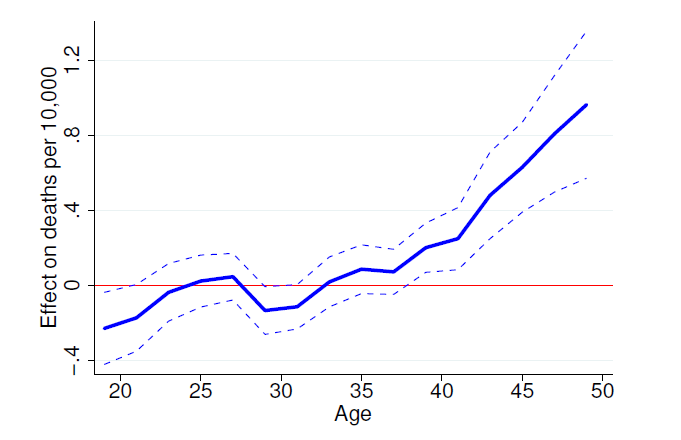
A new paper by Hannes Schwandt and Till von Wachter shows that this also affects mortality in midlife. Using several large cross-sectional data sources, the authors find that cohorts coming of age during the deep recession of the early 1980s suffer increases in mortality that appear in their late 30s and further strengthen through age 50 (see figure below).

These mortality impacts are largely driven by disease-related causes such as heart disease, lung cancer, and liver disease, as well as drug overdoses. At the same time, unlucky middle-aged labor market entrants earn less and work more while receiving less welfare support. They are also less likely to be married, more likely to be divorced, and experience higher rates of childlessness.

The findings of the study thus demonstrate that temporary disadvantages in the labor market during young adulthood can have substantial impacts on lifetime outcomes, can affect life and death in middle age, and go beyond the transitory initial career effects typically studied.

Children of crisis

But the role of luck comes into play already much earlier in life – even before birth. Using Turkish survey data, a new study by Mevlude Akbulut-Yuksel, Seyit Mumin Cilasun and Belgi Turan shows how newborns suffer from expectant mothers’ exposure to a severe economic crisis.

The authors explore the deep crisis of the Turkish economy between 2001 and 2008 and use regional variation in the crisis impact to analyze the effects on newborns, compared to their siblings. The findings reveal that regional GDP contributes significantly to better birth outcomes among crisis-time children, in terms of lower probability of low birthweight, less premature births and a longer pregnancy duration.

Adverse health effects are mainly observed among children born to mothers with low socio-economic status, which suggests that credit constraints play a major role.

Since previous IZA research has shown that low birthweight has long-term adverse effects on education, income, and mortality, the “children of crisis” are likely to face disadvantages later in life that warrant policymakers’ attention.

Filed Under: Research Tagged With: birth, crisis, labor market entry, mortality, recession

How biased news affect our willingness to pay taxes

February 12, 2020 by Mark Fallak

People’s willingness to pay taxes does not only depend on the fear of a tax audit or the amount of penalties for cheaters. Satisfaction with the actions and trustworthiness of the government is another crucial driver of tax compliance.

Theoretical work in economics suggests that if citizens believe that the government does not spend their taxes well, they may want to reciprocate by refusing to pay their full tax liability. If instead the belief prevails that institutions use taxes to fund public goods and services adequately, taxpayers will be more willing to comply.

These perspectives imply a vital role for information about the efficiency and fairness of government action and, more generally, of the political process. Media coverage of economic and policy issues, however, is far from balanced. Mass media tend to overreport negative news as they generate stronger reactions in the audience and better fit the public’s preference for negative content.

This negative bias creates what has been called the ‘spiral of cynicism’, as the public’s demand for sensational news strengthens the incentive for journalists and newsmakers to provide negative content. The recent spreading of anti-establishment narratives related to the rise of populist movements has further exacerbated the negativity bias in reporting about the efficiency and fairness of public institutions.

Laboratory experiment

A new IZA discussion paper by Miloš Fišar, Tommaso Reggiani, Fabio Sabatini, and Jiří Špalek explores in a controlled laboratory environment how this negativity bias in the coverage of economic policy issues affects tax compliance.

In their novel experiment, the authors compared the tax compliance of three groups of subjects under three different conditions. The first group was exposed to negatively biased news about government actions. This treatment was intended to reflect the media negativity bias that is the status quo in the supply of news about public finance and policy issues. The experimenters exposed the second group of participants to positively biased news and the third (control) group to a placebo treatment.

Pieces of good news raise tax compliance

Compared to the placebo treatment, exposure to negative news does not affect tax compliance, confirming that participants perceive the media negativity bias as the norm rather than the exception. As the selection and tonality of news deviate from the status quo resulting in positive content, participants become significantly more compliant than the control group. The effect is economically sizable: subjects treated with good news reported a compliance rate of 23 percentage points higher than those exposed to negative or neutral news.

These results reveal that how the media present public finance and policy issues is a crucial determinant of tax compliance, suggesting that biased news act as a constant source of psychological priming. Individuals tend to reciprocate the behavior they observe in the government, and more generally in public institutions, as if they were bound to them by a ‘psychological contract’. The systematic tendency of the media to focus on negative news entails hidden social costs related to the government’s inability to fully exploit its tax revenue potential and meet its fiscal goals, with detrimental effects on the efficient provision of public goods and services.

The most striking finding of the study, however, is the positive effect on tax compliance of even brief exposure to good news about the public sector’s activity. Contrary to intuition, according to which a piece of adverse news is more salient than a good one, merely exposing participants with a few (authentic) pieces of information about the appropriate use of tax revenues acts as a powerful determinant of higher levels of tax compliance.

Promoting the impartial reporting of good news

This result suggests that stronger attention of newsmakers in impartially reporting (also) good news may ultimately strengthen the psychological contract between taxpayers and the state by allowing the public sector to fully exploit its tax revenue potential, which could, in turn, be conducive to improvements in the provision of public goods and services.

The authors’ take-home message for policymakers:

Public policy can create the preconditions to promote tax compliance in previously unsuspected ways. The design of strategies and incentives nudging the provision of more balanced information that impartially reports also positive news could help the government to meet its tax revenue objectives, possibly feeding a virtuous cycle through the more efficient provision of public goods and services. In doing so, the preservation of freedom of expression and critique would play a crucial role not only in supporting democracy but also in strengthening the belief that the political process is fair and the policy outcomes legitimate, which could, in turn, further underpin tax morale.

Filed Under: Research Tagged With: fiscal policy, media bias, tax compliance

  • Previous Page
  • Page 1
  • …
  • Page 18
  • Page 19
  • Page 20
  • Page 21
  • Page 22
  • …
  • Page 69
  • Next Page

Primary Sidebar

© 2013–2025 Deutsche Post STIFTUNGImprint | Privacy PolicyIZA