Do sexual minorities face barriers in accessing jobs with supervisory and managerial workplace authority? And once on the managerial ladder, do they face glass ceilings that block them from higher-level posts? A new IZA discussion paper by Cevat Giray Aksoy (EBRD & IZA), Christopher Carpenter (Vanderbilt University & IZA), Jeff Frank (Royal Holloway) und Matthew Huffman (UC Irvine) answers these questions using confidential data from the UK.
The study provides the first large-scale systematic evidence on the relationship between a minority sexual orientation and workplace authority, which yields clear and surprising findings. They find that gay men and lesbians are significantly more likely to have objective measures of workplace authority compared to otherwise similar heterosexual men and women. However, they find strong evidence that there are glass ceilings: the managerial advantage experienced by gay men stems entirely from the fact that they are more likely than heterosexual men to be low-level managers. In other words, gay men are less likely than otherwise similar heterosexual men to attain the highest-level managerial positions that come with increased status and pay.
The researchers also find that the majority of the difference is due to differential returns to observed characteristics and skills (such as education) as opposed to differential endowments. That is, the evidence is most consistent with discrimination explaining differential access to top managerial positions. They further show that women and non-white men are disadvantaged in attaining high-level managerial posts: they too face glass ceilings.
The authors argue that access to managerial authority, and particularly high-level managerial posts, is not just about the individual. Those holding these posts are the exemplars, the mentors and the decision-makers on who will be the next generation of senior leaders. Bringing more sexual minorities, women and non-whites into managerial posts potentially increases the access for those further down the managerial/supervisory ladder – with similar characteristics – to be promoted. As with representation of women and minority groups on corporate boards, there is the potential to shift to a more representative outcome more broadly within the organization.
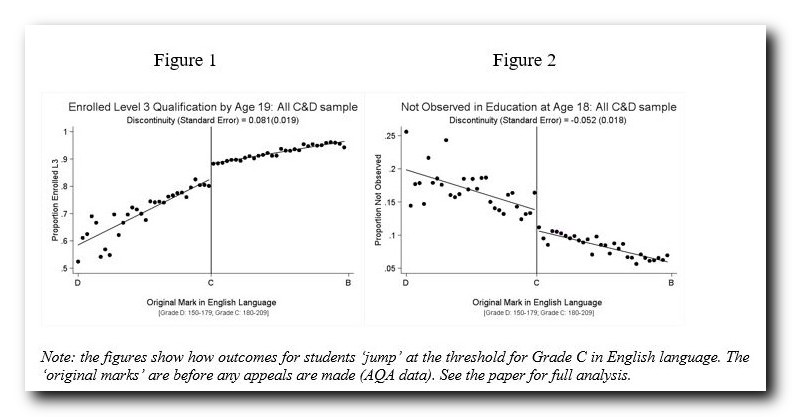 Further, narrowly missing a grade C increases the probability of dropping out of education at age 18 by about 4 percentage points (in a context where the national average is 12%) – illustrated in Figure 2. Those entering employment (and without a grade C in English) are unlikely to be in jobs with good progression possibilities.
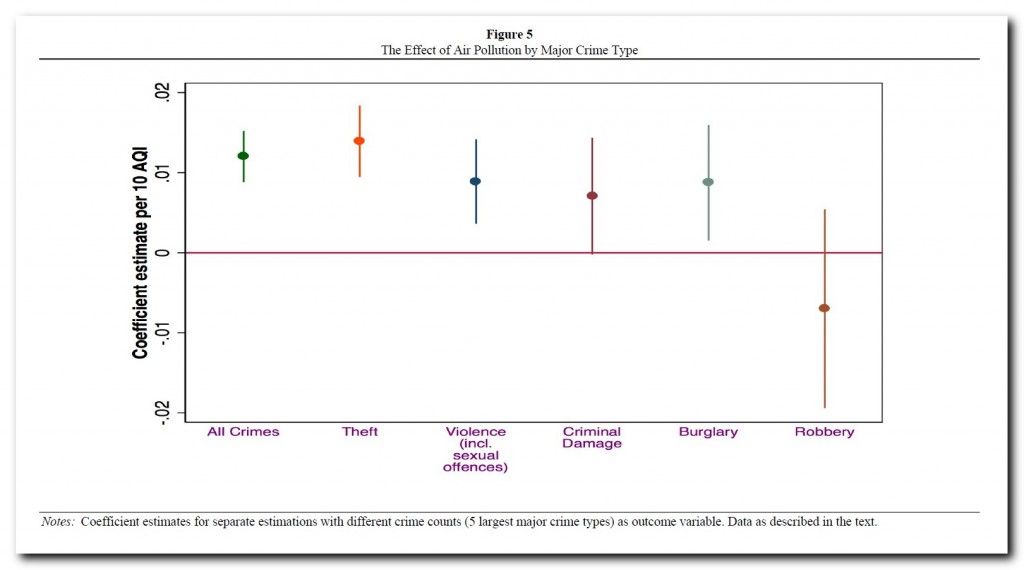 While they did not find that London’s ongoing spate of knife crime would be affected by improved air quality, the authors argue that the police could potentially be freed up to allocate more resources to these types of very serious incidents if the number of less serious crimes could be reduced. Given that the effect of air pollution on crime occurs at levels which are well below current regulatory standards in the UK and the US, it could be beneficial to lower these existing guidelines, according to the study.
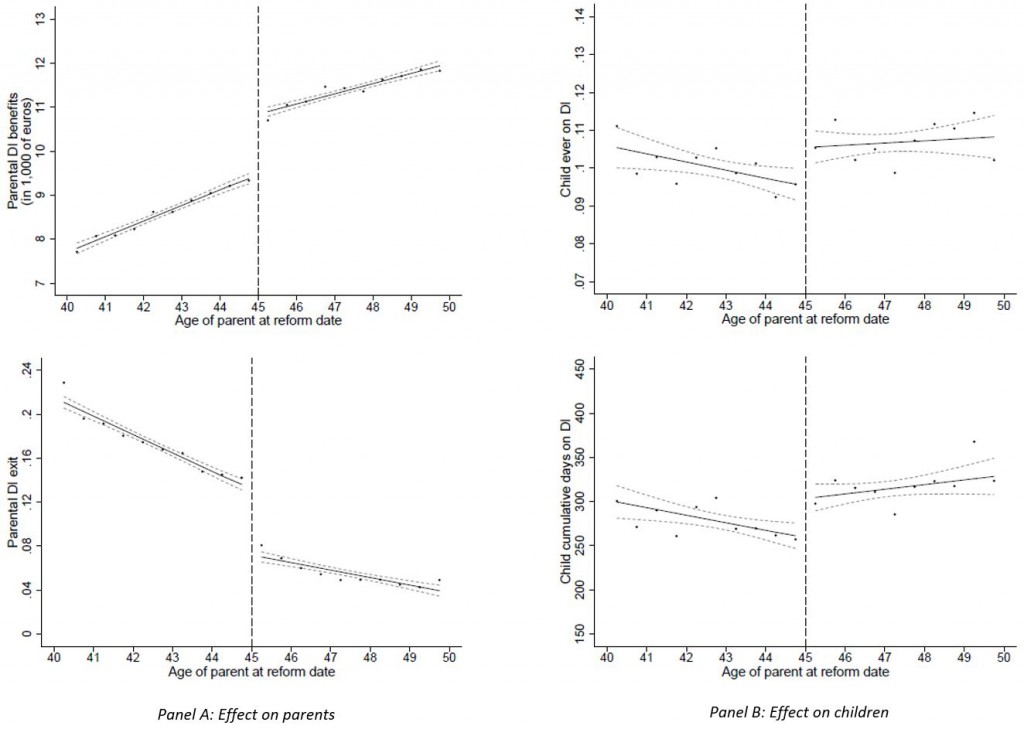 The findings show that more than 20 years after the reform, reduced parental DI dependency led to a lower DI dependency among children. Both the probability that a child is on DI as well as the benefits received from DI are substantially lower for those children whose parent’s DI use was reduced due to the reform (see Figure 1, Panel B). In addition, there are positive effects on future labor market outcomes for these children, with a higher employment rate and a higher level of labor market earnings. Consistent with an anticipated future with less reliance on DI, children of parents exposed to the reform invest in additional schooling while young.
 Our behavior is strongly influenced by comparisons with others. These “others” are not usually assigned to us, but we choose who we interact and compare ourselves with. Or, as economists put it, individuals self-select into certain environments and into specific peer groups within given environments. However, little is known about the consequences of these self-determined choices.
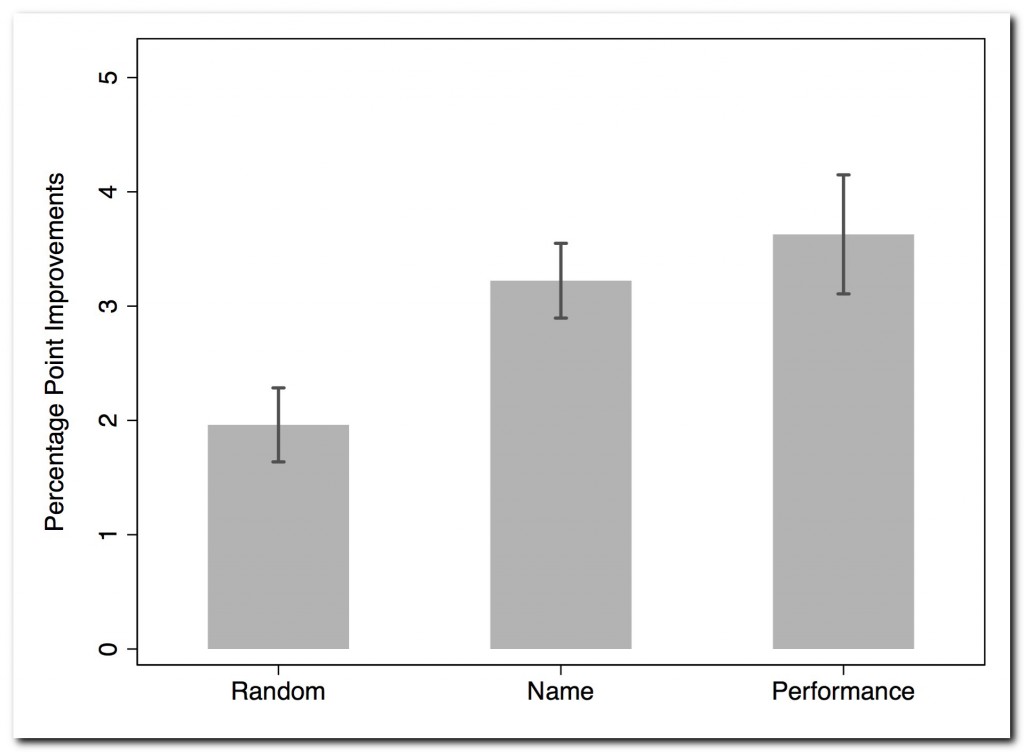 The results show that the two peer-assignment mechanisms with self-selected peers improve average performance by 1.27–1.67 percentage points or .14–.15SD relative to randomly assigned peers.
 The costs and benefits of free trade are one of the most contentious topics in economic policy. Economists often argue in policy discussions that trade is Pareto improving (i.e., at least one party wins without any other party losing) and that free trade has the potential to raise living standards in all trading countries.
 The growing success of online dating platforms seems to indicate that finding your partner in the “real” world becomes harder. But still, there are such offline opportunities: At universities, for example, people with lined-up interests as well as similar age and education interact each day.