 Trust is a fundamental asset for economic development. Social media have been credited with the potential of reinvigorating trust by offering new opportunities for social and political participation. This view has been recently challenged by the rising phenomenon of online incivility, which has made the environment of social networking sites (SNS) increasingly hostile to users.
Online incivility is a manner of harassing behavior that can range from aggressive commenting in threads, incensed discussion and rude critiques, to outrageous claims, hate speech, and more severe forms of harassment such as purposeful embarrassment and physical threats. Pew Research Center (PRC) reports that the majority of Americans have been targeted, or have witnessed others being targeted, with online incivility. The descriptive evidence available so far indicates that social media users perceive incivility as the norm of online interaction.
Given the penetration of social media and the importance of trust in the economic activity, the role of SNS-mediated social interaction is also a relevant topic for economic research. What are the consequences of online incivility and civility on social media users’ trust in others? Does incivility weaken the positive potential of social media?
Experiment in a Facebook setting
To answer these questions, a research team consisting of Angelo Antoci, Laura Bonelli, Fabio Paglieri, Tommaso Reggiani, and Fabio Sabatini conducted a novel experiment in a Facebook setting to study how the effect of social media on trust varies depending on the civility or incivility of online interaction. The study is now available as IZA Discussion Paper No. 11290.
The authors compared the trust and trustworthiness of three samples of participants randomly involved in two kinds of Facebook-mediated interaction. One group was exposed to four, authentic, threads of uncivil discussion. Another group was exposed to the same threads in which uncivil discussions have been replaced with polite interactions by experimenters.
The third group was used as a control condition: participants were exposed to the same thematics used in the other treatments, but in the form of short news excerpts and without any kind of social interaction. To assess trust and trustworthiness, the researchers then made the experiment participants play a trust game.
They found that participants exposed to civil Facebook interaction are significantly more trusting. In contrast, when the use of Facebook is accompanied by the experience of online incivility, no significant changes occur in users’ behavior.
The results of the experiment indicate that when the tone of discussions deviates from the “uncivil status quo” and is accompanied by civil interaction, it significantly raises participants’ trust with respect to both the uncivil treatment and the control condition, whereas it has no effect on trustworthiness. In contrast, if Facebook use is associated with the experience of online incivility in line with the status quo, no significant change in participants’ trust and trustworthiness with respect to the control condition can be observed.
Incivility as the norm of online interaction
This study provides the first experimental evidence of a positive effect of online civility on social trust. While exposure to civil online interaction induced a significant increase in people’s trust, the opposite condition, i.e. online incivility, seemed to be considered “business as usual” and thus did not produce any effect on trust, with respect to the control treatment.
This lack of effect of online incivility is striking, whether it is interpreted as a form of expectation matching (incivility is what people routinely expect online, thus being exposed to it does not change their expectations on others’ behaviors) or as a sort of immunization effect (people are used to such a high level of online incivility that the experimental manipulation failed to elicit a response): in either case, incivility seems to be perceived as the norm of online interaction, rather than the exception.
This is a rather depressing finding, but also one in full accordance with the survey data and the anecdotal evidence available so far. What is much less depressing, and indeed encouraging, is the positive effect on trust of even a brief exposure to online civility: contrary to intuition, according to which a quarrel is much more salient than a polite discussion, a simple lack of aggression in expressing a difference of opinions online acts as a powerful determinant of higher levels of trust towards other people.
Echo chambers and the polarization of public opinion
SNS are facing increasing criticism and scrutiny, since recent analyses of key political events (such as the 2016 US presidential election and the Brexit referendum) have suggested a link between the extreme polarization of public opinion and the relatively small number of platforms that monopolize online discourse – most notably, Facebook and Twitter.
Public discussions on such platforms have also been shown to create and maintain so called “echo chambers”, thus leading to increased polarization and partisanship. Therefore the authors are not entirely surprised to find confirmation, in their results, of a rather bleak outlook on public discourse on SNS, where uncivil debate seems to be considered as normal.
However, the striking result is that even minimal exposure to the opposite trend, i.e. civil online interaction, has a significant effect on social trust. This suggests that what is at stake in moderating online discussion is not simply the prevention of negative phenomena (hate speech, cyberbullying, digital harassment, etc.), but also the achievement of significant social benefits, most notably a measurable increase in social capital that can, in turn, positively affect economic development.
Promoting civil discussion on online platforms
The take-home message for policy makers is rather straightforward: instead of only focusing on fighting against noxious online behavior, we should also (and perhaps mostly) create the preconditions to promote civil discussion on online platforms. Obviously, this goal cannot be effectively pursued via strict regulations, but rather needs to be fostered by carefully designing (or tweaking) the platforms themselves, bringing a wide variety of competencies to bear on such a task: most notably, psychological insight on users’ attitudes and profiles, interaction design principles from ergonomics, nudging strategies and incentives planning from economics.
 The earnings differential between men and women is a recurring topic in academic research and policy debates. While the gender pay gap is sometimes interpreted as a blatant sign of discrimination that calls for stricter equal pay legislation, the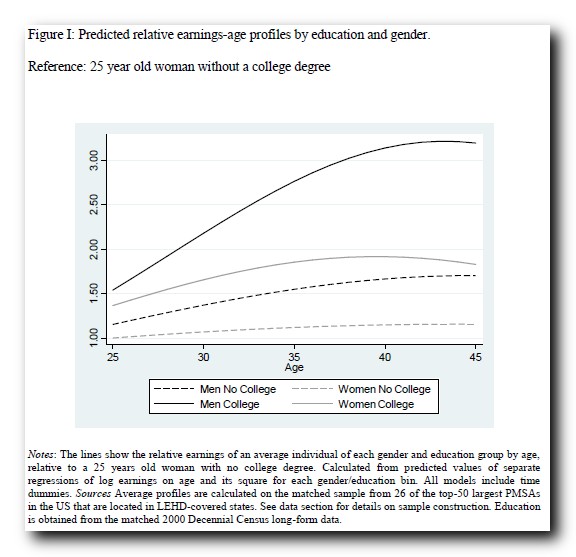
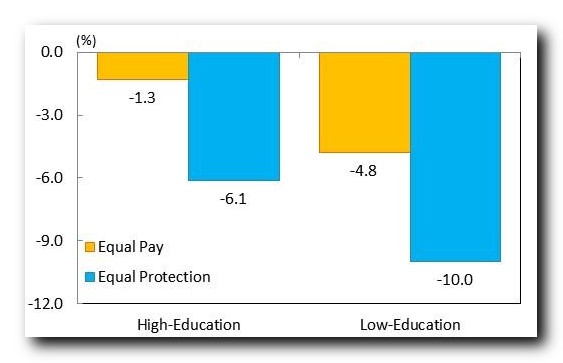 Equal Pay legislation for part-time and full-time work would therefore do little to close the gender pay gap, also due to its behavioral impact on labor supply decisions. Instead, the study finds that Equal Protection policies aimed at equalizing the layoff probabilities for part-time and full-time workers would be more effective in reducing the gender wage gap, especially among low-educated individuals.

 Given that employment prospects vary substantially across regions in many industrialized countries, it seems economically attractive to geographically relocate unemployed job-seekers from depressed to prosperous regions in order to reduce overall unemployment. Governments thus offer financial support to unemployed job-seekers who search for and/or accept jobs in distant regions. Is this money well spent?
 Climate change is considered one of the major challenges of the 21st century. While politicians and scientists at the
 While there is a vast literature considering the labor market effects of immigration, less has been done to investigate how immigration affects the educational choices of young natives, especially in Europe.
 The rapid diffusion of the Internet, and in particular of high-speed, broadband Internet, has characterized the life-changing digital revolution that began around the turn of the twenty-first century. The profound social and economic implications of the spread of the Internet have been highlighted since its inception by social science scholars. More recently, researchers have also started to focus on the effect that the Internet has on family life. Scholars interested in family and fertility have long been focused on the importance of technological change.

 Bei Krankschreibungen gilt in Deutschland bislang die Alles-oder-Nichts-Regelung: Arbeitnehmer sind entweder arbeitsunfähig oder müssen die volle Arbeitsleistung erbringen. In der Realität sind krankgeschriebene Beschäftigte aber häufig willens und in der Lage, schrittweise und mit verringerter Stundenzahl in den Job zurückzukehren. Immer wieder wird daher das Modell der Teilkrankschreibungen diskutiert, das in Deutschland selten und nur auf freiwilliger Basis Anwendung findet.