• Skip to primary navigation
  • Skip to content
  • Skip to primary sidebar

IZA Newsroom

IZA – Institute of Labor Economics

  • Home
  • Archive
  • Press Lounge
  • DE
  • EN

Thematic series: Reforming minimum wage and labor regulation policies in developing economies

August 4, 2016 by admin

Minimum wages are a not just a hot policy issue in the United States and other highly developed nations. They are also a central aspect of the policy discourse in developing and transition economies, with diametrically opposite perspectives dominating the debate. Theory is ambiguous, and at its core this is an empirical question, not least because enforcement can vary across countries.

A collection of papers published in the IZA Journal of Labor & Development conduct detailed and country specific analyses of the consequences of minimum wage policies for China, Indonesia, Thailand, Russia, Honduras and South Africa. They provide the empirical foundations for a reasoned debate on this contentious policy question.

  • View the Thematic Series (Guest Editors: Haroon Bhorat, Ravi Kanbur and Shi Li)

Filed Under: Research Tagged With: Development, IZA Journal, labor regulation, minimum wages

Peer effects! Peer effects everywhere! Whether you are shopping, working, leaving the nest…

August 2, 2016 by admin

Does the social environment influence what individuals buy? Are mothers more likely to work when other women in the neighborhood have a job? Do young people choose to continue living with their parents because their friends also do? If so, how does this mechanism work? From an economic point of view, understanding the influence of peers on individual decision-making is important in several ways.

Social networks can have considerable impact on social programs like welfare, for example, when households live beyond their means or save less in order to keep up with the consumption of peers. From a policy perspective, understanding these network effects is relevant not only because of the particular effects of specific policies on the intended group, but also because often these effects span beyond the group that was originally targeted.

Peer effects on consumption

To advance the understanding of the social influence of peers on consumption, Giacomo De Giorgi (NY Fed), Anders Frederiksen (Aarhus University & IZA) and Luigi Pistaferri (Stanford University & IZA) analyze data on the consumption behavior of the entire Danish population, organized into various social network categories and at the household and firm level.

Their paper, published as IZA DP No. 9983, uses administrative data on income and assets and constructs reference groups made of co-workers sharing similar characteristics such as occupation or education. They then match this dataset with the results from a large Danish consumption survey covering three years from 1994 until 1996. Consumption is also divided into three categories: visible goods (cars, luxury goods, clothing, etc.), neutral goods (e.g., food at home) and non-visible goods (insurance, rent, etc.).

Keeping up with the Joneses

The researchers find statistically significant evidence for “intertemporal” effects of social influence on individual consumption, showing that many households “follow” the consumption choices of either the wife’s or the husband’s colleagues over time. The results are in line with the “Keeping up with the Joneses” model, in which individual utility depends on the current average consumption of one’s peers.

Interestingly, the social influence on consumption did not change significantly with regard to the type of goods that were consumed. Therefore, De Giorgi and his colleagues were able to reject the “conspicuous consumption” model, which argues that the peer effects on consumption are tilted towards very visible goods, such as jewelry, luxury cars, and restaurants.

From a policy perspective, these results highlight the importance of taking into account the degree of connectedness of the policy’s target group. Depending on how much these buying habits actually pressure others to do the same, the overall effects of specific policies might reach beyond the intended group, for example, when a tax increase for the rich also affects less wealthy households that “follow” the consumption of their richer peers.

Peer effects on female labor supply

Network effects also affect behavior in the labor market. In another recent paper, published as IZA DP No. 9985, Nuno Mota (Fannie Mae), Eleonora Patacchini (Cornell University & IZA) and Stuart S. Rosenthal (Syracuse University) examine the influence of neighbors on the decision of women to work.

Their results reinforce the importance of neighborhood peer effects and the significance of cultural norms as drivers of economic decisions: Women appear to emulate the work behavior of nearby women with similar-age children. Adding one additional working peer to a woman’s adjacent neighbors increases her tendency to work by 4.5 percentage points, while adding a non-working peer reduces her tendency to work by 9 percentage points. For men, similar peer effects are mostly absent.

Read more about this topic in a previous IZA Newsroom Post.

Peer effects on nest-leaving behavior

A third new paper, IZA DP No. 10070 by Efi Adamopoulou (Bank of Italy & IZA) and Ezgi Kaya (Cardiff University), finds that the behavior of peers also explains, to some extent, why young adults nowadays tend to continue living with their parents longer. The researchers show that young adults with friends who have already made the choice to leave their parents’ home are also more likely to do the same.

The study analyzes data from the National Longitudinal Study of Adolescent Health (Add Health) on a representative sample of adolescents in the U.S. who were followed until young adulthood. The analysis accounts for various demographic and socioeconomic characteristics of young adults as well as the local labor and housing market conditions. Using the differences in the timing of leaving parental home, the paper investigates the causal effect of “leaving the nest” on friends in the same peer group.

The authors find significant effects on the decision of young adults to remain or leave their parents’ home depending on the respective choices made by their friends. They also show that the similarity in the choices of adolescents and their friends to leave the nest is neither simply due to the fact that people select friends with similar behavior to their own, nor to shared common factors that might affect the living arrangements of the entire peer group.

Imitation and reduced stigma

Furthermore, other possible mechanisms, such as the complementarities between friends that move out at the same time or the desire to maintain friendship ties, also fail to explain the main reason driving this peer influence. Rather, the authors conclude that the reduced stigma of living with parents during young adulthood, or simply imitation among friends, may lie behind these peers’ similar behavior.

This is relevant for debates over evaluating policies that are intended to boost youth independence or mobility. Almost five years after the end of the Great Recession in the U.S., even though labor market conditions have greatly recovered, the proportion of young adults living with their parents remains high. Moreover, in the “millennial” age group aged 20-24, who experienced the recession right at the beginning of their careers, it continues to increase. The new findings by Adamopoulou and Kaya suggest that in the presence of positive peer effects, the increasing trend may persist regardless of the labor and housing market conditions.

Image sources: pixabay 1 | 2 | 3

Filed Under: Research Tagged With: adolescents, consumption, female labor supply, labor market behavior, nest-leaving, parental home, peer effects, social environment, spending

How female labor supply is influenced by working neighbors and retired grandmothers

July 20, 2016 by admin

Over the last century, female labor participation has increased in almost all developed countries. The availability of child care and increased contraceptive access along with other institutional, cultural and policy changes have made it easier for women to reconcile family and career.

But while the employment gender gap is still substantial in many European countries, more recent decades have seen a flattening of this trend. In a time when progressive population aging makes an increase in female labor force participation more relevant than ever, economists are increasingly studying the factors affecting women’s labor market decisions.

Three recent IZA discussion papers investigate causal mechanisms that affect female labor supply in both Europe and the US by analyzing the influence of peer effects on women (US, Norway) or the availability of grandparents as care takers (Italy).

Neighbors affect women’s decision to work

The IZA paper by Nuno Mota (Fannie Mae), Eleonora Patacchini (Cornell University & IZA) and Stuart S. Rosenthal (Syracuse University) examines how neighborhood peers affect American women’s decision to work. The researchers use panel data from the American Housing Survey (AHS) from the years 1985 to 1993 and classify individuals into peer groups. In contrast to earlier studies that based groups on race, gender, or some other trait, the authors assume that peers can influence each other through role model effects or information spillovers and look at individual behavioral choices which align with those in the same peer group.

Their findings show that women appear to emulate the work behavior of nearby women with similar age children. Their results suggest that adding one additional working peer to a women’s adjacent neighbors increases her tendency to work by 4.5 percentage points. Adding a non-working peer reduces her tendency to work by 9 percentage points, while adding non-peers to a women’s adjacent neighbors has little influence on her decision to work.

Socio-cultural norms and the family peer effect

Addressing the same phenomenon from a different angle, the IZA paper by University of York researchers Cheti Nicoletti and Emma Tominey with Kjell G. Salvanes (NHH & IZA) uses a comparable approach but focuses on mothers only. Since the rise in female labor participation has been largely driven by women that returned to the labor market after childbirth, they analyze how the choices of peers with similar family structures affect that decision. Using the Norwegian administrative data covering the full population of
mothers giving birth between 1997 and 2002, they show that mothers too tend to emulate the work behavior of nearby women with similar age children.

Their results show that an increase of one hour worked in a family-peer group raises the mothers’ working hours by about half an hour in the first six years after birth. Such family peer effects would imply a social multiplier of about two, meaning that a policy change which causes a direct effect on mothers’ labor supply of one working hour would be amplified by a factor of two through the indirect effect of the influence of family peers.

The study also finds a similar peer effect for mothers’ labor supply after the second childbirth, indicating that the family peer effect is not primarily driven by the mere information about potential consequences of a mother’s decisions to work. Rather, after their second childbirth, mothers can be expected to be well informed about the benefits and consequences of their decision to enter the labor market.

Thus, the researchers point instead to the importance of social and cultural norms. Furthermore, they find that the family peer effect is smaller for mothers with a university degree, leading the authors to the conclusion that the role of information transmission via peer groups is larger for less educated women.

Available grandparents increase mothers’ labor supply

Next to social norms, another more practical, but no less relevant factor affecting women’s decision to work is the availability of grandparents as babysitters. Especially in countries that spend little on public child care, parents often rely on their own parents to look after their children when they go to work. The IZA paper by University of Milan scholars Massimiliano Bratti, Tommaso Frattini and Francesco Scervini (HDCP-IRC) seeks to find out how changes in the availability of grandparents affects female labor supply.

In order to measure the effect, they investigate how three pension reforms in Italy that gradually elevated the retirement age to 65 affected the employment of women who have children under 15 years of age. They classify grandparents as ‘available’ if they are eligible for meeting the pension requirements. Italy presents an ideal case for this study, with its low rates of female employment, little formal child care provision, and the several pension reforms implemented in a relatively short time span.

The Italian researchers find that among the women studied those whose own mothers are eligible for retirement have a 13 percent higher probability of being employed than those whose mothers are ineligible. The pension eligibility of maternal grandfathers and both grandparents on the father’s side, however, has no significant effect on women’s employment probability.

The study demonstrates that the eligibility of maternal grandmothers for retirement greatly affects their availability as child care providers. Therefore, raising the retirement age without at the same time sufficiently investing in public child care may further widen the already large intergenerational and gender gaps in employment by reducing the labor force participation of young women.

Image Source: pixabay

Filed Under: Research Tagged With: childcare, children, cultural norms, female employment, female labor supply, grandparents, labor market, neighborhood peer effects, peer effects, women

Pocket money and part-time job: Do parents tax their children?

July 15, 2016 by admin

Young adults who are still living with their parents and still in compulsory education finance their independent consumption using either parental transfers (pocket money), or by working part-time. Parents care about their own and their children’s consumption, but also about the effect that part-time work might have on their children’s study time and academic achievement, so are prepared to sacrifice some of their income to subsidize their children’s expenses.
A new IZA Discussion Paper by Angus Holford (ISER, University of Essex) investigates how parents and their teenage children interact to set the amounts of (i) pocket money and (ii) part-time work. The analysis uses data on part-time working hours, and pocket money from parents, reported by around 5,000 girls and 5,000 boys in compulsory education in England, interviewed annually between 2004 (when they were 14) and 2006 (when they were 16).

Teenage gender pay gap

At age 14, 25% of boys but only 19% of girls had a part-time job. By age 16, girls had overtaken (32% against 29%) but were earning slightly lower wages for similar hours (£4.06 against £4.34 per hour, both for about 6.5 hours a week). The propensity to offer regular allowances from parents was very similar for boys and girls, at around 80% over this period.

Children take into account the money they get from parents when deciding whether to work or not. At age 14 they are 10-15 percentage points less likely to work if they are receiving an allowance, and this gap increases to 20 percentage points by age 16. Similarly, parents are around 15 percentage points less likely to give an allowance if their child is in paid work.

Parental safety net

The empirical analysis of parents’ and children’s behavior reveals two key findings. The first is that, other things equal, parents are more likely to give regular pocket money to teenagers who will have a harder time finding a job. This includes teenagers who are younger within their academic year at school so at a disadvantage when vacancies arise in the autumn, both before the run-up to Christmas and when older cohorts leave for university; those living in areas with higher rates of adult unemployment; and those living in areas from which the nearest shops are less accessible.

This tells us that rather than being opportunistic (“these parents don’t need to pay their children not to work, so they don’t”), parents effectively ‘insure’ their child’s independent consumption against labor market difficulties outside their control. They would like them to finance their own personal spending money, but will not penalize them if this proves difficult.

More work, less pocket money

The second is that parents are less likely give regular pocket money to teenagers, the longer the teenager’s hours of part-time work. In other words, parents effectively tax their children’s earnings from part-time work, by taking away cash they would otherwise be handing over. This effect is larger for girls than boys and strongest when they are 16 years old.

The findings suggest that close to the high-stakes GCSE exams, which determine these children’s future educational and labor market opportunities, parents become more inclined to use their financial resources to reduce their child’s incentive to work, hoping they will spend more time studying instead.

Image source: pixabay

Filed Under: Research Tagged With: children, insurance, parents, part-time work, pocket money, student job, tax, UK

Is your government a big spender?

July 11, 2016 by admin

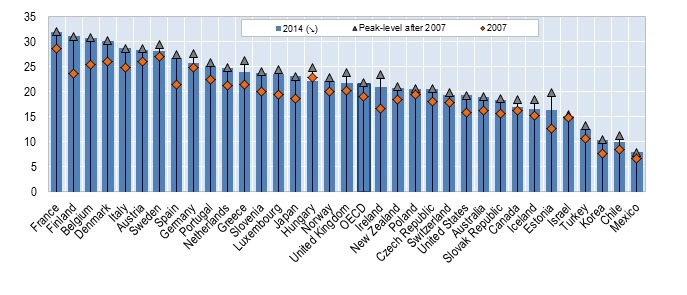
In 2014, the OECD average in public social spending was about 22% of GDP, with upward trends being observed in almost every country. The question about the role and extent of state interventions is at the core of the economics profession, and most economists have been traditionally skeptic about the steady growth in the magnitude of public spending.

Public social expenditure as a percent of GDP, 2007, peak-level after 2007, and 2014.
Source: OECD Social Expenditure Database.

While political scientists interpret this rising importance of the state as the outcome of the collective desires of voters, it remains unclear in how much the public debate might be based on false beliefs and expectations about the current size of government spending. If citizens are imperfectly informed about the actual extent of public expenditures, the size of government may not be well aligned with their preferences.

With these questions in mind, researchers Philipp Lergetporer, Guido Schwerdt, Katharina Werner, and Ludger Woessmann analyze in their new IZA Discussion Paper how information about actual levels of public spending affects German citizens’ support for increased public spending.

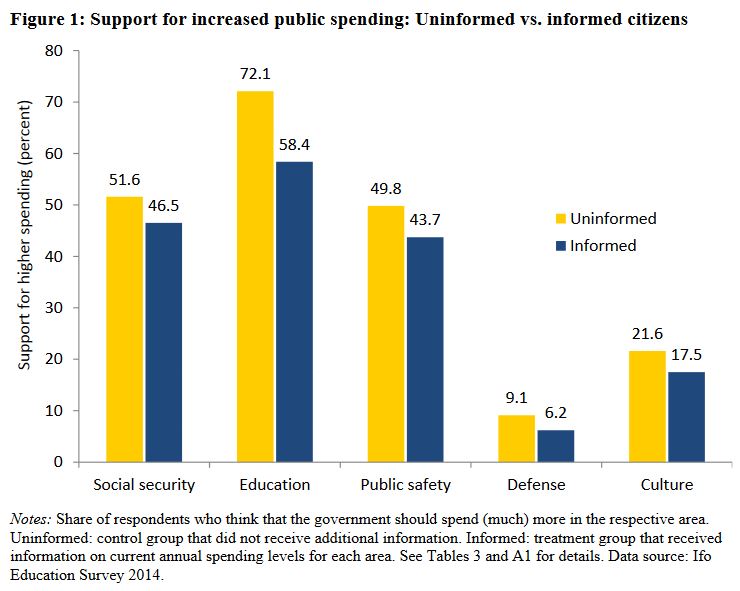
The authors devised a series of experiments in a survey with over 4,000 respondents who were randomly classified into a control and a treatment group and asked about their preferences for increased spending in Germany. Prior to the survey, the treatment group was provided with information on current levels of public spending: €227 billion on social security, €95 billion on education, €38 billion on public safety, €27 billion on defense, and €10 billion on culture. The control group, on the other hand, was not provided this information before the questions were asked.

The results summarized in Figure 1 highlight a strong correlation between the provided (or withheld) spending information and the level of support for increased spending levels. Across all domains, the informed individuals showed less support for more spending compared to individuals who did not receive the information, with the strongest differences found for education.

The observed differences depending on access to information indicate that a sizable share of respondents hold incorrect beliefs about current spending levels. To delve deeper, in a follow-up experiment the authors confirm that the results are primarily driven by those who underestimated actual spending levels before receiving the true information, while well-informed individuals did not react to the additional information.

Taken together, the results imply that high levels of public support for growing public spending levels are actually based on a lack of information, and providing accurate spending information may be expected to lower public support for increased government expenditure.

Filed Under: Research Tagged With: biased information, false information, government spending, information, public spending, state interventions

Has Uber made it easier to get a ride in the rain?

June 30, 2016 by admin

Standing or walking in the rain is an activity best avoided. In New York City (NYC), when faced with such inclement weather, the demand for personal transportation naturally increases. During such scenarios, taxi drivers spend less time searching for customers and could thus earn a higher wage. Nonetheless, it has been a common complaint that it is difficult to find a taxi in the rain.

As an alternative to taxis, Uber entered the NYC market in May 2011 with surge pricing and mobile driver-passenger matching technology. Surge pricing means passengers pay a higher rate for the Uber service during times of high demand, which gives incentives to Uber drivers to provide rides in inclement conditions. Uber could thus be a logical response to unmet demand during poor weather.

Is it easier to find a taxi or an Uber driver in the rain?

In a new IZA DP, Abel Brodeur (University of Ottawa & IZA) and Kerry Nield (Carleton University) examine whether the number of Uber and taxi rides increases in inclement weather conditions. Based on all Uber and taxi rides in NYC in 2014-2015, they find evidence that the number of Uber rides per hour is about 25 percent higher when it is raining, which suggests that surge pricing encourages an increase in supply. On the other hand, the number of taxi rides per hour rises by only 4 percent during this time period.

Is Uber depressing taxi demand?

The study also examines to what extent the increasing popularity of Uber in NYC is harming taxi drivers. The researchers found that the number of taxi rides per hour decreased by 8 percent after Uber entered the market. This result is consistent with a substitution from taxis to Uber cars.

Has Uber made it easier to get a ride in the rain?

The researchers then test whether it has become easier to find a ride in the rain since May 2011. They first compare the total (Uber plus taxi) number of rides in a post-Uber period to the number of taxi rides in a pre-Uber period and find that the total number of rides increased by approximately 9 percent in post-Uber years. Then, they test whether it has been relatively easier to get a ride in rainy than in non-rainy hours after May 2011. The results indicate that the total number of rides has increased proportionally more in rainy hours.

The results have important implications for the ongoing debate on whether Uber is depressing taxi demand and whether Uber increases consumers’ welfare. In particular, they highlight that Uber is substituting taxi drivers and that surge pricing seems effective in increasing labor supply.

Image Source: Pixabay

Filed Under: Research Tagged With: cab, consumer welfare, labor demand, labor supply, New York, rain, surge pricing, taxi, Uber, weather

Now over 10,000 papers in the IZA DP series!

June 27, 2016 by admin

Established in 1998, starting with 100 papers in the first two years, the IZA Discussion Paper series now includes more than 10,000 working papers authored by IZA researchers and network members. On average, a new IZA DP goes online every ten hours. Covering a wide range of topics in labor economics and related fields, our papers are freely available online through the IZA website and various online databases. About two-thirds of the papers have meanwhile been published in refereed journals and volumes. Click on the image for more facts&figures!

From the CEO…

“The IZA discussion paper series has had an enormous impact on establishing IZA’s reputation as a top-level research institution in labor economics – and it will continue to play a key role. Providing an efficient platform for researchers to disseminate their work at an early stage, the IZA discussion papers stimulate constructive feedback from peers. They serve as an invaluable device of scientific quality control, and I dare say this series has its own merits in shaping labor economics as an important sub-discipline within economics.”

— Hilmar Schneider (CEO of IZA)

Or as the IZA network coordinator puts it…

“The first IZA Discussion Paper appeared in April 1998. While not there yet, the IZA Discussion Paper series is now much nearer to being, “… as the stars of the heaven, and as the sand which is upon the seashore….” [Genesis 22:17] And like the stars of the heaven, the Discussion Papers have illuminated very wide areas. They are central to the lives of professional economists, experts on labor and increasingly journalists and policy makers, and are a testimony to the usefulness of the IZA Network of scholars and experts.”

— Daniel S. Hamermesh (Chief Coordinator of the IZA Network)

Here’s what our fellows say…

“Throughout its history, the IZA Discussion Paper series has been a major outlet for new research in labor economics and related fields such as family economics, demographic economics and the methodology that supports serious empirical research. It provides an opportunity for very diverse scholars and methodologies to share ideas, to take fresh approaches to old problems and to pose new problems free of the threat of censoring, publication bias, or club membership bias. The series deserves the highest praise for disseminating a variety of good ideas and path-breaking analyses, and helping make economics an open and vigorous field.”

— James J. Heckman (University of Chicago), 84 IZA DPs

“Over the years the IZA Discussion Paper series has been an invaluable resource for labour economists worldwide, and many papers have subsequently appeared in the economics profession’s leading academic journals. To me, they have proven to be a great outlet both for my own work and for getting early previews of cutting edge research being undertaken in labour economics.”

— Stephen Machin (University College London & LSE)

“The IZA Discussion Paper series has been instrumental in ensuring that my work always has the greatest visibility among the world’s best economists. Over time, the stock of knowledge contained in this series has become quite extraordinary. It’s an invaluable resource when reviewing what is happening not only in labor economics research, but in economics research more generally.”

— Deborah A. Cobb-Clark (University of Sydney)

“The IZA DP series is an ever growing ocean of knowledge about labor economics issues. The series is interesting for students who want to learn about state of the art research. The series is also interesting for experienced researchers who want to remain up-to-date with the research output of colleagues. Contributing to the series means that your work will be read and cited. I think the IZA DP series is an asset for the research community in support for the advancement of science.”

— Jan C. van Ours (Tilburg University)

“The IZA DP series is both a prompt and permanent way to disseminate your research outcomes. It is prompt since your fresh research results can be immediately transmitted to the relevant scientific community within a few weeks; it is permanent since IZA DPs are so well diffused and reputed globally that they keep on being read and downloaded for years, sometimes more read and cited than regular journal articles.”

— Marco Vivarelli (Università Cattolica del Sacro Cuore – Milano),
co-author of the all-time top downloaded IZA DP

What the 10,000th IZA DP is all about…

IZA DP No. 10000 by Rasmus Landersø and James J. Heckman compares intergenerational social mobility in Denmark and the US. Denmark has a far more generous welfare state than the US. In terms of after tax and transfer income, Denmark has far greater intergenerational mobility. In terms of education, differences are especially strong at the top of the income distribution. Denmark and the US are equally mobile.

The generous welfare state of Denmark with its free education and universal childcare improves the cognitive test scores of comparably disadvantaged children. However, it weakens the incentives of those children to acquire schooling. These impaired incentives joined with the sorting of advantaged and disadvantages families into neighborhoods and schools explain the near parity in educational mobility across the two societies.

Stay informed…

More than 4,000 subscribers receive e-mail alerts with new papers 2-3 times a week. For better structuring and readability, new papers are sent out in batches of 4-5 papers each, grouped by similar topics.

To receive e-mail alerts announcing new IZA Discussion Papers, subscribe here.

Filed Under: IZA News, Research Tagged With: labor economics, publications, research

Promoting replications in social science to overcome the tragedy of the (research) commons

June 22, 2016 by admin

Although empirical economics often claims to provide rigorous estimates of behavioral parameters which must be judged against a gold standard of experimental evidence, a key feature of this method is typically neglected—the role of replications in assessing the reliability of estimates and, importantly, detecting fraudulent and erroneous research.

Given the large impact of economic research on policy-making, errors or fraud can have far-reaching consequences. An infamous recent example is the study “Growth in a Time of Debt” by Harvard economists Carmen Reinhart and Ken Rogoff. Invoked to justify strict austerity as a way to stimulate economic growth in the U.S. Republicans’ budget proposals, their results were shown to be driven by a simple mistake in Excel.

Making replications mandatory in curricula would be useful

German researchers tend to agree with the notion that replication studies are important and worthwhile. Nonetheless, as yet they have not been willing to devote significant time to conduct such studies, often due to the low chances of publication. This is one of the key findings from a survey among 300 German researchers from various disciplines conducted by economists Benedikt Fecher (DIW), Mathis Fräßdorf (DIW) and Gert G. Wagner (DIW & IZA), which was recently published as IZA Discussion Paper No. 9896.

The authors characterize this situation as a typical “tragedy of the commons:” Every researcher knows that replications are useful, but most people count on others to conduct them. If replications are done at all, they are typically only used for teaching purposes and doctoral theses. This situation points to the need for providing new incentives for these types of studies to increase their attractiveness for researchers, e.g., through better publication possibilities or specific funding supporting this type of research.

Research parasites are beneficial for the organism as a whole

Replications in general depend on the availability of data from the original works. The view that data should be universally available for this purpose is not undisputed though. In a second contribution, which appeared as IZA DP No. 9895, Wagner and Fecher point to a recent discussion in medical science about “research parasites,” or researchers who primarily work with secondary data instead of engaging in original data collection.

Against this background, the authors highlight the need for new instruments of credit that allow researchers who engage in original data collection to boost their reputation status if their work is used in secondary analyses. A culture of citation of data sets, bestowing awards for the best data sets and data collection, is proving to develop as an important and prominent factor in the overall assessment of scientific research standards.

IZA’s CEO Hilmar Schneider underscores these arguments, explaining:

H. Schneider

Up to now, the effort put into doing a replication has been rewarded unequally. While the chances of getting a replication published which uncovers serious errors in a previous study are quite high, the chances for a replication which simply reproduces existing findings are close to zero. Therefore, researchers doing replications are facing a substantial risk of wasting their time, which has the consequence of effectively preventing scientific quality control. It’s high time to give equal credit to any replication, no matter whether it falsifies or reproduces existing find

Image Source: pixabay

Filed Under: Research Tagged With: data, empirical research, errors, fraud, publications, reliability, replications, research parasites

Automatic stabilizers: shock absorber or incentive killer?

June 21, 2016 by admin

The Great Recession has revived aggregate demand management policies. In particular, “automatic stabilizers” are praised since they are rule-based and thus operate swiftly and symmetrically across the cycle. The idea is to temper the economy when it overheats and provide economic stimulus when the economy slumps, without direct intervention by policymakers.

Automatic stabilizers work through the tax and transfer system: If the economy is slowing down, with unemployment and short time work rising, an increasing number of households will be eligible for welfare instruments and income tax cuts. This opens the door for active fiscal policies using increases in benefits and tax reductions on a discretionary basis, thereby absorbing some of the negative effects of recessions on aggregate demand.

What sounds simple has been unpopular since the 1970s when experiments with such aggregate demand management policies led to dismal experiences. Instead, governments implemented structural labor market reforms, following advice to cut high participation taxes and unemployment benefits to increase work incentives in boom times.

Strengthening stabilizers without harming incentives

As the size of participation taxes (earnings and income taxes) is key for a functioning automatic stabilizer, a new article recently published in the IZA Journal of European Labor Studies by Torben M. Andersen (University of Aarhus and IZA) analyzes the interplay between stabilizers and labor market reforms and whether stabilizers have been unintentionally weakened through these reforms.

Andersen points to the fact that ultimately labor market reforms aiming at strengthening the incentive structure always imply a trade-off between incentives and insurance/redistribution. He argues that advocates propagating automatic stabilizers neglect the increasing difficulty of reallocating workers across jobs. Still, he concludes that it is possible with well targeted labor market policies to strengthen automatic stabilizers without necessarily harming the underlying incentive structure for work and job search.

Monetary union needs automatic stabilizers

In the same issue of the IZA Journal of European Labor Studies, former EU Commissioner for Employment, Social Affairs and Inclusion László Andor (Hertie School of Governance) also picks up the issue of automatic stabilizers against the background of the recent crisis. He warns that without proper automatic stabilizers, a monetary union can only deliver sub-optimal results, and may not even be sustainable.

While propagating a common unemployment insurance with a partial pooling of unemployment benefit schemes as a model with continuous impact and direct connection with the citizens, he acknowledges difficulties in the political feasibility of an EMU reform encompassing more fairly distributed costs and benefits.

Image Source: pixabay

Filed Under: Research Tagged With: aggregate demand management, automatic stabilizers, budget, fiscal policy, Great Recession, labor market, labor market reforms, unemployment

The effect of minimum wages on firm value

June 14, 2016 by admin

Ever since minimum wages were first introduced into labor markets, policy controversies have been fought out over the question of whether minimum wages cause companies to lay off employees and whether they impact on firm performance, for example by decreasing overall company profits. A so far under-researched area, however, has been the effect of the introduction or increase of a minimum wage on a firm’s stock market valuation.
In a new IZA Discussion Paper, Brian Bell (University of Oxford) and Stephen Machin (University College London) fill this gap by studying the impact of an amendment to the minimum wage law that was announced in the UK in July 2015.

Study of an unexpected minimum wage announcement

When the UK Chancellor of the Exchequer revealed the introduction of the National Living Wage (NLW), a change to a band of the National Minimum Wage which significantly increases the minimum rate of pay for workers 25 years and older, political and economic observers were caught completely off guard, especially because the policy change was coming from a newly elected right of center government that has traditionally opposed increasing minimum wages.

The unanticipated nature of the announcement creates a unique advantage for Bell and Machin’s analysis because the sharp reaction of the stock market can be directly linked to the particular moment that the decision was announced. Earlier studies on stock market reactions have been unable to deliver such clear results primarily because the disclosure of changes in the minimum wage was always more gradually introduced to the public and less unexpected.

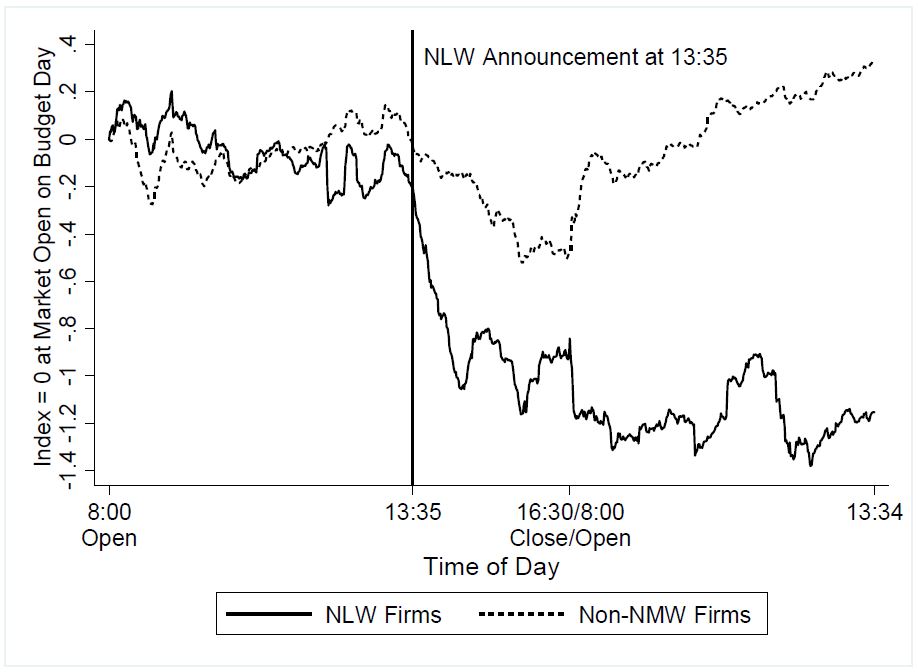
Stock market returns on the day of the minimum wage announcement and 24 hours after (based on 442 FTSE All-Share Index quoted firms, comprising 20 NMW firms and 422 Non-NMW firms). Source: IZA DP No. 9914

To understand how the stock market took the news, Bell and Machin compared the differential responses of lower-wage firms that employ a sizeable share of minimum wage workers (NMW firms), e.g., a retail firm, a pub group or a hospitality firm, with higher wage firms (non-NMW firms) whose employees’ wages are unlikely to be significantly affected by the change.

They looked at both the minute-by-minute changes surrounding the announcement and at cumulative abnormal returns in the days before and after the announcement. As the graph shows, the stock market value of the low wage firms most affected by the NLW introduction decreased significantly after the news had hit the markets, while the stocks of non-NMW companies quickly recovered after the initial shock.

Within a day of the budget speech, firm values were around 1.2 percent lower for the employers of mostly minimum wage labor and ended up stabilizing around 2 to 3 percent lower after five days.

Stock market losses are as high as the cost shock itself

What is interesting about these results is the magnitude of the stock market losses. In total, the decrease in firm value is consistent with the firms taking the entire burden of the additional wage cost as reduced profits in the short-run but over time managing to offset the costs in one way or another. Evidence from reports of the individual firms affected suggest this offset will most likely come via raising prices and improved efficiency. None of the firms affected mention reduced employment as a response.

Thus, the paper by Bell and Machin provides evidence of the damaging short-run effects that minimum wage announcements can have on the stock value of low-wage firms, an insight that previous studies on stock market responses to minimum wages in other settings were unable to provide.

Image Source: pixabay

Filed Under: Research Tagged With: employment, firm value, low-wage firms, minimum wage, National Living Wage, stock market, UK, wage cost

  • Previous Page
  • Page 1
  • …
  • Page 37
  • Page 38
  • Page 39
  • Page 40
  • Page 41
  • …
  • Page 69
  • Next Page

Primary Sidebar

© 2013–2025 Deutsche Post STIFTUNGImprint | Privacy PolicyIZA