
• Skip to primary navigation
  • Skip to content
  • Skip to primary sidebar

IZA Newsroom

IZA – Institute of Labor Economics

  • Home
  • Archive
  • Press Lounge
  • DE
  • EN

Why aging and working makes us happy – in four charts

October 10, 2014 by admin

Carol Graham, Milena Nikolova

By Carol Graham and Milena Nikolova

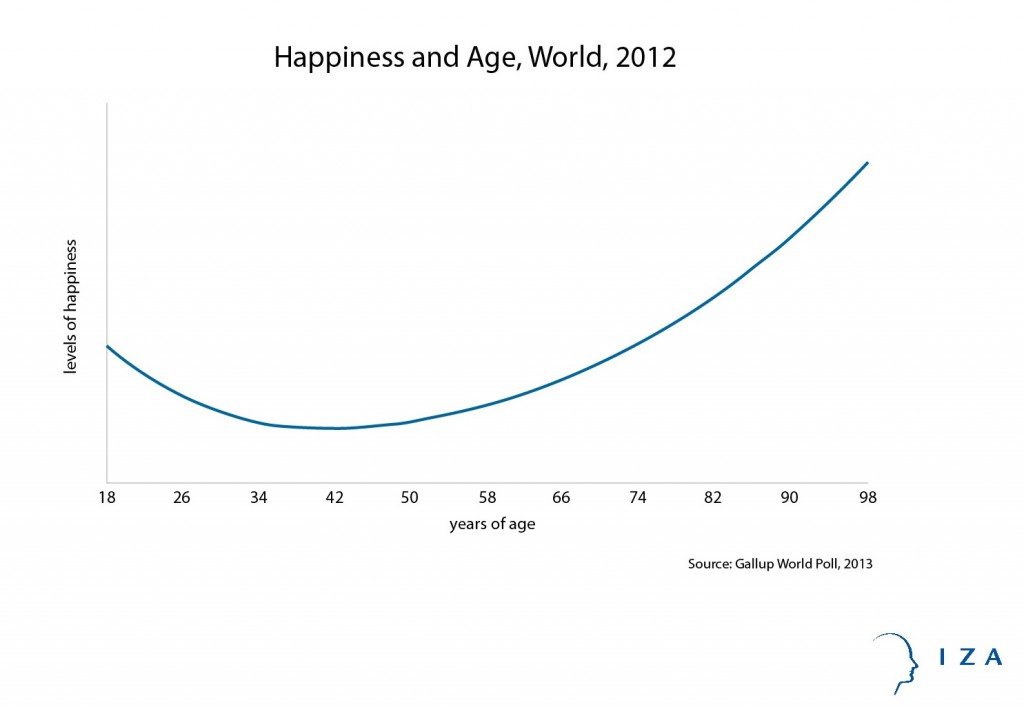
In the past few years, economists and other social scientists have made great strides in developing measures to assess subjective well-being (or, more colloquially, happiness), which has deepened our understanding of well-being beyond the traditional income dimensions. There are remarkably consistent patterns in the determinants of subjective well-being across people within and across countries and cultures around the world. One of the most striking of these is the relationship between age and happiness (which is good news for those of us who are already on the “back-nine”). There is a U-shaped curve, with the low point in happiness being at roughly age 40 around the world, with some modest differences across countries. It seems that our veneration of (or for some of us, nostalgia, for) youth as the happiest times of our lives is overblown, the middle age years are, well, as expected, and then things get better as we age, as long as we are reasonably healthy (age-adjusted) and in a stable partnership.
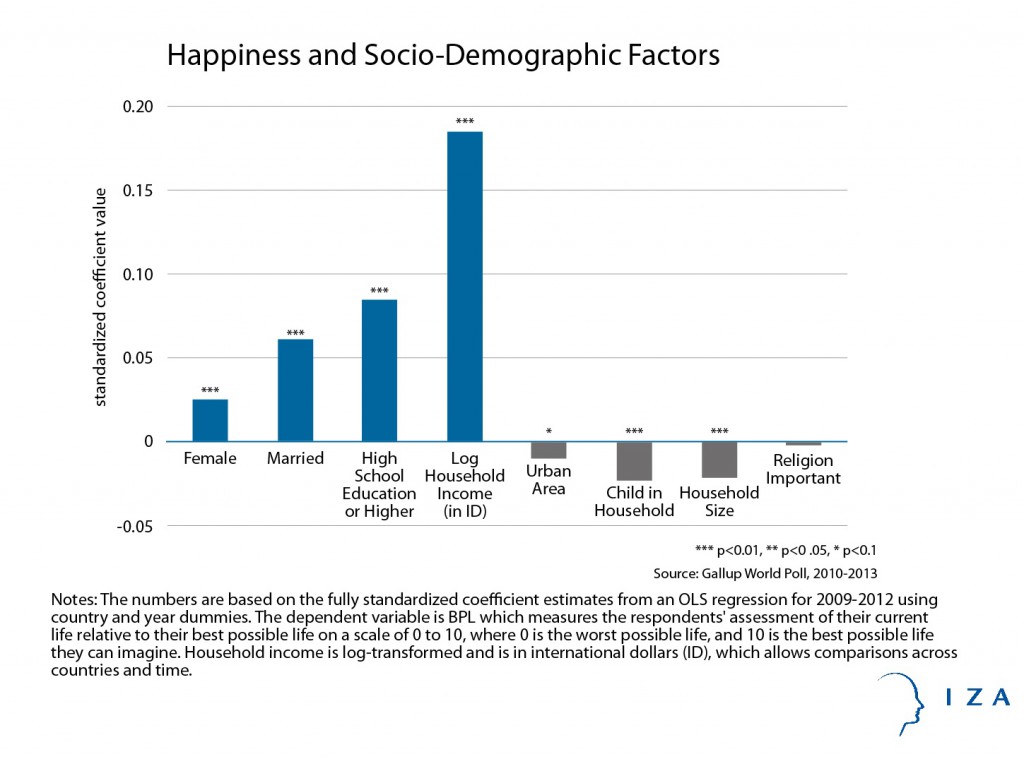
There are other consistent patterns. Income matters to individual happiness in every context we have studied this relationship. Yet after basic needs are met, other things like how your income compares to that of your peers also start to matter. Moreover, married people (and those in a civil union) are typically happier than their non-married counterparts (there is a direction-of-causality-issue here, though, as happier people are more likely to marry each other); healthier people are happier; and women are, in most places, happier than men (as long as gender rights are not severely compromised).
Another variable that is absolutely critical for subjective well-being is employment status. The unemployed are less happy than the employed worldwide. And both psychologists and economists find that long-term unemployment has psychological scarring effects. Long-term unemployment and under-employment, and the youth’s delayed entrance into employment, coupled with the over-burdened pension systems, are major problems in the U.S. and Europe. At a time when these issues have risen to the fore, it is perhaps worth considering more flexible labor market arrangements. While several solutions have been proposed, we are left wondering whether there would be public receptivity to changing labor market arrangements. While this is hard to predict, what we can measure – and did in our recent article in the IZA Journal of European Labor Studies – is the well-being costs and benefits of different work arrangements. As we argue in the study, different employment and retirement arrangements may be appropriate for people at different stages of their lives, depending on their career goals or innate well-being levels. Understanding how employment, retirement, and late-life work relate to well-being can contribute to ongoing public policy discussions. [Read more…] about Why aging and working makes us happy – in four charts

Filed Under: Research Tagged With: age, employment status, happiness, health, income, late-life-work, long-term unemployment, married, partnership, socio-demographic factors, under-employment, well-being

Immigrant women: Not just secondary workers any more

October 9, 2014 by admin

Immigrant women in the labor market have long been viewed as “secondary workers” who work in unskilled jobs, mainly as a response to family needs and to support their husbands’ skills upgrading. As household financial constraints ease with men’s assimilation in their destination country, women’s labor market participation is expected to drop again. An IZA Discussion paper by Alícia Adserà and Ana Ferrer on immigrant women in Canada finds that this is no longer true.

The authors combine data of over 800,000 women in Canada for the period 1991 to 2006 with information on the skill requirements of the jobs women hold (such as physical strength or analytical abilities) to examine the labor market patterns of immigrant women. They show that the recent behavior of married immigrant women does not fit the profile of secondary workers, but rather conforms to the recent patterns of native Canadian wives, with rising participation in the labor market and wage gains as they stay longer in Canada.

Immigrant women’s behavior displays a path of assimilation similar to that of immigrant men. They increasingly make labor supply decisions guided by their own opportunities in the labor market rather than by their husbands’ trajectories. At best, only uneducated immigrant women in jobs requiring very basic skills may fit the profile of secondary workers with slow skill mobility and low-status job-traps.

Filed Under: Research Tagged With: Canada, immigrants, job-traps, labor market participation, married, migration, secondary worker, skills, women

Where does the gender gap in economics enrolment arise?

September 30, 2014 by admin

Although women account for 57% of all students at UK universities, the share of female economics students is only about 27%. In a new IZA paper, Mirco Tonin and Jackie Wahba use rich data on university applications to explore the reasons behind the big gender gap in economics enrolment. They also explain why it would be in the interest of society to close this gap.

Economists generally have an influential role in policy making, directly or as academics, consultants or policy analysts. The gender of those making policies matters because males and females tend to have different policy preferences. Also, since economics is one of the subjects associated with relatively high average earnings, lower enrolment by females is a contributing factor behind the gender pay gap.

The study finds no indication that universities discriminate against females when making their offers. As the acceptance rate does not differ between males and females, the enrolment gap is entirely due to low application rates: Only 1.2% of females apply to economics, as opposed to 3.8% of males. An important limiting factor (though not the whole story) seems to be the gender gap in math. Among those who enroll at university, math is an A level subject for 19% of males, but only 10% of females.

There is evidence that this gap in math is cultural rather than “biological”, as the gap disappears in more gender-equal societies. Thus, a policy aimed at reducing the gap in math could be very effective. In particular, it could start a positive loop, with an improvement in the participation of girls to educational paths leading to positions of influence generating more equality in society, again encouraging girls to seek educational paths leading to positions of influence, and so on.

Filed Under: Research Tagged With: cultural impact, economics enrolment, enrolment gap, gender gap, gender pay gap, gender wage gap, gender-equal societies, math, universities

Grades and rank: How do they affect student effort?

September 22, 2014 by admin

The educational system is built upon a sequence of tests to measure student performance. Improving student performance is a key educational and economic policy issue to which much time and resources are devoted. At the same time, the results of these tests often lay the foundation for the distribution of school resources and spur considerable public debates. A question that has not received as much consideration is how test incentives inherent in our conventional grading system affect student motivation and effort? What if we leave the beaten path of grading students on scale from 1 to 6 or A to F and introduce alternative ideas of incentivizing students?

In a new IZA Discussion paper Nina Jalava, Juanna Schrøter Joensen and Elin Pellas conduct a randomized field experiment on more than a thousand sixth graders in Swedish primary schools to shed light on the effects of alternative incentive systems in the classroom. They find that ranking students by distinguishing the top three performers in the class has particularly large motivational power for highly-skilled boys and girls. While the boys seem to compete independent of the peer group, highly skilled girls seem less motivated if they are tested in a class where they do not know their classmates well. In addition, these girls also increase their effort if offered a certificate for high performance – an incentive boys do not react to. However, looking at the low skilled students, these incentive measures may backfire and exert negative effects on effort.

Based on these results, the author call for caution in using financial incentive schemes for schools and teachers – such as school accountability or teacher performance pay systems — based on the outcomes of students’ test scores. The study implies that the distribution of financial resources will be highly dependent on how the students prepare for the tests, whether students know their peers during the tests and how teachers set incentives in terms of grading. It could therefore be easy for teachers and principals to manipulate such measures by simply giving a symbolic reward or singling out the top performers on the day of the test, which would in turn mask and bias true student ability.

Filed Under: Research Tagged With: grades, incentive, motivation, performance, ranking, school, students, Sweden, teachers, test scores

Ethnically diverse co-authors produce better research papers

September 19, 2014 by admin

Thinking about a new research paper? You may want to start searching for co-authors of different ethnicity. Statistically, this will increase the chances to get your paper accepted in a top journal. That’s what a new IZA Discussion Paper (written by an ethnically diverse author duo) suggests.

Using data from the Thomson-Reuters Web of Science, the study by Harvard economists Richard B. Freeman and Wei Huang examines the ethnic identity of authors in over 2.5 million papers written by U.S.-based authors from 1985 to 2008. In this period the frequency of English and European names among authors fell relative to the frequency of names from China and other developing countries. In 1985, 57 percent of authors had “English” names. This share dropped below 50 percent in 2008. Over the same period, the proportion of Chinese named authors tripled from 4.8 to 14 percent.

To determine whether a name is English, Korean or Russian, the authors used a name-ethnicity matching program, which combines information on the distribution of names by ethnicity (e.g. Kim is typically Korean, while Zhang is most likely Chinese) and the metropolitan areas in which particular ethnicities are disproportionately represented.

The analysis shows that persons of similar ethnicity co-author together more frequently than predicted by their proportion among authors. Freeman and Huang compare the distribution of observed co-authorships with the distribution that would arise if authors were matched randomly. For example, one would expect 1.522 percent of all two-author papers to be written by two Chinese researchers, but their actual share is 4.157 percent.

They also find that greater homophily is associated with publication in lower impact journals and with fewer citations, even holding fixed the authors’ previous publishing performance. By contrast, papers with authors in more locations and with longer reference lists get published in higher impact journals and receive more citations than others.

Greater diversity thus seems to contribute to the quality of the scientific papers that a research team produces. This may be because diversity raises productivity by widening ideas. Papers from more diverse collaborations should then contain a wider range of scientific terms, use more varied equipment, procedures, or data and reference a wider range of previous work than papers from more homogeneous groups. Another potential explanation is that having co-authors of different ethnicity increases citations through network effects rather than through novel ideas.

Filed Under: Research Tagged With: author, China, diversity, ethnicity, homophily, journal, publication, research, Science, team

Flexible working hours improve job satisfaction

September 17, 2014 by admin

Temporal and locational flexibility (TLF) is an important element in current policy debates about working conditions and the combination of work and private life. More flexibility provides employees with a greater scope to reconcile their professional, private, and family lives. Furthermore, TLF is expected to increase female labor participation and reduce skilled labor shortages.

From a theoretical point of view, many advantages are conceivable: TLF provides employees with more control over their working life, leads to a better match between paid work and other activities, decreases the amount of stress experienced by employees, and signals to workers that their employer cares about their well-being and their responsibilities outside work. Since higher job satisfaction translates into fewer job quits and lower absenteeism, it is not only beneficial to employees, but should also be a key concern for employers.

In a new IZA Discussion Paper Daniel Possenriede and Janneke Plantenga analyze whether flexibility in the work schedule (flexi-time), location (telehomework) and duration (part-time) improves the work/leisure balance and increases employee’s overall job satisfaction. They use panel data on Dutch households with self-reported measures of job satisfaction. In the sample, 39% of the employees report freedom to determine the start and end times of their work, and 17% work at home at least once a week.

The analysis finds that a flexible work schedule is positively associated with both working-time fit and job satisfaction. Surprisingly, the effects are not stronger for employees with family responsibilities, who would be expected to struggle more with the combination of work and private life than other groups of workers.

Telehomework or location flexibility is also related to higher job satisfaction, although to a smaller extent than flexible working times. Part-time work increases working-time fit similarly to flexi-time, but it sometimes even has a negative effect on job satisfaction for women – contrary to some previous empirical findings. Overall, the results indicate that schedule flexibility may be a superior alternative to duration flexibility.


Filed Under: Research Tagged With: family, flexibility, job satisfaction, Netherlands, part-time work, working conditions, working hours

Peter Kuhn on the internet as a labor market matchmaker

September 15, 2014 by admin

Since the internet’s earliest days, firms and workers have used various online methods to advertise and find jobs. Until recently there has been little evidence that any internet-based tool has had a measurable effect on job search or recruitment outcomes. However, recent studies, and the growing use of social networking as a business tool, suggest workers and firms are at last developing ways to use the internet as an effective matchmaking tool. In addition, job boards are also emerging as important for the statistical study of labor markets, yielding useful data for firms, workers, and policymakers.

Read more in an article for IZA World of Labor watch this video interview with author, Peter Kuhn (IZA Visiting Research Fellow from UC Santa Barbara).


Filed Under: Research, Videos Tagged With: government resources, internet-sourced data, labor market, online job searching, reemployment

Chinese imports push low-skilled Norwegians into unemployment

September 12, 2014 by admin

China’s rise to global economic power has had a major impact on the recent globalization process. In 2009, China became the world’s largest exporter. This evolution affects local labor markets all over the planet. Many nations complain that Chinese competition increases domestic unemployment and depresses wages. But how large is this effect really?

In a recent IZA Discussion Paper Ragnhild Balsvik, Sissel Jensen and Kjell G. Salvanes explore the impact of import shocks from China on the Norwegian labor market from 1996 to 2007. In this time range, the amount of imports from China increased more than sixfold while employment in the manufacturing sector declined.

The researchers find that this negative employment effect is especially pronounced for low-skilled workers who are pushed into unemployment, or even leave the labor force entirely. For workers without college education, an increase in import exposure of about 1,600 U.S. dollars per worker reduces manufacturing employment by about 0.8%. At the same time, employment in other private sectors rises by 0.5%. Unemployment rises by 1.8%, and labor force exits by 0.3%.

This outcome is related to the import of intermediate goods rather than products for final consumption. Also, the decline in employment is mainly due to imports from China to Norway’s domestic market, not to increased competition in Norwegian export markets.

Consistent with features of the Nordic welfare state, such as generous unemployment benefits or disability pensions and a centralized wage bargaining process that makes wages rather sticky, the authors find no significant change in earnings. Overall, about 10% of the reduction in the manufacturing employment share can be attributed to import competition from China. This is roughly half the size of the effect found for the U.S. in another IZA paper.

Filed Under: Research Tagged With: China, employment, export, globalization, import, industry, manufactoring, Norway, trade, unemployment, wage bargaining

Union threat: Where is it highest?

September 8, 2014 by admin

What kind of businesses do unions approach to organize workers? Much is known about what happens to a business after it becomes unionized. But there is little information on where the threat of union formation is highest, and where union activity is most concentrated. Do unions mainly try to organize big and profitable business establishments? These establishments can provide larger employment and benefits to the union. However, they may also be harder for unions to organize, because in general they have higher wages, as well as greater resources and better management to resist unionization.

Alternatively, unions may more frequently focus on smaller or medium-sized establishments that may be easier to organize because of poorer labor conditions and weak management. These establishments also offer lower wages and benefits in general, potentially implying a higher demand for unionization.As to the timing of union activity, when in an establishment’s life cycle does a union try to organize it? Does a union emerge in a business when the business is young, or later when it is more established? Such timing can matter for the survival and growth prospects of an establishment, if a union is successful in extracting surplus from a young establishment in the early stages of growth.

A new IZA discussion paper by Emin Dinlersoz, Jeremy Greenwood, and Henry Hyatt explores the union organizing process in the US. They offer a model of union learning in which a union gradually gathers information about the productivity of a business and decides whether to organize its employees at some point in time.

The model predicts that unions target large and productive establishments early on in their life cycles. To see the relevance of these predictions, the authors assemble a new, comprehensive panel data on union activity at the establishment level for the period 1977-2007. The data allows tracking of union activity in an establishment starting from its birth until exit, making it possible to identify when exactly a union election occurs in an establishment’s lifetime.

The analysis of data reveals that unions are indeed much more likely to target and successfully organize larger, more productive, and younger businesses. For example, in manufacturing a large plant with 500 or more employees is about 25 times more likely to be targeted by a union for organizing purposes, compared to a small plant with less than 10 employees.Furthermore, unions do not wait too long to target a large and productive establishment after it is born. The youngest group of establishments (0-3 years old) is approximately twice as likely to be targeted as the oldest group (25+ years old).

Given that unions generally target, and successfully organize, large, productive firms in the U.S. economy, any effects of unions on business outcomes may be larger than previously thought, as these establishments account for the bulk of economic activity. First, the disproportionate presence of the mere threat of union targeting in these establishments can have larger welfare consequences. For instance, these establishments may have to raise wages and devote more resources to resist unionization.Second, the concentration of successful union organizing in these establishments means that post-unionization effects can be more prevalent in the larger and more productive segment of the establishments. If unions indeed have large adverse effects on businesses, this prevalence has important consequences.

Filed Under: Research Tagged With: business, employment, firm size, management, organization, union, USA, wage, worker

Using employee recognition to boost productivity

September 2, 2014 by admin

Good bosses know that recognition and words of appreciation are key tools to motivate employes and increase productivity. But what is the most effective way? Is it better to praise all employees, or just the top performers? A new IZA Discussion Paper suggests that the happy medium may be the best choice.

For their study, Christiane Bradler, Robert Dur, Susanne Neckermann and Arjan Non conducted a field experiment with more than 300 students to investigate how exclusive or inclusive recognition optimally should be. The participants were paid 25 euros for a three-hour task of entering survey results into a database. Eight of them shared a room, but they all worked independently.

After two hours of work, thank-you cards were unexpectedly given out – either to all eight students, or to the top three performers, or only to the single most productive worker so far. This surprise recognition had no material value but clearly showed appreciation of the work effort.

Compared to a control group, all treated increased their productivity by an average of at least 5 percent for the remaining hour. If all eight students received a thank-you card, they subsequently performed 5.2 percent better. If only the most productive worker was picked out, average effort in the group rose by 5.6 percent. The best outcome was found in groups with three recognized workers, where overall performance increased by 7.3 percent.

Most strikingly, this increase in work effort is driven by those who did not receive a card. Even though they were made aware that there was no chance to receive a card later if they worked harder, their performance improved by more than 10 percent. In contrast, those who received a card raised their effort by only 3.3 percent.

According to the authors of the study, these results can be largely explained with a desire for conformity: Upon learning that one does not belong to the best three performers in a group of eight, non-recipients apparently feel inclined to improve performance so as to adhere to the apparent group norm. But reciprocity also seems to plays a role. This would explain why recipients of recognition in treatments with scarce recognition did not reduce their performance.

In conclusion, the authors suggest that recognition is a cost-effective tool to stimulate performance in a workplace setting, and that exclusivity may motivate relatively poor performers to catch up. However, if recognition becomes too scarce, its effectiveness diminishes. The optimal level, of course, depends on the organizational setting – particularly whether or not it is desirable from a management point of view to provide information to employees about the work norm prevalent in the group.

Filed Under: Research Tagged With: effort, employees, field experiment, motivation, performance, recognition, reward

  • Previous Page
  • Page 1
  • …
  • Page 51
  • Page 52
  • Page 53
  • Page 54
  • Page 55
  • …
  • Page 69
  • Next Page

Primary Sidebar

© 2013–2025 Deutsche Post STIFTUNGImprint | Privacy PolicyIZA