
• Skip to primary navigation
  • Skip to content
  • Skip to primary sidebar

IZA Newsroom

IZA – Institute of Labor Economics

  • Home
  • Archive
  • Press Lounge
  • DE
  • EN

Extending paid maternity leave makes no sense economically

November 15, 2013 by admin

Paid maternity leave has become more and more popular over the past few decades as mothers have increasingly entered the workforce: the median number of weeks of paid leave to mothers in OECD countries rose from only 14 in 1980 to 42 in 2011. But what are the labor market effects of (longer) paid maternity leave? A new IZA Discussion Paper by Gordon B. Dahl, Katrine Vellesen Loken, Magne Mogstad and Kari Vea Salvanes answers this question by studying parents’ responses to a series of policy reforms in Norway, which expanded paid leave from 18 to 35 weeks without changing the length of job protection. The authors present four sets of results:

First, none of the reforms affected the length of unpaid leave. Each reform increased the amount of time spent at home by roughly the increased number of weeks allowed. Since income replacement was 100% for most women, the reforms did not affect family income.

Second, the expansions had little effect on a wide variety of outcomes, such as children’s school outcomes, parental earnings and labor market participation, fertility, marriage and divorce.

Third, the authors show that paid maternity leave has negative redistribution properties. Since unpaid leave did not respond to the reform, the extra leave benefits can be seen as a pure leisure transfer, financed by everyone and mostly taken up by middle and upper income families.

Fourth, the authors investigate the financial costs of the extensions in paid maternity leave. They find that the reforms had little impact on parents’ future tax payments and benefit receipt. As a result, the large increases in public spending on maternity leave imply a considerable increase in taxes.

Taken these four findings together, the authors conclude that the generous extensions to paid leave were costly, had no measurable effect on outcomes and exhibited poor redistribution properties. In a time of harsh budget realities, there seem few economic arguments in favor of extending paid maternity leave beyond baseline levels.

Filed Under: Research Tagged With: fertility, financial costs, government budget, labor market effects, marriage, maternity leave, Norway, OECD, paid maternity leave, redistribution, school, taxes

What predicts a successful life?

November 13, 2013 by admin

How much of adult well-being is determined by childhood influences? The answer to this question is very important to policy-makers since it influences educational and family policies. In a new discussion paper, Richard Layard, Andrew E. Clark, Francesca Cornaglia and Nattavudh Powdthavee estimate how adult life-satisfaction is predicted by childhood influences. The authors differentiate between direct effects of childhood influences and indirect effects affecting adult life-satisfaction through adult circumstances.

According to the study, the most powerful childhood predictor of adult life-satisfaction is the child’s emotional health. Next comes the child’s conduct. The least powerful predictor is the child’s intellectual development. Although intellectual performance is a good predictor of the person’s educational achievement and income, it has hardly an effect on adult life-satisfaction since income itself has been found to have a very limited impact well-being. Likewise, family background (economic, social and psychological) is a quite limited predictor of most adult outcomes except educational qualifications.

Filed Under: Research Tagged With: children, educational policy, family policy, happiness, income, life satisfaction, well-being

Study abroad programs boost labor market careers

November 8, 2013 by admin

Despite the great popularity of international educational mobility schemes like the European Erasmus scholarship program, relatively little research has been conducted to explore their benefits. A new IZA discussion paper by Giorgio Di Pietro tries to fill this gap. Using a large dataset of recent Italian graduates, the paper investigates the extent to which participation in study abroad programs during university studies impacts subsequent employment likelihood. Di Pietro accounts for the problem that certain universities or departments might have a better reputation, which increases job prospects and the likelihood of sending students abroad. Moreover, the analysis addresses the problem that students studying abroad might simply be smarter than those staying at home. The results indicate that studying abroad has a relatively large and meaningful effect on the later labor market career: graduates who studied abroad during university are about 24 percentage points more likely to be in employment 3 years after graduation relative to their non-mobile peers. This effect is mainly driven by the impact that study abroad programs have on the employment prospects of graduates from disadvantaged backgrounds.

The findings have important policy implications as the European Commission is currently planning to significantly expand the ERASMUS program over the next years. This plan, named “ERASMUS for all”, would give the possibility to study abroad to a larger number of students. Di Pietro expects a considerable proportion of future study abroad participants to come from disadvantaged backgrounds, since currently many students from disadvantaged backgrounds are left out from the list of study abroad winners as the criteria for the award of an ERASMUS scholarship (e.g. academic achievement, motivation letter) tend to favor their peers from advantaged backgrounds.

Filed Under: Research Tagged With: education, educational mobility, employment, Italy, job prospects, university

Persuading mothers to work: results from an experiment

November 4, 2013 by admin

Many women see themselves as the better providers of care for their children, and thus refrain from delegating child care. At the same time, they may be skeptical about their chances of being successful both as mothers and in their working career. One explanation for such a view could be lacking information on the psychological and educational effects of female labor market participation on children. Consequently, informing mothers about the consequences of maternal employment could have a positive effect on female labor force participation.

A new IZA discussion papers tests this hypothesis: Vincenzo Galasso, Paola Profeta, Chiara D. Pronzato and Francesco C. Billari designed a randomized survey experiment, in which 1500 Italian women aged 20 to 40 are exposed to information on the positive consequences of formal child care on children’s future educational attainments. Surprisingly at first glance, the authors find that women on average reduce their intended labor supply. However, there are substantial differences by educational attainment in the response: highly educated women respond to better information by increasing their intended use of formal child care. In contrast, low educated women do not modify their formal child care decision and reduce their intended labor supply. The authors explain these heterogeneous responses with different monetary incentives and different preferences for maternal care between high and low educated women.

For policymakers, these mixed findings send a warning signal about the true effectiveness of often advocated public policies regarding formal child care. The authors conclude that public policies should acknowledge that child care decisions by mothers may depend on budgetary restrictions — as in the case of low wage mothers — but also on maternal identity. Thus, some (low educated) mothers may in fact choose to stay at home and take care of the children, even when family friendly institutions are available.

Filed Under: Research Tagged With: child care, female labor supply, field experiment, Italy, maternal leave, wage, women

How to manage the quality-quantity tradeoff

November 1, 2013 by admin

A commonly acknowledged problem in running a business is that the more that is produced, the lower the quality due to an increasing amount of errors committed. This quality-quantity tradeoff is widely thought to be worsened by incentive payments, which typically, it is said, reward quantity but overlook quality.

In a field experiment, John S. Heywood, W. Stanley Siebert and Xiangdong Wei study the relationship between incentive pay, worker monitoring, worker commitment and the quantity versus quality aspects of worker performance. Participants in the experiments had to manually input data obtained from survey questionnaires. Quantity is measured in terms of 1000’s of words input per day, and quality is measured as the number of mistakes. 60 workers were tracked for a month, and separated randomly into high monitored (50% chance of being checked per day) and low monitored (10% chance) groups. Initially the groups were paid according to a time rate. Then, halfway through the period, the system was changed to a piece rate, with high returns for quantity and at the same time a fine for mistakes. Given the different monitoring probabilities, the expected fine was larger for the highly monitored group. At the same time the workers’ motivations for doing the work were carefully surveyed with the aim of measuring worker “commitment”, e.g., whether they found the task meaningful.

The paper shows that worker monitoring, the piece rate’s high-powered incentives, and worker commitment all influence a worker’s quality-quantity performance. Hence, by choosing appropriate combinations of these variables, many different quality-quantity combinations are available to a firm. The authors show that these different combinations have different costs. For example, high monitoring requires supervisors to be paid, while high worker commitment implies costly worker selection. Nevertheless, the results imply that a firm is far from being bound by a given quality-quantity tradeoff. It can refine its worker selection and monitoring options together with the payment system to deliver a chosen (optimum) quality-quantity mix. Moreover, there is no reason to fear piece rates, provided that these are combined appropriately with worker monitoring. The paper also shows that time rates, for their part, are best combined with careful worker selection policies, and not with strict monitoring, which seems simply to demotivate in this context.

Filed Under: Research Tagged With: costs, field experiment, monitoring, production, productivity, quality-quantity tradeoff, worker selection

High school counselors effectively help students choose the right college major

October 28, 2013 by admin

Choosing the right field of study at college is a very important, but also a very difficult decision. Many prospective students face a high level of uncertainty as they have little information on employment prospects and the wage structure of occupations they may work in after graduating. And they can often only guess whether their individual preferences will match the actual job characteristics. Hence, reducing uncertainty about the right field of study could result in substantial efficiency gains, leading to higher individual job satisfaction, higher overall productivity and a lower likelihood of changing the field of study or dropping out of college before graduating.

A new IZA discussion paper by Lex Borghans, Bart H.H. Golsteyn, Anders Stenberg points at an effective way to reduce this costly uncertainty. The paper provides evidence that an individual meeting with a study counselor at high school significantly improves the quality of choice of tertiary educational field. The results are strongest among students with low educated parents – a group which is likely to have the least information at the outset. Tentative analyses also indicate that counselors reduce students’ uncertainty about their own individual preferences at least to the same extent as uncertainty about objective measures such as employment prospects.

Filed Under: Research Tagged With: employment prospects, field of study, high school, higher education, study counselor, tertiary education, university

Relative bonus payment schemes do not increase performance

October 25, 2013 by admin

Many firms run employee-of-the-month or job promotion contests. Stock brokers get additional money if they beat the index. Bonus payment schemes, where bonuses are awarded for outperforming competitors, are widely used nowadays. Yet, a potential problem of these schemes is that workers have intermediate information on their performance relative to their competitors and/or to their target. This information could neutralize the intended incentive effect. For instance, consider a salesman who can earn a bonus by attaining a monthly sales target while receiving daily or weekly sales figures. When sales – halfway through the month – are such that it remains challenging but possible to reach the target, the bonus scheme provides strong incentives. The incentive effect is much weaker, however, when intermediate sales are particularly high or low: either the salesman can hardly miss the bonus or the target is practically out of reach.

In a new IZA discussion paper, Josse Delfgaauw, Robert Dur, Arjan Non and Willem Verbeke empirically test the incentive effects of such relative performance pay schemes. The authors conducted a field experiment among 189 stores of a retail chain in the Netherlands. Employees in the randomly selected treatment stores could win a bonus by outperforming three comparable stores from the control group over the course of four weeks. Treatment stores received weekly feedback on relative performance. Control stores were kept unaware of their involvement, so that their performance was not affected by the experiment. As predicted by theory, the authors find that treatment stores that lag far behind do not respond to the incentives, while stores close to winning a bonus increased the performance. The authors conclude that on average, the introduction of the relative performance pay scheme does not lead to higher performance.

Filed Under: Research Tagged With: bonus payment, effort, field experiment, Netherlands, performance, work incentives

Welfare benefits are no magnet for migrants

October 21, 2013 by admin

EU commissioner Laszlo Andor has been under fire since he claimed last week that welfare tourism is “neither widespread nor systematic.” However, the newly published International Handbook on the Economics of Migration, co-edited by Amelie F. Constant and Klaus F. Zimmermann from IZA, confirms Andor’s position.

Anti-immigration sentiment is on the rise in Europe. The UK has recently joined Germany and several other EU member states in projecting a rather reserved position when it comes to access of immigrants to their labor markets and welfare systems.

Reviewing the state of the art in economic research, the handbook chapter on welfare migration concludes that “fears about immigrant abuse of welfare systems are unfounded or at least exaggerated.” Robust evidence shows that even if some relationship between immigration and welfare generosity is found, it is rather exiguous.

“In fact, recent research suggests that immigration may lead to increased welfare generosity,” explains Corrado Giulietti, one of the contributing authors. According to a research paper by an IZA team that came out in International Journal of Manpower earlier this year, the economic situation or presence of relatives or other contacts in receiving countries are some of the much more important pull factors. The main goal of migrants from new member states coming to the old EU states is employment, according to the Handbook.

Immigrants have been scapegoated, and not only by rising anti-immigrant parties in countries such as France or the Netherlands, also for their alleged abuse of social benefits. An earlier study by IZA and the Economic and Social Research Institute (ESRI, Dublin) shows that in most EU member states immigrants are in fact less likely to use the welfare system than natives.

“Analysis of hard data reveals that even for unemployment benefits immigrants are equally and in several countries less likely recipients than comparable natives,” asserts Martin Kahanec, co-author of the study. “We need a paradigm shift, from the debate about abuse to a debate about lack of access to social benefits and services,” he adds.

Aging and crisis-stricken Europe needs to tap on all available resources. Mobile workers can provide the much-needed flexibility and skills where they are needed. “The role of migration is ever more, and not less, important in times of economic crisis. Mobility can not only absorb some of the negative shocks, but also contribute to recovery through increased efficiency,” concludes IZA Director Klaus F. Zimmermann.

For more information on the International Handbook of the Economics of Migration, see the Handbook’s homepage and a video of the Handbook’s Presentation with statements of the editors.

Filed Under: Opinion, Research Tagged With: anti-immigration movement, demographic change, employment, Europe, European Union, Germany, immigration, migration, UK, welfare migration, worker mobility

Peer effects at work are smaller than often suggested

October 14, 2013 by admin

What happens to a worker’s own productivity if one of her less productive colleagues is replaced by a highly productive new co-worker? Would this have any impact on that worker’s own productivity? And if so, then what is the possible channel?
There are at least two reasons why this new productive colleague makes her co-workers in the same peer group more productive. First, workers may learn from each other, and the new colleague may transmit knowledge to her co-workers which increases their productivities (knowledge spillover). Alternatively, co-workers might feel guilty or ashamed if their productivity falls short of that of their new colleague, and they may therefore work harder when a new and very productive new co-worker enters their peer group (social pressure).

Whether such spillovers in productivity exist, and what are the channels, is not only important for our understanding of the wage setting process and the hiring policy of the firm, but has also implications for wider issues such as wage inequality. Despite the potentially important implications of spillovers in the workplace, empirical evidence on this question is still scarce. The existing empirical literature on productivity spillovers in the workplace is so far restricted to only to a handful of studies referring to very specific settings, such as supermarket cashiers, soft fruit pickers, teachers or scientists.

In a new IZA discussion paper, Thomas Cornelissen, Christian Dustmann and Uta Schönberg go beyond the existing literature and investigate peer effects in the workplace for a representative set of workers, firms, and sectors of a large local labor market over two decades. Further, the authors focus on peer effects in wages rather than productivity. The researchers find only small peer effects in the labor market in general, as well as in highly skilled occupations. Hence, the larger peer effects established in specific settings in existing studies do not carry over to the labor market in general. This is an important finding, and suggests that – overall and for high skilled occupations – peer effects contribute little to wage inequality. In low-skilled occupations, in contrast, peer effects are sizable, indicating that a 10% increase in co-worker quality increases a worker’s own wage by 0.6-0.9%. The authors present several pieces of additional evidence suggesting that social pressure is the primary source of these peer effects.

Filed Under: Research Tagged With: co-workers, colleagues, peer effects, productivity, wage inequality

“The Price of Rights”: How to regulate international labor migration

October 11, 2013 by admin

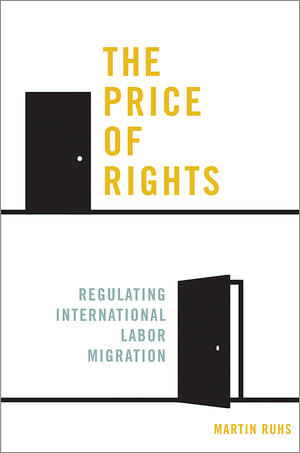
Many low-income countries and development organizations are calling for greater liberalization of labor immigration policies in high-income countries. At the same time, human rights organizations and migrant rights advocates demand more equal rights for migrant workers. “The Price of Rights“, a new book by Oxford Economist and IZA Research Fellow Martin Ruhs, shows why you cannot always have both.

The author analyzes the trade-offs between admitting migrants and granting them rights. The book examines labor immigration policies in over 45 high-income countries, as well as policy drivers in major migrant-receiving and migrant-sending states. It finds that greater equality of rights for new migrant workers tends to be associated with more restrictive admission policies, especially for admitting lower-skilled workers from poorer countries. The tension between “access and rights” applies to a few specific rights that are perceived to create net-costs for the receiving countries including especially the right of lower-skilled migrants to access certain welfare services and benefits.

Most low-income countries around the world are acutely aware of the trade-off between access to labor markets in high-income countries and some migrant rights. Few migrant-sending countries are willing to insist on full and equal rights for fear of reduced access to the labor markets of higher-income countries. As discussed in The Price of Rights, some migrant-sending countries have explicitly rejected equality of rights for their nationals working abroad on the grounds that it constitutes a restrictive labor immigration policy measure.

How to respond to the trade-off between openness and rights is an inherently normative question with no one right answer. Martin Ruhs argues that there is a strong case for advocating the liberalization of international labor migration, especially of lower-skilled workers, through temporary migration programs that protect a universal set of core rights and account for the interests of nation-states by restricting a few specific rights that create net costs for receiving countries, and are therefore obstacles to more open admission policies.

The book suggests that we should start discussing the creation of a list of universal ‘core rights’ for migrant workers that would include fewer rights than the 1990 UN Convention of the Rights on Migrant workers with a higher chance of acceptance by a greater number of countries – thus increasing overall protection for migrant workers including in countries that admit large numbers of migrants.

Filed Under: Research Tagged With: admission policy, high-income countries, high-skilled, immigration, labor migration, liberalization, migration, population aging, welfare migration

  • Previous Page
  • Page 1
  • …
  • Page 60
  • Page 61
  • Page 62
  • Page 63
  • Page 64
  • …
  • Page 69
  • Next Page

Primary Sidebar

© 2013–2025 Deutsche Post STIFTUNGImprint | Privacy PolicyIZA