• Skip to primary navigation
  • Skip to content
  • Skip to primary sidebar

IZA Newsroom

IZA – Institute of Labor Economics

  • Home
  • Archive
  • Press Lounge
  • DE
  • EN

admin

Generosity of unemployment benefits affects job search effort

November 30, 2016 by admin

Unemployment insurance (UI) schemes face a dual challenge: By partly replacing forgone labor income, they should enable unemployed individuals to actively search for re-employment, while on the other hand they have to ensure that job seekers are not incentivized to lower their search effort.

The disincentive effects of unemployment insurance systems have been well identified by empirical research. In a nutshell, evidence has demonstrated that extensions of the benefit duration or increases in the benefit level significantly extend job seekers’ spells of unemployment, irrespective of worker characteristics or institutional characteristics of the labor market.

These increases in unemployment duration are commonly attributed to reductions in search effort or higher reservation wages, the lowest wage at which a worker would be willing to accept a job. However, direct empirical evidence regarding the importance of these channels in contributing to this aggregate effect on unemployment is sparse.

A recent IZA Discussion Paper by Andreas Lichter addresses this question more explicitly by exploiting variation in the potential benefits duration for one specific group of job seekers as well as individual-level information on short-run job search behavior.

German reform increased benefit duration for older job seekers

The variation in the potential benefit duration was the result of an unexpected and rapidly-implemented policy reform in Germany in late 2007. In short, the respective legislative reform, which was motivated by social justice concerns and political-economy considerations, extended the potential benefit duration for eligible job seekers aged 50 to 54 by twelve weeks (from twelve to fifteen months), while younger job seekers remained unaffected.

Using information from the IZA Evaluation Dataset Survey, a dataset covering a large sample of individuals registering as unemployed at the German Federal Employment Agency just prior to and after the reform (June 2007 to May 2008), the study investigates changes in the job search behavior and the associated job finding rate with respect to this policy change.

To disentangle the actual causal effect of lengthening the benefit duration from other changes coinciding with the reform, Lichter applies what economists call a Difference-in-Differences approach: Mimicking the experimental standard of treatment and control groups, he compares changes in the search behavior and job finding rate of individuals affected by the reform with the job search behavior of slightly younger individuals aged 45 to 49, who were not affected.

Reform caused reductions in job applications and job finding rates

The results show that job seekers aged 50 to 54, who were subject to the more generous benefit scheme, significantly reduced their search effort while their stated reservation wages remained unaffected. Search effort declined by an average of around 1.8 applications per week (or 60% of a standard deviation in total applications) and was found to be substantially smaller in areas with low unemployment, i.e., in labor markets where reductions in search effort appear to be less costly.

In line with standard job search theory, the study further shows that this overall reduction in search effort is accompanied by a significant decrease in the short-run job-finding rate. Evaluated at the mean, a ten percent decrease in the number of applications is found to lower the short-run job finding probability by around 1.3 percentage points.

Image source: pixabay

Filed Under: Research Tagged With: German Federal Employment Agency, Germany, reservation wage, search effort, unemployed, unemployment, unemployment benefits, unemployment insurance, unemployment rate

Mixing kids in school leads to more mixed-race adult relationships

November 24, 2016 by admin

Does the racial mix of students’ classmates affect their behavior later on in life? A new IZA Discussion Paper by Luca Paolo Merlino, Max Friedrich Steinhardt and Liam Wren-Lewis compares American students, contrasting those who happen to be in an age group with fewer blacks in their class compared to other classes in the school.

The study finds that white students with more black classmates are more likely to cohabit and have children with a black partner later on in life. The effect is driven by a change in racial attitudes: These students are less prejudiced, and as adults they are less likely to think that race is an important factor within a relationship.

Class composition thus affects relationships formed many years after school, implying that the increase in mixed-race relationships is not simply driven by students meeting more black partners in school or via school friends.

The results suggest that racial diversity in schools can help lead to positive changes in attitudes and behavior towards members of other races.

Image source: pixabay

Filed Under: Research Tagged With: high school, race, racial attitudes, racial diversity, relationships, social integration, social interaction, tolerance

Money to study? Research on motivation and incentives for students

November 21, 2016 by admin

Differences in educational outcomes based on socioeconomic background is a well-documented phenomenon and a key driver of inequalities later in life. Thus, these parities should be of high importance for policy makers. Two recent contributions to the IZA discussion paper series provide insights from behavioral and education economics on how to motivate and incentivize students, especially those from disadvantaged backgrounds.

Financial and non-financial incentives in secondary schooling

Simon Burgess (U Bristol, IZA), Robert Metcalfe (U Chicago) and Sally Sadoff (UC San Diego) pursue quite a direct approach to motivate students: they pay them. What makes their study different from previous experiments in this fashion (which produced rather ambiguous results on effectiveness) is that the authors do not pay students for receiving good grades, but incentivize them to increase their inputs in the educational process – attendance, behavior, classwork, and homework.

The experiment includes about 10,000 students in 63 schools spread across England in their final year of compulsory schooling, leading up to the high stakes assessment called GCSE, a gatekeeper exam to progress to university. Schools were randomized into treatment groups, where students receive either substantial financial incentives (up to 80 £ for a half term) or the chance to qualify for a high-value event (e.g., visiting a soccer stadium or theme park), and a control group of schools not offering any incentives.

The results indicate that incentives work best for students at the lower tail of the achievement distribution, mainly through increased effort in classwork. Contrarily, incentives appear ineffective for students who are already highly motivated. The study emphasizes that focusing on average impacts of field interventions might be misleading, however, and rolling out incentive schemes uniformly might result in a cost-ineffective strategy compared to focusing interventions on those students with high predicted responses.

Setting goals increases the commitment of college students

Damon Clark (UC Irvine, IZA), David Gill, Victoria Prowse (Purdue University, IZA), and Mark Rush (U Florida) pursue a more subtle approach of motivating college students. For their study, they conducted a randomized experiment on 4,000 students in which the treatment group was asked to set goals for themselves – either based on their performance (exam scores) or on achieving certain tasks (e.g., the number of completed practice exams). Students were then reminded of their goals several times throughout the term.

The authors argue that in contrast to financial incentives, goal setting is a low-cost and simple intervention that directly addresses students’ lack of self-control. Insights from behavioral economics suggest that simple commitment devices like individually set goals can help to self-regulate behavior and to overcome the lack of self-discipline.

The results of the experiment are only partially in favor of this notion: While performance-based goals had no discernible impact on course performance, task-based goals had large and robust positive effects on the level of task completion, which also led to increased course performance.

Evidence-based incentive design can shape educational policy

By providing guidance on how to implement incentive designs to reduce educational inequality, both studies are good examples of research that provides robust empirical evidence of very high value for educational policy-making. Financial incentives work, though better for some students than for others, but might be costly to introduce. Behavioral insights hint at low-cost alternatives, such as goal-setting, but these have to be carefully designed to actually affect student behavior.

Image source: pixabay

Filed Under: Research Tagged With: education, education policy, goal-setting approaches, goals, highschool, incentives, motivation, student performance, university

What a difference a day makes

November 11, 2016 by admin

Family stability is a prerequisite for a number of social outcomes that policy makers care about, not the least being child well-being and inequality. Still, the underlying factors influencing marital stability are not well understood. In their new discussion paper, IZA Fellows Jan Kabátek and David C. Ribar analyze a rather unusual suspect: the wedding date.
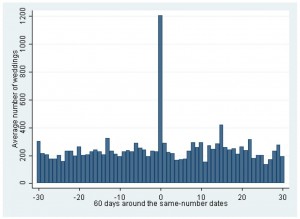
Weddings on Valentine’s Day are incredibly popular. This is also true for dates with the same day/month/year (e.g., 11/11/11 – if you celebrate your fifth anniversary today, you will know) or a sequence like 01/02/03. In the Netherlands, where the study is based, the authors found that of the 1.1 million marriages from 1999 to 2013, on average, twice as many weddings occurred on Valentine’s Day than on any of the surrounding dates in the month before and after. At least four times as many weddings occurred on the average “same-number date” than on most of the surrounding dates.

Average daily number of weddings in the 60-day interval around same-number dates

Unfortunately, weddings starting on such special days are also much more likely to end in divorce compared to weddings on ordinary dates. By their ninth anniversaries, 21% of Valentine’s Day marriages and 19% of same-number-date marriages had ended, while only 16% of ordinary date marriages had failed.

Why does the wedding day play such a big role?

“Putting superstition and numerology aside, it is hard to pin a causal explanation on the wedding date itself. Skeptics might go farther to argue that dates shouldn’t matter at all,” Kabátek and Ribar state in their study. Still, the authors suggest that the choice of a wedding day can give clues about the commitments of a couple. Choosing a wedding day based on outside factors potentially indicates a lower commitment to the marriage’s relationship than choices shaped by attributes of the couple itself. These choices, therefore, may indirectly reveal information on the expected quality of relationships.

Furthermore, the researchers find that couples who marry on special dates are less alike than couples who marry on ordinary dates. They also have other vulnerabilities, such as lower levels of schooling. However, statistical analyses that control for these differences still find that divorce risks are higher for couples who marry on special dates. The results are consistent with family relations theories which predict that partnerships that are shaped by external considerations will be more vulnerable than those shaped by internal characteristics of the couples and the quality of their relationships.

Image source: pixabay

Filed Under: Research Tagged With: date, divorce, family, marriage, Netherlands, partnership, wedding

Will robots take over? How automation changes the world of work

November 8, 2016 by admin

Technological change has advanced digitalization and automation in a number of industries, raising fears that human workers will eventually become redundant. Recent studies predict that almost half of existing jobs are at risk of becoming extinct due to this process. But how grim are the prospects really for human workers? Hilmar Schneider discussed this topic in the recent edition of “Made In Germany,” a business program of Deutsche Welle TV.

Schneider pointed out that this pessimistic outlook is based on gross figures. It’s easy to see what gets destroyed by new technologies, but it’s hard to see the jobs that emerge, he said. “Imagine in 1995, when the Internet was starting up, someone having to predict what type of jobs would emerge within the next five years. No one would have been able to do that.” What we have learned from technological change in the past is that “people became wealthier, jobs became easier, and work did not disappear – it just changed.”

While low-skilled workers who perform primarily mechanical tasks can be replaced by robots, and computers can be used for anything that can be “coded,” humans remain superior to machines in all areas related to creativity and social interaction. “This is something that machines up to now – and probably also in the next couple of decades – will not be able to do,” predicted Schneider.

Watch the video:

Filed Under: Opinion, Research, Videos Tagged With: automation, digitalization, future work, machines, robots, technology

Terrorism, hurricanes, economic crises: Learning through exogenous shocks

November 7, 2016 by admin

Economists seem to have a conspicuous interest in unexpected, far-reaching or even catastrophic events. In most cases, though, this interest does not reflect a tendency for cruel fascination and sensationalism, but stems from the academic desire to uncover meaningful causal effects of x on y.

To estimate causal relationships between two variables, in other words, whether one variable is dependent on the other, researchers have the need for what is known as exogenous variation: a change in a causing factor that can be precisely measured, that is out of the control of the subject affected by the change, and that cannot be anticipated. The discipline of economics has put increasing emphasis on the need for such exogenous variation in analyzing economic interactions to move from describing mere correlations to the provision of causal estimates. Most economists strongly believe that only the latter can offer meaningful advice for policy design.

Three recent IZA discussion papers highlight how exogenous shocks, which are drastic in their consequences, offer opportunities as “natural experiments” for carefully designed empirical strategies to analyze dynamics of human capital accumulation.

Terrorism’s impact on enrollment rates smaller than portrayed

Terror and conflict have serious adverse effects on children’s educational attainment. Next to the negative effects on the overall level of education, conflicts may have additional implications for the gender-based education gap. It is widely known that extremist Islamist groups in Afghanistan, Pakistan, and elsewhere have sought to remove females from public life. In IZA Discussion Paper No. 10168, Sarah Khan (University of Goettingen) and Andrew J. Seltzer (Royal Holloway, University of London & IZA) address such an impact of an unexpected terror campaign by the Pakistani Taliban in the north-western province of Khyber Pukhtoonkhwa which aimed at removing girls from school from the age of 10.

Using data from the Pakistan Social and Living Standards Measurement and the Global Terrorism Database, the researchers show that low levels of exposure to terrorism, which consisted of attacks on schools and threatening teachers and students, had a smaller effect on school enrollment than was thought. High levels of exposure reduced the enrollment rate for boys by about 5.5 percent and girls by about 10.5 percent. This impact on enrollment, although strongly significant, still indicates that a large portion of students continued to pursue schooling, making the decline far smaller than has commonly been portrayed in the media. Finally, although the Taliban pushed for students to enroll in religious schools (madrassas) rather than secular schools, the researchers found no evidence for and increased enrollment in such schools in the affected regions.

Hurricanes affect student performance mainly in technical subjects

A different source of shock to education comes from natural disasters, such as storms, which create problems like impassable roads, limited transportation, or damage to school infrastructure that could limit student attendance. But does the reduced attendance automatically deteriorate student performance? And are all subjects equally affected?

IZA DP No. 10169 by Nekeisha Spencer (University of the West Indies), Solomon Polachek (Binghamton University & IZA), and Eric Strobl (Aix-Marseille University) sought to answer these questions by analyzing over 800 schools in thirteen Caribbean countries between 1993 and 2010.

The results show that less time spent in the classroom does not always affect learning outcomes. For the more technical and lab-oriented subjects – Biology, Chemistry and Physics — the results show a negative and statistically significant relationship between hurricanes and test scores. For subjects in the humanities – French, Spanish and Geography — hurricanes had no impact on standardized exam performance. This does not imply that students can pass humanities exams without attending school but that students can perform satisfactorily in these subjects even with a reduction in school days.

High unemployment pushes high schoolers into further education

Besides sudden and drastic events like terror campaigns and hurricanes, a third type of exogenous shock can be induced by economic fluctuations. Economic crises display the requirements for exogenous shocks: they are not anticipated, are usually out of individual control and arguably affect individual economic decisions.

Experiences with previous economic downturns have shown that during periods of poor economic conditions, the demand for education increases. While this counter-cyclical phenomenon is well-documented, less is known about the types of individuals who are impacted by weaker labor market prospects.

IZA DP No. 10167 by Ernest Boffy-Ramirez (University of Colorado Denver & IZA) examines how higher unemployment rates before high school graduation impact subsequent educational attainment measured 30 years later. Using data from the 1979 US National Longitudinal Survey of Youth, Boffy-Ramirez identifies individuals who are on the boundary between pursuing and not pursuing additional education. For these individuals, exposure to a higher unemployment rate at age 17 is strongly associated with higher educational attainment, pushing individuals into continuing their studies to elude bad labor market conditions.

Image Source: pixabay

Filed Under: Research Tagged With: downturn, economic crisis, education, enrollment, exogenous shocks, hurricane, shock, student performance, terrorism

Reality (TV) Check: The Value of Replication Studies

October 26, 2016 by admin

When you ask an applied economist what distinguishes economics from other social sciences, the likely answer will include economists’ use of rigorous quantitative methodologies lent from the natural sciences – where empirical strategies are judged against a gold standard of randomized experimental designs.
Despite this methodical application of research criteria that are not always easy to implement in the analysis of social interactions, economists put far less emphasis on a related scientific practice that is standard in other disciplines like medicine or psychology: the replication of earlier results. This appears especially worrisome with respect to the strong influence of economic findings on policy making. Many reasons for the lack of interest in replication studies can be traced to the lack of career incentives to do so, e.g., through the unwillingness of editors to publish research on the (lack of) replicability of previous results.

A noteworthy exception has now been undertaken by researchers David A. Jaeger (CUNY Graduate Center, U Cologne, IZA, NBER), Ted Joyce (Baruch College, CUNY Graduate Center, NBER) and Robert Kaestner (UC Riverside, NBER) and can be accessed as IZA Discussion Paper No. 10317.

The authors address a recent article in the American Economic Review (a flagship journal of the economic profession) that had been published after a seemingly thorough peer-review process in 2015. In the paper, “Media Influences on Social Outcomes: The Impact of MTV’s 16 and Pregnant on Teen Childbearing”, researchers Melissa Kearney and Philip Levine conclude on the basis of their statistical analysis that the MTV reality shows 16 and Pregnant, Teen Mom, and Teen Mom 2 caused a 4.3 percent drop in teen birth rates between July 2009 and December 2010 by dramatizing the challenges of pregnancy and child rearing. The paper garnered immediate and widespread media attention in print and on TV.

Despite this influence on public debate and the apparent high quality of the publication (signaled through the AER’s reputation), Jaeger, Joyce and Kaestner now conclude from a reassessment of Kearney and Levine’s results and research design that causal conclusions about the impact of 16 and Pregnant on teen births are unwarranted.

The original approach utilizes the fact that the attributes of MTV’s viewership prior to the beginning of 16 and Pregnant broadcasting in June 2009 had been heterogeneous across US regions (designated market areas or DMAs). This would allow the researchers to uncover differences in the intensity of the impact of the reality show.

Birthrates were already declining in some regions

Jaeger, Joyce, and Kaestner argue that because 16 and Pregnant began broadcasting everywhere in the U.S. at the same time, there is no clear way to identify teens who were not exposed to the show; in other words, there was no group that could serve as a comparison group. Such “control” groups are critical for eliminating the possibility that other changes might have affected outcomes in addition to or instead of the availability of television or the specific programming.

The authors of the rebuttal argue that other unobserved factors that coincidentally happened in the same time window as the broadcasting of 16 and Pregnant – such as locally deteriorating labor market conditions after the beginning of the Great Recession – could have also influenced the outcomes found in the original study.

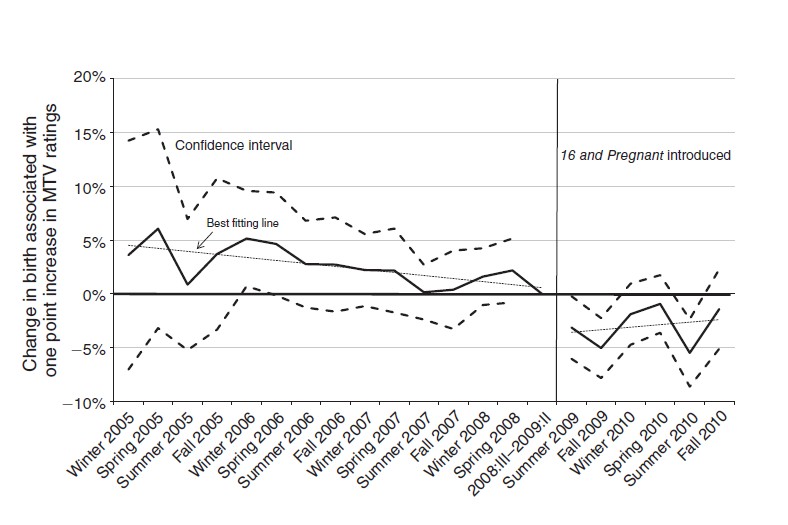
Figure 5 in Kearney and Levine (2015)

If this claim is valid, then the question arises: Are the regions in which MTV was watched more frequently by young people prior to the beginning of 16 and Pregnant different from regions in which they watched much less MTV? And if so, could teen birthrates have already been falling faster in the regions with high MTV viewership relative to regions with low MTV viewership before the release of 16 and Pregnant?

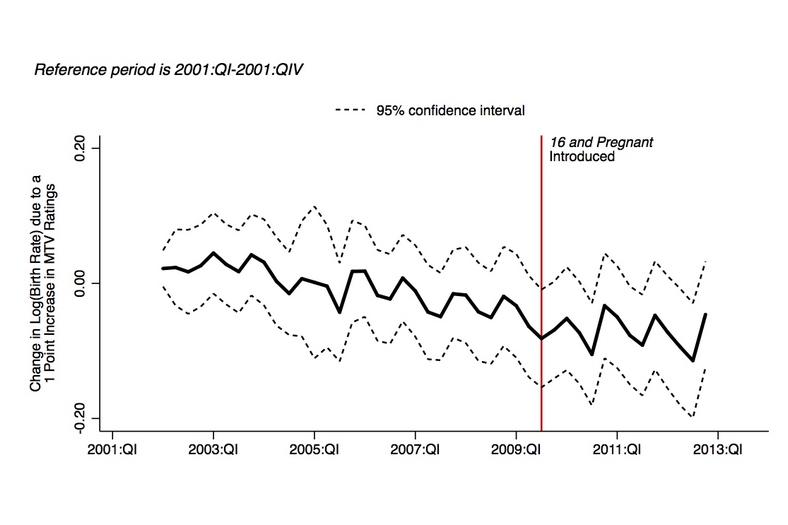
Figure 4 in Jaeger, Joyce and Kaestner (2016)

To answer whether these regions were in fact different, the authors begin by replicating the exact same statistical methodology as the original study but extend the observation window by several years. Extending the time window by 3 years indicates a noticeable downward trend in birth rates even before the broadcasting of 16 and Pregnant, which according to Jaeger, Joyce and Kaestner, invalidates the original research design. In addition, they find little evidence of a discontinuity at the point when 16 and Pregnant was released (click figures to enlarge).

Artificially changing the broadcast dates challenges show’s effect

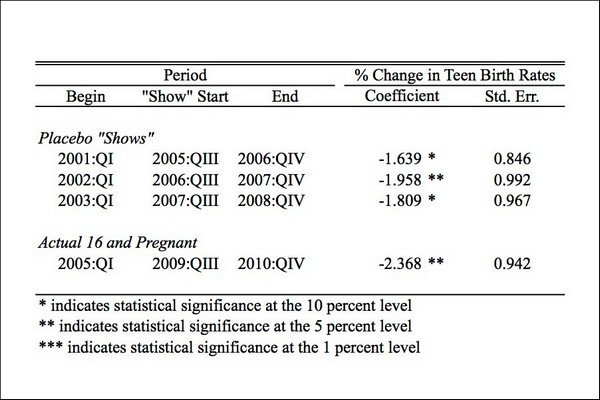
Similar to clinical studies, the authors use what is known as a placebo test to demonstrate their findings. If 16 and Pregnant actually reduced teen births, no effect should appear when the original analysis is replicated with the “broadcasting” of 16 and Pregnant being artificially assigned to placebo periods prior the actual premier in 2009. When changing the release date to 2005, 2006, and 2007, the placebo tests confirm that pre-trends in regions with high MTV viewership indeed have confounded the original results. Regardless of the chosen fictitious broadcasting, significant negative effects on fertility appear where none should be (see table below).

Excerpted from Table 1 in Jaeger, Joyce and Kaestner (2016)

What are the lessons from this reassessment? Most importantly, Jaeger, Joyce and Kaestner’s revisiting of the original results adds to the growing evidence in economics and other social sciences that replication is important and necessary. Without this replication, the problems in the original analysis would not have come to light, and there would be no opportunity to correct the record on the effect of reality television on teen reproductive activity.

Beyond the purely scientific correction, because the original study also attracted extensive media coverage, policymakers may believe that “nudges” like those represented by 16 and Pregnant are effective when, at least in this case, no causal link has been proven. Getting the answer right, which depends on both revisiting the analysis with the original data and replications of the “experiment” in different contexts, should have a higher priority in economics and social sciences journals.

Update (Nov. 2, 2016): Kearney/Levine have posted a response (IZA DP No. 10318).

Providing incentives for replications

The rebuttal by Jaeger, Joyce and Kaestner highlights the important role replications play in building a robust base of empirical evidence. A previous IZA Newsroom post discussed the lack of replications as a classical “tragedy of the commons”: There is wide agreement that replications are useful, but most people count on others to conduct them. New incentives, e.g., through better publication possibilities or specific funding supporting this type of research, have to be provided to raise the intrinsic value of replications, especially for early career researchers.

Filed Under: Research Tagged With: 16 and Pregnant, American Economic Review, MTV, replication, teenage pregnancy

Increase in imports adversely affects provision of public services across U.S. localities

October 19, 2016 by admin

Recent research suggests that workers living in places with a heavy manufacturing presence in the U.S. have experienced both a decline in wages and a deterioration of employment prospects due to increased imports from China. While social assistance and trade adjustment programs at the federal level did kick in, they did not make up for the adverse labor market outcomes in these areas. As a result, workers in the manufacturing sector, but also in non-manufacturing sectors which do not face direct competition from China, have experienced a decline in incomes.

Local governments may play an important role in this context both by mitigating risk through welfare spending and by investing in public services, such as high quality education and infrastructure, to ensure the competitiveness of workers and firms. The problem is that funding for these public services is highly localized in the U.S., with a heavy reliance on property and sales tax revenues. Therefore, a decline in the level of local economic activity and incomes in an area’s labor market depresses revenues and restricts the ability of local governments to fund services, precisely at a time when these expenditures may be needed the most.

To what extent are the local governments in the U.S. able to smooth out such trade-induced income shocks? A recent IZA paper by Johns Hopkins University researchers Leo Feler and Mine Z. Senses addresses this question by analyzing the effect of trade-induced income shocks on local government finances and the provision of local public services in the U.S. Their findings suggest that the adverse effects of trade on workers in the hardest hit localities extend beyond the labor market to include deteriorating public services – relatively lower local spending on public housing, welfare and public transport, higher crime rates in the communities and lower quality schools for children.

Hardest hit areas show relative declines in government spending

The paper documents that between 1990 and 2007, localities that experienced a relative decline in employment and incomes due to higher exposure to Chinese imports have also experienced a relative decline in business activity and house prices. The resulting decrease in local government revenues, mainly due to declining property and sales tax receipts, has translated into a decline in local government expenditures on almost all major budget items.

Specifically, a $1000 increase in Chinese imports per worker (equivalent to the difference between the top and bottom quartile localities in terms of exposure) resulted in a relative decline in per capita expenditures on public welfare by 7.7%, on public transport by 2.4%, on public housing by 6.8%, and on public education by 0.9%; public safety spending remained unchanged.

Federalist system could smooth shocks through transfers

A decline in locally generated revenues results in a proportional decline in expenditures unless intergovernmental transfers compensate for the revenue loss. Within a federalist system like the U.S., it is possible that the state and/or the federal government could help equalize local per capita expenditures and public goods provision across localities through intergovernmental transfers.

The findings of the paper suggest, however, that state and federal governments have limited ability to smooth local shocks. Moreover, the state intergovernmental transfers can function as a mechanism to smooth local outcomes only when localities and the remaining areas of a state face different economic shocks. When both the locality and the remaining areas of a state experience negative economic shocks, or in other words, when shocks at the locality and the rest of state are highly correlated, then the negative effects on local revenues, expenditures, and outcomes can become compounded.

Local resources drying up exactly when public services are needed most

Precisely at a time when local resources for public services were declining or remaining constant in trade-affected localities, there was an increase in the demand for local public goods such as education, public safety, and public welfare in these areas. In their study, Feler and Senses document that expenditures on public safety remained constant at a time when local poverty and unemployment rates were rising. Given the documented association between worsening economic outcomes and higher crime rates, the consequence of this funding decision is an increase property crime rates in these areas relative to less exposed localities.

Similarly, a relative decline in education spending coincides with an increase in the demand for education as students respond to a deterioration in employment prospects for low-skilled workers by remaining in school longer. The result is a deterioration of public schools in trade-exposed localities.

Furthermore, expenditure cuts on public services, especially those that disproportionately benefit low-income households such as public welfare, public housing, and public transport, at a time when the poverty rate in these localities is increasing are also likely to result in deterioration of public services in these localities.

Deterioration of public services exacerbate the negative income shock

Improving the response of local governments and their ability to provide local services and amenities will help mitigate or further amplify the effects of the initial negative economic shock on the locality. The areas that experience a decline in incomes may have greater difficulty in recovering from these shocks if they fail to provide high quality public services. Given an array of policies that makes it more difficult for workers, especially low-skilled workers, to migrate to more economically vibrant areas, the consequence would be greater disparity both in incomes and in the quality of essential public services across the U.S.

In tracing out how trade and income shocks can ultimately affect local public services, the results of this study constitute an important input to the design of welfare enhancing government policies to either equalize opportunities or reduce barriers to migration across localities.

Image source: pixabay

Filed Under: Research Tagged With: crime, imports, income shocks, infrastructure, public services, trade, U.S. localities, welfare

Can European integration increase people’s life satisfaction?

October 18, 2016 by admin

by Milena Nikolova and Boris Nikolaev

The United Kingdoms’s decision to leave the European Union, or the so-called Brexit, poses important questions for the rest of Europe. Fears of a chain reaction and a contagion of “exits” have flooded public debates. Amidst the flurry of confusion and uncertainty, a relevant question that experts and ordinary people ask is whether EU membership has brought any tangible benefits. Nauro Campos and co-authors have offered one answer: Every country except Greece gained from EU membership and the average EU member is 12 percent richer in terms of per capita income due to joining the EU (this excludes the 2007 and 2013 enlargements).
In a novel paper, we offer an alternative way of measuring the benefits of European integration based on the new science of well-being measurement. The advantage of this approach is its simplicity: relying on people’s own judgment about how satisfied they are with their lives aggregates their experiences in a way that reflects their own preferences. We focus on Bulgaria and Romania, which joined the EU on January 1, 2007. These two countries are the EU’s poorest and among the least happy and most corrupt members. For example, in 2014, the purchasing-power-parity-adjusted GDP per capita of Bulgaria and Romania was about 42 percent of that in the advanced EU members (EU-15), while life satisfaction was about 76 percent of the average EU-15 level.

Comparing countries with different EU accession dates

Using Eurobarometer data, we compare the before-and-after life satisfaction scores of individuals in Bulgaria and Romania with those of Croatians. Why Croatians? The important point for our analysis is that during the study period (2006-2008), Croatia was on a membership path but joined the EU later than Bulgaria and Romania did. In this way, Croatia demonstrates what would have happened to life satisfaction in Bulgaria and Romania if the two countries had not joined the EU. Croatia is a good comparison as it is geographically similar, is also a former socialist country, and experienced similar macroeconomic and institutional developments as Bulgaria and Romania during the analysis period.

Our most important finding is that joining the EU increased life satisfaction in Bulgaria, while the effect in Romania was positive but not significant in the statistical sense. One explanation is that trust in the EU only increased in Bulgaria after joining. In addition, Romania experienced political turmoil only a few months after joining, which may have canceled out the positive consequences of EU membership.

Implications for EU membership candidates

Yet, the analysis also reveals that life satisfaction increased in Romania in the first two quarters of 2008, after the political war subsided. In both countries, the positive life satisfaction effects of EU membership were felt some months after joining, likely because Bulgarians and Romanians required time to start “feeling” European. We also show that the young, employed, and those with high-school education and some college experience were most successful in integrating into the EU.

These results are important not only for countries evaluating whether they should stay in the EU but also for those preparing for EU accession. With the exception of Turkey, the next nation states waiting to join—Albania, former Yugoslav Republic of Macedonia, Montenegro, Serbia, Kosovo, and Bosnia and Herzegovina—have similar historical and politico-economic backgrounds to Bulgaria and Romania. Our findings can thus guide the expectations of policymakers in these countries about the well-being consequences of EU membership.

Cultural integration is a complex process

Importantly, our results imply that the EU-related life satisfaction boost may be a short-run phenomenon. Joining the EU by itself is not a silver bullet and cannot close the quality of life gap between the new and old EU members. Furthermore, although becoming a EU citizen in the legal sense can happen overnight, cultural integration is a complex process that entails both positive and negative experiences with a period of adjustment and adaptation. While our study shows that EU membership could raise the life satisfaction in new member countries in the short run, joining the EU is by no means a substitute for social transformation and national reforms targeted at improving the governance and quality of life.

+++

This is a slightly edited version of an article that originally appeared on the Brookings Institution’s Up Front blog. Reposted with kind permission.

Image source: pixabay

Filed Under: Research Tagged With: Bulgaria, Croatia, EU, EU accession, EU membership, Eurobarometer, European integration, European Union, life satisfaction, Romania, satisfaction

Immigrants’ enclaves – stepping stones or stumbling blocks for integration?

September 29, 2016 by admin

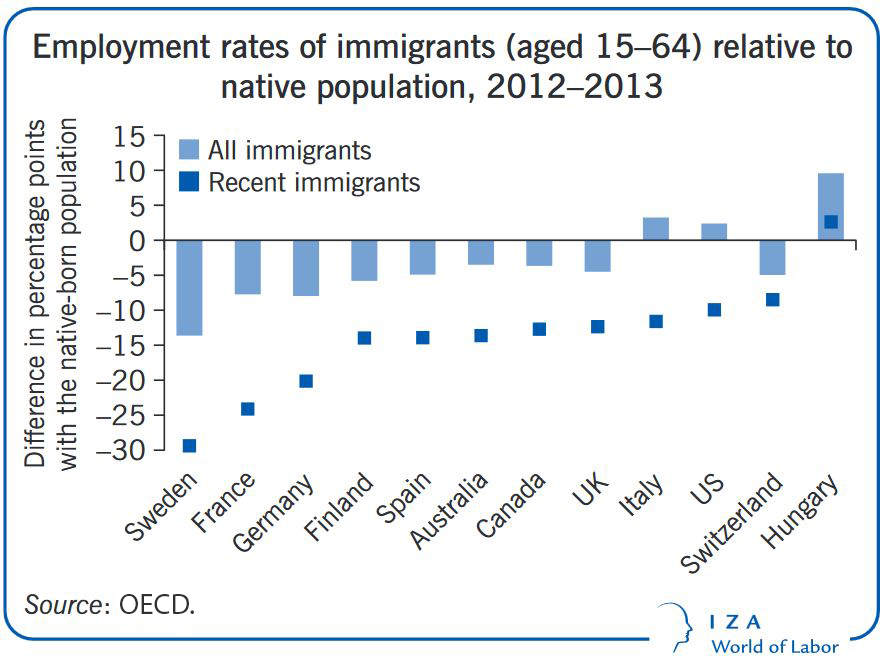
Immigrants typically do not settle evenly across the countries in which they move. Rather, they tend to cluster in particular neighborhoods. In public discourse these ethnic enclaves are often seen as an inhibitor to societal and labor market integration. Statistics show that employment rates of immigrants are lower than those of natives in most countries that receive immigrants (see graph below).

But does clustering in ethnic enclaves actually help explain the persistent differences in employment rates and earnings between immigrants and the native population?
An IZA World of Labor article by Simone Schüller (Ifo Institute, FBK-IRVAPP, and IZA) scrutinizes existing studies on the topic and provides advice for immigration policies that make use of the potential of these neighborhoods on immigrants’ economic integration.

The true effects of ethnic enclaves on immigrants’ labor market outcomes are far from obvious. On the one hand, immigrants can profit from living in an enclave. Social networks within the community can provide immigrants with valuable information about job opportunities and provide shelter from discrimination, both of which could be conducive to labor market success.

At the same time, ethnic enclaves might hamper immigrants’ economic assimilation into broader society. An enclave economy can only offer a limited number of jobs, usually with below-average wages. Enclaves might also become “mobility traps” in the long term by reducing the incentives for immigrants to acquire important skills necessary in the host country, especially language skills.

“Low quality enclaves” can reduce employment chances of immigrants

Schüller’s article shows that immigrants can benefit from living in an ethnic enclave if the other immigrants living in the neighborhood are well-educated, work in well-paid jobs, and if the employment rate in the community is high. On the contrary, low levels of employment and education might significantly harm labor market outcomes for immigrants. Hence, labor market integration could improve if newly-arriving economic migrants, refugees, and asylum-seekers settle in neighborhoods with relatively high average education levels and relatively high employment rates among the co-ethnic population.

Possible policies might include a targeted geographical allocation of incoming refugees and asylum-seekers across areas according to socio-economic characteristics, such as education levels and employment rates of the resident ethnic populations. With respect to labor migrants, policy makers should opt for measures that encourage and incentivize especially the low-skilled immigrants to settle in regions with relatively high employment rates and education levels among co-nationals.

Policies should discourage socioeconomic segregation

Overall, enclave quality (measured in terms of levels of income, standards of education, and rates of employment) is more important than enclave size for driving economic success. Therefore, Schüller advises policy makers to focus less on avoiding ethnic “ghettoization” per se, but instead aim to discourage socioeconomic residential segregation and implement housing policies that promote mixed residential areas in terms of high- and low-skilled workers.

Filed Under: Research Tagged With: ethnic enclaves, immigration policy, integration, migration, refugees, segregation

  • Previous Page
  • Page 1
  • …
  • Page 8
  • Page 9
  • Page 10
  • Page 11
  • Page 12
  • …
  • Page 45
  • Next Page

Primary Sidebar

© 2013–2025 Deutsche Post STIFTUNGImprint | Privacy PolicyIZA