• Skip to primary navigation
  • Skip to content
  • Skip to primary sidebar

IZA Newsroom

IZA – Institute of Labor Economics

  • Home
  • Archive
  • Press Lounge
  • DE
  • EN

admin

Now over 10,000 papers in the IZA DP series!

June 27, 2016 by admin

Established in 1998, starting with 100 papers in the first two years, the IZA Discussion Paper series now includes more than 10,000 working papers authored by IZA researchers and network members. On average, a new IZA DP goes online every ten hours. Covering a wide range of topics in labor economics and related fields, our papers are freely available online through the IZA website and various online databases. About two-thirds of the papers have meanwhile been published in refereed journals and volumes. Click on the image for more facts&figures!

From the CEO…

“The IZA discussion paper series has had an enormous impact on establishing IZA’s reputation as a top-level research institution in labor economics – and it will continue to play a key role. Providing an efficient platform for researchers to disseminate their work at an early stage, the IZA discussion papers stimulate constructive feedback from peers. They serve as an invaluable device of scientific quality control, and I dare say this series has its own merits in shaping labor economics as an important sub-discipline within economics.”
— Hilmar Schneider (CEO of IZA)

Or as the IZA network coordinator puts it…

“The first IZA Discussion Paper appeared in April 1998. While not there yet, the IZA Discussion Paper series is now much nearer to being, “… as the stars of the heaven, and as the sand which is upon the seashore….” [Genesis 22:17] And like the stars of the heaven, the Discussion Papers have illuminated very wide areas. They are central to the lives of professional economists, experts on labor and increasingly journalists and policy makers, and are a testimony to the usefulness of the IZA Network of scholars and experts.”
— Daniel S. Hamermesh (Chief Coordinator of the IZA Network)

Here’s what our fellows say…

“Throughout its history, the IZA Discussion Paper series has been a major outlet for new research in labor economics and related fields such as family economics, demographic economics and the methodology that supports serious empirical research. It provides an opportunity for very diverse scholars and methodologies to share ideas, to take fresh approaches to old problems and to pose new problems free of the threat of censoring, publication bias, or club membership bias. The series deserves the highest praise for disseminating a variety of good ideas and path-breaking analyses, and helping make economics an open and vigorous field.”
— James J. Heckman (University of Chicago), 84 IZA DPs

“Over the years the IZA Discussion Paper series has been an invaluable resource for labour economists worldwide, and many papers have subsequently appeared in the economics profession’s leading academic journals. To me, they have proven to be a great outlet both for my own work and for getting early previews of cutting edge research being undertaken in labour economics.”
— Stephen Machin (University College London & LSE)

“The IZA Discussion Paper series has been instrumental in ensuring that my work always has the greatest visibility among the world’s best economists. Over time, the stock of knowledge contained in this series has become quite extraordinary. It’s an invaluable resource when reviewing what is happening not only in labor economics research, but in economics research more generally.”
— Deborah A. Cobb-Clark (University of Sydney)

“The IZA DP series is an ever growing ocean of knowledge about labor economics issues. The series is interesting for students who want to learn about state of the art research. The series is also interesting for experienced researchers who want to remain up-to-date with the research output of colleagues. Contributing to the series means that your work will be read and cited. I think the IZA DP series is an asset for the research community in support for the advancement of science.”
— Jan C. van Ours (Tilburg University)

“The IZA DP series is both a prompt and permanent way to disseminate your research outcomes. It is prompt since your fresh research results can be immediately transmitted to the relevant scientific community within a few weeks; it is permanent since IZA DPs are so well diffused and reputed globally that they keep on being read and downloaded for years, sometimes more read and cited than regular journal articles.”
— Marco Vivarelli (Università Cattolica del Sacro Cuore – Milano),
co-author of the all-time top downloaded IZA DP

What the 10,000th IZA DP is all about…

IZA DP No. 10000 by Rasmus Landersø and James J. Heckman compares intergenerational social mobility in Denmark and the US. Denmark has a far more generous welfare state than the US. In terms of after tax and transfer income, Denmark has far greater intergenerational mobility. In terms of education, differences are especially strong at the top of the income distribution. Denmark and the US are equally mobile.

The generous welfare state of Denmark with its free education and universal childcare improves the cognitive test scores of comparably disadvantaged children. However, it weakens the incentives of those children to acquire schooling. These impaired incentives joined with the sorting of advantaged and disadvantages families into neighborhoods and schools explain the near parity in educational mobility across the two societies.

Stay informed…

More than 4,000 subscribers receive e-mail alerts with new papers 2-3 times a week. For better structuring and readability, new papers are sent out in batches of 4-5 papers each, grouped by similar topics.

To receive e-mail alerts announcing new IZA Discussion Papers, subscribe here.

Filed Under: IZA News, Research Tagged With: labor economics, publications, research

Promoting replications in social science to overcome the tragedy of the (research) commons

June 22, 2016 by admin

Although empirical economics often claims to provide rigorous estimates of behavioral parameters which must be judged against a gold standard of experimental evidence, a key feature of this method is typically neglected—the role of replications in assessing the reliability of estimates and, importantly, detecting fraudulent and erroneous research.

Given the large impact of economic research on policy-making, errors or fraud can have far-reaching consequences. An infamous recent example is the study “Growth in a Time of Debt” by Harvard economists Carmen Reinhart and Ken Rogoff. Invoked to justify strict austerity as a way to stimulate economic growth in the U.S. Republicans’ budget proposals, their results were shown to be driven by a simple mistake in Excel.

Making replications mandatory in curricula would be useful

German researchers tend to agree with the notion that replication studies are important and worthwhile. Nonetheless, as yet they have not been willing to devote significant time to conduct such studies, often due to the low chances of publication. This is one of the key findings from a survey among 300 German researchers from various disciplines conducted by economists Benedikt Fecher (DIW), Mathis Fräßdorf (DIW) and Gert G. Wagner (DIW & IZA), which was recently published as IZA Discussion Paper No. 9896.

The authors characterize this situation as a typical “tragedy of the commons:” Every researcher knows that replications are useful, but most people count on others to conduct them. If replications are done at all, they are typically only used for teaching purposes and doctoral theses. This situation points to the need for providing new incentives for these types of studies to increase their attractiveness for researchers, e.g., through better publication possibilities or specific funding supporting this type of research.

Research parasites are beneficial for the organism as a whole

Replications in general depend on the availability of data from the original works. The view that data should be universally available for this purpose is not undisputed though. In a second contribution, which appeared as IZA DP No. 9895, Wagner and Fecher point to a recent discussion in medical science about “research parasites,” or researchers who primarily work with secondary data instead of engaging in original data collection.

Against this background, the authors highlight the need for new instruments of credit that allow researchers who engage in original data collection to boost their reputation status if their work is used in secondary analyses. A culture of citation of data sets, bestowing awards for the best data sets and data collection, is proving to develop as an important and prominent factor in the overall assessment of scientific research standards.

IZA’s CEO Hilmar Schneider underscores these arguments, explaining:

H. Schneider

Up to now, the effort put into doing a replication has been rewarded unequally. While the chances of getting a replication published which uncovers serious errors in a previous study are quite high, the chances for a replication which simply reproduces existing findings are close to zero. Therefore, researchers doing replications are facing a substantial risk of wasting their time, which has the consequence of effectively preventing scientific quality control. It’s high time to give equal credit to any replication, no matter whether it falsifies or reproduces existing find

Image Source: pixabay

Filed Under: Research Tagged With: data, empirical research, errors, fraud, publications, reliability, replications, research parasites

Automatic stabilizers: shock absorber or incentive killer?

June 21, 2016 by admin

The Great Recession has revived aggregate demand management policies. In particular, “automatic stabilizers” are praised since they are rule-based and thus operate swiftly and symmetrically across the cycle. The idea is to temper the economy when it overheats and provide economic stimulus when the economy slumps, without direct intervention by policymakers.

Automatic stabilizers work through the tax and transfer system: If the economy is slowing down, with unemployment and short time work rising, an increasing number of households will be eligible for welfare instruments and income tax cuts. This opens the door for active fiscal policies using increases in benefits and tax reductions on a discretionary basis, thereby absorbing some of the negative effects of recessions on aggregate demand.

What sounds simple has been unpopular since the 1970s when experiments with such aggregate demand management policies led to dismal experiences. Instead, governments implemented structural labor market reforms, following advice to cut high participation taxes and unemployment benefits to increase work incentives in boom times.

Strengthening stabilizers without harming incentives

As the size of participation taxes (earnings and income taxes) is key for a functioning automatic stabilizer, a new article recently published in the IZA Journal of European Labor Studies by Torben M. Andersen (University of Aarhus and IZA) analyzes the interplay between stabilizers and labor market reforms and whether stabilizers have been unintentionally weakened through these reforms.

Andersen points to the fact that ultimately labor market reforms aiming at strengthening the incentive structure always imply a trade-off between incentives and insurance/redistribution. He argues that advocates propagating automatic stabilizers neglect the increasing difficulty of reallocating workers across jobs. Still, he concludes that it is possible with well targeted labor market policies to strengthen automatic stabilizers without necessarily harming the underlying incentive structure for work and job search.

Monetary union needs automatic stabilizers

In the same issue of the IZA Journal of European Labor Studies, former EU Commissioner for Employment, Social Affairs and Inclusion László Andor (Hertie School of Governance) also picks up the issue of automatic stabilizers against the background of the recent crisis. He warns that without proper automatic stabilizers, a monetary union can only deliver sub-optimal results, and may not even be sustainable.

While propagating a common unemployment insurance with a partial pooling of unemployment benefit schemes as a model with continuous impact and direct connection with the citizens, he acknowledges difficulties in the political feasibility of an EMU reform encompassing more fairly distributed costs and benefits.

Image Source: pixabay

Filed Under: Research Tagged With: aggregate demand management, automatic stabilizers, budget, fiscal policy, Great Recession, labor market, labor market reforms, unemployment

The effect of minimum wages on firm value

June 14, 2016 by admin

Ever since minimum wages were first introduced into labor markets, policy controversies have been fought out over the question of whether minimum wages cause companies to lay off employees and whether they impact on firm performance, for example by decreasing overall company profits. A so far under-researched area, however, has been the effect of the introduction or increase of a minimum wage on a firm’s stock market valuation.

In a new IZA Discussion Paper, Brian Bell (University of Oxford) and Stephen Machin (University College London) fill this gap by studying the impact of an amendment to the minimum wage law that was announced in the UK in July 2015.

Study of an unexpected minimum wage announcement

When the UK Chancellor of the Exchequer revealed the introduction of the National Living Wage (NLW), a change to a band of the National Minimum Wage which significantly increases the minimum rate of pay for workers 25 years and older, political and economic observers were caught completely off guard, especially because the policy change was coming from a newly elected right of center government that has traditionally opposed increasing minimum wages.

The unanticipated nature of the announcement creates a unique advantage for Bell and Machin’s analysis because the sharp reaction of the stock market can be directly linked to the particular moment that the decision was announced. Earlier studies on stock market reactions have been unable to deliver such clear results primarily because the disclosure of changes in the minimum wage was always more gradually introduced to the public and less unexpected.

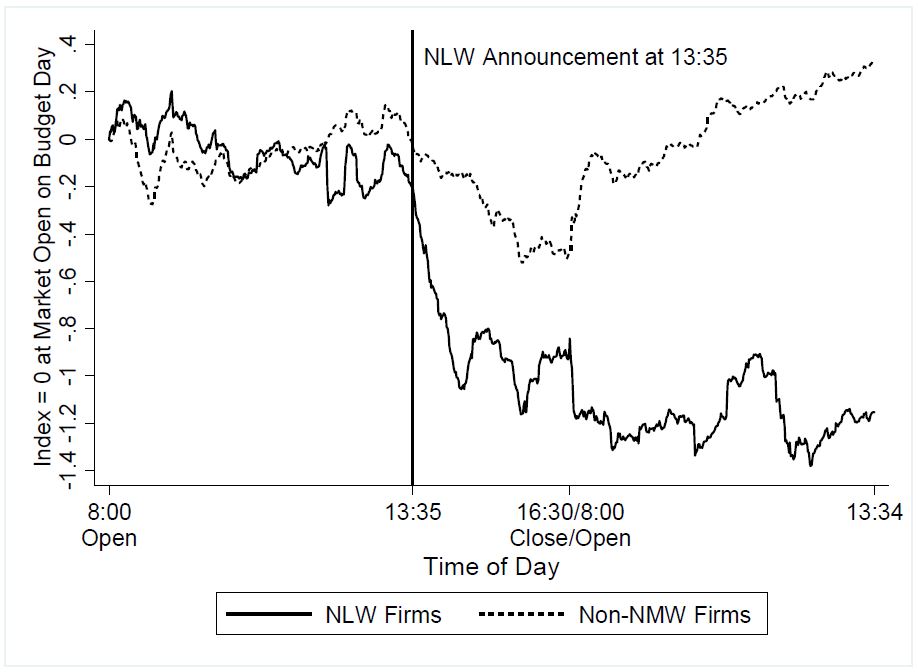
Stock market returns on the day of the minimum wage announcement and 24 hours after (based on 442 FTSE All-Share Index quoted firms, comprising 20 NMW firms and 422 Non-NMW firms). Source: IZA DP No. 9914

To understand how the stock market took the news, Bell and Machin compared the differential responses of lower-wage firms that employ a sizeable share of minimum wage workers (NMW firms), e.g., a retail firm, a pub group or a hospitality firm, with higher wage firms (non-NMW firms) whose employees’ wages are unlikely to be significantly affected by the change.

They looked at both the minute-by-minute changes surrounding the announcement and at cumulative abnormal returns in the days before and after the announcement. As the graph shows, the stock market value of the low wage firms most affected by the NLW introduction decreased significantly after the news had hit the markets, while the stocks of non-NMW companies quickly recovered after the initial shock.

Within a day of the budget speech, firm values were around 1.2 percent lower for the employers of mostly minimum wage labor and ended up stabilizing around 2 to 3 percent lower after five days.

Stock market losses are as high as the cost shock itself

What is interesting about these results is the magnitude of the stock market losses. In total, the decrease in firm value is consistent with the firms taking the entire burden of the additional wage cost as reduced profits in the short-run but over time managing to offset the costs in one way or another. Evidence from reports of the individual firms affected suggest this offset will most likely come via raising prices and improved efficiency. None of the firms affected mention reduced employment as a response.

Thus, the paper by Bell and Machin provides evidence of the damaging short-run effects that minimum wage announcements can have on the stock value of low-wage firms, an insight that previous studies on stock market responses to minimum wages in other settings were unable to provide.

Image Source: pixabay

Filed Under: Research Tagged With: employment, firm value, low-wage firms, minimum wage, National Living Wage, stock market, UK, wage cost

The perfect moment to score a goal? A football myth debunked

June 8, 2016 by admin

It is often thought that a goal just before half-time serves as a morale-booster and will increase a team’s chances of winning. However, a new IZA Discussion Paper by Ghent University researchers Stijn Baert and Simon Amez suggests that the effect may actually work in the opposite direction: If a home team scores just before half-time, it often scores less after half-time and ends up, on average, with a lower goal difference.

Analyzing 1,179 games played in the UEFA Champions League and the UEFA Europe League between September 2008 and May 2014, the authors show that this football myth does not stand up to the data. For a given score at half-time, a goal just before half-time does not have any statistically significant effect on the chances of winning.

“Furthermore, when a home team scores a last goal between the beginning of minute 45 and the end of the first half, instead of any different moment, they see the final goal difference at the end of the game drop, on average, by half a goal”, says Stijn Baert. For an away team the effect of a goal just before half-time on the final goal difference is statistically insignificant.

Decompression, overestimation and wrong decisions

In the search for clarification of these surprising findings, the results were evaluated by national and international sport psychologists. They seemed less surprised. A first possible explanation is that a goal just before half-time leads to what is known as “decompression.” The healthy pressure of the game ebbs away, consciously or unconsciously, and causes a loss of concentration, resulting in less tension, and thus less effort put forward by the players.

This first explanation is corroborated by further findings in the paper. Simon Amez notes, “A home team that scores a goal just before half-time—all other elements kept equal, including the score at half-time—has less chance of scoring another goal after half-time and, specifically, less chance on being the first team to score one.”

A second explanation has to do with a growing confidence and self-awareness that a (home) team can experience when, applauded by the (home) audience, it can go to the dressing rooms with a goal that was just scored. This can lead to overestimation. Furthermore, this higher level of self-awareness can result in more (negative) pressure.

A final explanation is linked to tactical changes that the coach suggests during half-time. The positive emotions after a goal possibly obscure his evaluation of the level of competition between the teams.

A different and less common football myth is that another ideal moment to score is just after half-time. This would hypothetically give a boost to the scoring team, and provide a great confirmation of the strategy made during half-time. Likewise, this myth cannot be backed up by the data. For a given score after 50 minutes in the game, the scoring or not scoring of a goal within five minutes after half-time has no effect on the victory and the goal difference of a team.

Football and economics

Football is big business. In 2015, the English Premier League sold the television rights to its games for the period 2016–2019 for 1.712 billion pounds per year, or 10.190 million pounds per game to be shown live.

But economists are not only interested in financial matters. Researchers also benefit from the excellent development in the availability of data on individual and team performance, which allows them to analyze the factors that actually make the difference between winning and losing. This has important implications for personnel economics, particularly with regard to motivation, teamwork and performance incentives.

Previous IZA papers have shown, for instance, that a red card does not have any effect on the chances of victory and that the replacement of a coach does not necessarily lead to improvement of the team’s performance. Others looked at goal-scoring in the “dying seconds” of international football matches, or the influence of social pressure on football referees. More recently, IZA research found that air pollution has a significant effect on player performance.

Filed Under: Research Tagged With: football, goal, losing, motivation, overestimation, pressure, scoring, self-awareness, soccer, winning

How to promote entrepreneurship

June 3, 2016 by admin

Entrepreneurship has been shown to account for a large share of job creation and to promote innovation and growth. Hence it is no surprise that governments seek to encourage the formation of new businesses and to create favorable circumstances for them to flourish. In doing so, policies must strike the right balance between supporting the newly founded enterprises and keeping them competitive enough to survive in the long term. Several recent IZA articles deal with conditions and strategies that policymakers should bear in mind when promoting the creation of new businesses.

Young firms and creative destruction

In his IZA World of Labor article, Ramana Nanda (Harvard Business School) points out that a sizable proportion of net job creation and productivity growth comes from the continuous process of firm entry and exit, as new, more efficient firms replace existing ones. In this process of “creative destruction,” young firms play an exceptional role. On the one hand, they are responsible for a large share of newly created jobs, but they also account for a substantial portion of job destruction as the result of being more likely to fail. Thus, when governments provide loan subsidies and grants to small businesses, it becomes almost impossible for governments to predict which firms will succeed.

Nanda advises governments not to pick “winners” themselves, but instead to create an enabling environment for entrepreneurs, banks, and investors. High legal protection for investors and entrepreneurs increases the willingness of financial intermediaries to finance upcoming enterprises. Flexible labor markets and uncomplicated business entry regulations have also proven to increase the success rate of start-ups. Moreover, a growing body of research has found that small or decentralized banks have a comparative advantage in evaluating businesses by using so-called “soft” information such as regular personal interaction.

Since most entrepreneurial start-ups have a high risk of failing, providing a strong social safety net can also encourage entrepreneurship and experimentation by buffering the consequences of failure. In addition to measures that facilitate the most efficient allocation of resources, governments can also accelerate the growth of technological firms by playing the important role as a customer of new technologies.

Corporate income taxation as an entry barrier

Using an analysis of worldwide cross-sectional data, the IZA World of Labor article by Jörn Block (Trier University) explores the relationship between corporate income taxes and entrepreneurship and finds that higher corporate income tax rates reduce business density and entrepreneurship entry rates. However, higher corporate tax rates are not only associated with negative effects on entrepreneurship activity. Raising corporate income taxes can also cause an “entry barrier effect,” meaning that only “healthier” firms with more capital will be able to successfully establish themselves in the market. Research findings also suggest that a progressive tax system encourages entry into entrepreneurship, whereas highly complex tax codes have been shown to reduce entry rates.

From a government’s perspective, it is therefore important to understand these effects and the underlying mechanisms when designing legislation on corporate income taxation. For example, with regard to countries that have low-quality accounting standards, Block suggests that lowering taxes to increase entrepreneurship rates should be accompanied by an effort to improve the quality of accounting standards.

High-potential female entrepreneurship

The IZA World of Labor article by Siri Terjesen (Norwegian School of Economics) looks at female entrepreneurs and outlines the conditions for facilitating high-potential female entrepreneurship. While one-third of the world’s entrepreneurs are women, regional participation rates vary substantially. Hence, Terjesen recommends tailoring strategies aimed at promoting female entrepreneurship to each national and regional context. While in Latin America policies should seek to improve the focus on exports, East Asian countries are advised to target the improvement of women’s start-up knowledge and confidence in their start-up skills. Sub-Saharan African countries should aim to improve women’s access to banking and offer more training in financial components.

Access to finance is a general problem for female entrepreneurs, as most businesswomen have lower levels of initial financial capital than their male counterparts. Because capital for female start-ups is more likely to come from informal sources, such as their own savings or loans and gifts from family and friends, governments should improve women’s access to financing through banks, business angels, and venture capital firms. Another policy recommendation is to expand social capital to give women more direct access to entrepreneurial mentors and start-up networks and ensure that women have the same rights as men to work and travel freely.

By creating favorable conditions for high potential female entrepreneurship, governments can boost local and national economic development. Female-led ventures are market-expanding, export oriented and innovative and can also serve as models that encourage other high-potential female entrepreneurs.

Who is born to be an entrepreneur?

The role of personality in entrepreneurship is explored in a recent IZA Discussion Paper by Jutta Viinikainen (University of Jyväskylä) and co-authors. Their paper analyzes whether the so-called Type A behavior traits (aggression, leadership, responsibility, and eagerness-energy) measured among adolescents are predictive for becoming and succeeding as an entrepreneur in adulthood. The results indicate that among the four Type A behavior traits, only the adolescents’ leadership characteristics are relevant for their adult entrepreneurial propensity.

The researchers also reinforce prior evidence finding that having self-employed parents increases the likelihood of becoming an entrepreneur oneself. In addition to providing financial assets or an opportunity to take over the family business, successful self-employed parents may transfer entrepreneurial-specific skills to their children.

Image Source: pixabay

Filed Under: Research Tagged With: business, corporate income taxation, entrepreneur, entrepreneurship, female entrepreneuship, financial system, investment, personality, personality traits, start-up subsidies, start-ups

Against xenophobia and national barriers – in light of the refugee crisis in Europe

May 30, 2016 by admin

European leaders have failed to devise any short-term solutions to address the underlying drivers forcing refugees to flee Africa and the Middle East, pushing some policy makers and sections of the public to press for closing borders and raising fences and walls. Based on evidence presented in a number of IZA World of Labor Articles, managing editor Olga Nottmeyer argues that not only is it a human responsibility to fight this type of xenophobia, but such nationalist/protectionist policies have also been proven impractical and ineffective from an economic point of view.
+++

Whether—and how—to integrate asylum seekers features prominently on the political agenda in so many European countries. And yet, there is no sign of the crisis abating. The situation in Syria, Afghanistan, Iraq and other countries facing conflict, civil war, and terrorism make it impossible to ignore the challenges associated with the mass migration of people from these areas, and their call to Europe for help. Ignoring the crisis is no solution; neither is xenophobic rhetoric or building more fences and tightening border controls.

There is, however, a sensible approach that would certainly help with integrating refugees in the destination countries‘ labor markets. As Kathryn H. Anderson discusses in detail in her IZA World of Labor (WOL) piece, ‘[labor] migrants earn [considerably] less at entry and it takes many years for them to achieve parity of income’. But ‘policies to increase skills, such as language and local training and work experience, seem to be most effective in promoting assimilation’.

Whether minimum wages are a useful tool in this context as well is empirically unclear. As shown by Madeline Zavodny ‘the scarcity of research on the minimum wage and immigrants combined with the contradictory findings of some research limit the conclusions that policymakers can draw about whether […] immigrants benefit (or lose) from the minimum wage’. However, wage subsidy programs seem to be quite promising. As Anderson writes ‘[they give] the employer an incentive to hire workers who do not have local work experience but are bound by high contracted wages at the start of the job.’ Anderson mentions a three step model in which ‘immigrants are enrolled in language courses based on their education. [Then, they] participate in ALMP [active labor market policies] designed to place them in jobs. [And finally,] employers can receive wage subsidies to hire immigrants for a maximum of one year’.

So while refugees’ economic success will crucially depend on their own efforts and ambitions, in the same way it is for immigrants, it also depends to a great extent on the ability and willingness of the society in the destination country to offer support.

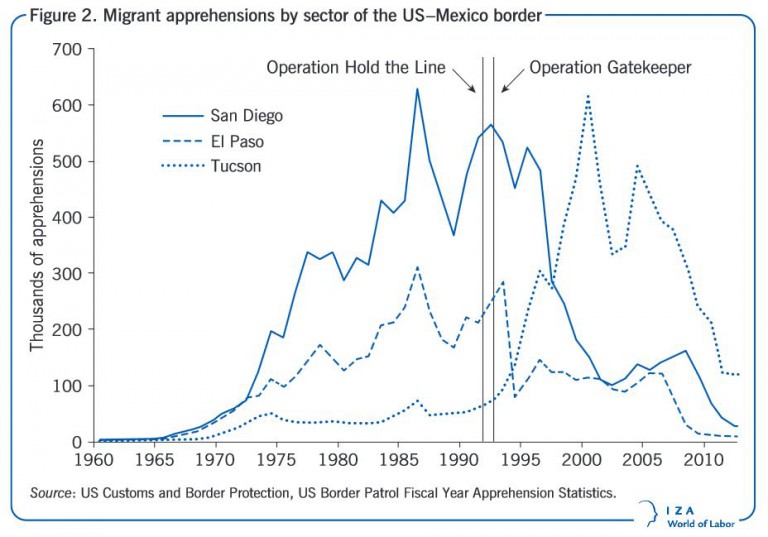
Why does fence building not work? As Pia Orrenius demonstrates impressively in her contribution to IZA World of Labor, ‘intensifying border enforcement leads to […] higher demand for smugglers, riskier crossings and more migrant deaths.’ It will not stop desperate people from coming, but forces them to alter their routes. This happened in the 1990s in the US when border crossings in El Paso and San Diego were impeded and people from Mexico shifted to a different route, via Tucson, to enter the US.

And we see this now when refugees desperately look for legal (or illegal) ways to enter the EU. Increasing the hurdles to gain entry and asylum is not a deterrent in this situation but will merely increase the risks associated with crossing borders, as well as the profits of human traffickers. At the same time, Orrenius writes, ‘[tightening border] enforcement is costly and can divert resources from other law enforcement.’ So in the end stricter border controls and immigration policies will come at high costs, both to the economy and to people’s lives.

So what is the alternative? In his very insightful WOL contribution Jesus Fernandez-Huertas Moraga introduces a combined model of tradable quotas (similar to emission quotas) and matching mechanisms (similar to those used to assign students to their preferred universities) to provide an ’efficient solution which addresses the concerns of the destination countries and protects refugees’ rights.’

This solution takes into account the needs of the refugees and asylum seekers, while addressing the security concerns of the society in the destination country at the same time. Thus, quotas would need to depend on the capacity of destination countries to absorb refugees, e.g. based on ‘GDP, population, unemployment rate, and the number of refugees resettled and asylum applications received during the previous five years’.

Of course, this does not mean treating refugees like widgets. On the contrary, as Alvin Roth says: ‘Refugees are not widgets to be distributed or warehoused. They are people trying to make choices in their best interest.’
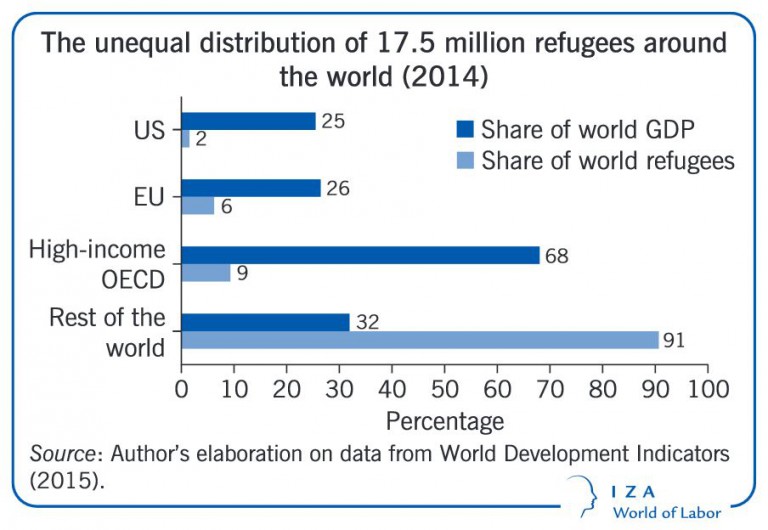
In 2014, the high-income OECD countries gave shelter to less than 10% of the world’s 17.5 million refugees, while the rest of the world (with only 32% of global GDP) took care of 91% of the world’s refugees. This unbalanced distribution simply cannot be the best and only solution. Instead, better coordination is imperative to guarantee ‘greater responsibility sharing and a fairer distribution of refugees across the globe.’

It is thus long overdue for the harmonization of asylum policies to be at the forefront of the European agenda. As explained by Tim Hatton in his impartial analysis of the current European asylum system, international cooperation can be beneficial to both refugees and the population in the destination country if the policies are appropriate. Again, this includes a fair allocation of refugees, skills training tailored to the needs of refugees and of potential employers, sufficient supply of language courses to increase chances to find employment and refugees’ commitment and effort to integrate.

The bottom line is that closing borders and intensifying enforcement does not and cannot solve the problem. Only the combined efforts of all parties —countries of origin, destination countries, the refugees themselves—and international collaboration can pave the way towards a long-term solution and successful economic integration. It is our human responsibility to fight against xenophobia and national barriers, and to create a more inclusive, welcoming society for all.

+++

Olga Nottmeyer is Managing Editor of IZA World of Labor. This article first appeared on the World Bank blog “Jobs and development”.

Image source: pixabay

Filed Under: Opinion, Research Tagged With: borders, European asylum system, integration, international collaboration, mass migration, migration, national barriers, refugee crisis, refugees, xenophobia

High times for students

May 24, 2016 by admin

When a U.S. state passes a medical marijuana law (MML), effectively lowering the costs of obtaining marijuana for both patients and non-patients, part-time college students in the state spend significantly less time attending and studying for class. Moreover, this reduction in educationally productive time is approximately offset by an increase in time spent watching television.

These results, reported in an IZA discussion paper by researchers Yu-Wei Luke Chu (Victoria University of Wellington) and Seth Gershenson (American University & IZA), enhance our understanding of how marijuana usage affects the accumulation of human capital in two main ways. First, it suggests that there is a negative, causal relationship between marijuana use and educational outcomes, since increased marijuana use is the main mechanism through which MMLs are likely to affect students’ time use.

Second, these results provide evidence on the mechanisms through which access to marijuana might affect college students’ educational achievement and attainment. These results are broadly consistent with those of a previous IZA paper, which demonstrates that increased access to marijuana decreased the academic performance of students at Maastricht University, particularly among relatively low-performing students.

Unintended consequences of medical marijuana laws

More generally, these results contribute to a growing literature on the impacts of MMLs on individuals’ behaviors and health outcomes, some of which are arguably unintended consequences of the laws. For example, past research documents positive effects of MMLs on illicit marijuana use and negative effects on the suicide rates of young men, alcohol-related traffic fatalities, and the prevalence of obesity.

Like in past studies, the authors identify the effect of MMLs on time use using a difference-in-differences strategy that compares student time use between MML and non-MML states, after controlling for pre-existing (i.e., pre-MML implementation) differences between the two types of states. Individuals’ daily time use is measured using data from 24-hour retrospective time diaries collected by the American Time Use Survey (ATUS), which is a nationally representative survey that has been administered annually since 2003 by the Bureau of Labor Statistics. Retrospective time diaries are the ideal instruments with which to measure time spent in school-related activities, as they likely yield more accurate measures of students’ non-school time use and are less prone to over-reporting of socially desirable activities than are other types of survey instruments.

MMLs did not affect secondary (high school) students’ time use, which is consistent with extant evidence that MMLs did not affect teenagers’ marijuana use, nor did MMLs affect full-time college students. Because full-time college-goers tend to be stronger academically than part-time college-goers, the latter null result is also consistent with evidence that access to marijuana disproportionately harms the achievement of relatively low-performing students. Another interesting source of heterogeneity is demographic background: the impact of MMLs on part-time students’ time use is slightly larger in magnitude among black students and male students, two demographic groups who attend and complete college at lower rates than their white and female counterparts.

These results remind of the potential for unintended consequences of public policy, which should be accounted for in both the design and evaluation of MMLs.

Image source: pixabay

Filed Under: Research Tagged With: education, education policy, educational outcomes, marijuana use, medical marijuana laws, part-time college students, student performance, USA

IZA Prize goes to Claudia Goldin

May 15, 2016 by admin

The 2016 IZA Prize in Labor Economics goes to Claudia Goldin, the Henry Lee Professor of Economics at Harvard University. Professor Goldin has been awarded the IZA Prize for her career-long work on the economic history of women in education and the labor market.

The award ceremony at which the Prize will be conferred formally will be held during the annual meeting of the Allied Social Science Associations in Chicago, IL, USA on January 6, 2017.

The decision on awarding the Prize was made by the IZA Prize Committee, which consists of six distinguished economists, five of whom are previous Awardees.

Read more about Claudia Goldin, her impressive vita, her “detective work” as an economic historian and labor economist, and her insights on the gender gap:

  • Claudia Goldin (Interview in Econ Focus, 2014)
  • “Reassessing the Gender Wage Gap” (Interview in Harvard Magazine, May 2016)
  • “The True Story of the Gender Pay Gap” (Freakonomics, 2016)
  • “Goldin Demystifies Gender Economics” (The Harvard Crimson, 2007)
  • “Exploring the Present Through the Past” (Interview in World Economics, 2007)
  • “The Economist as Detective” [doc file] (brief autobiographical essay, 1998)
  • Harvard profile page | IZA profile page

[more about the IZA Prize]

Filed Under: IZA News Tagged With: economic history, education, gender wage gap, Harvard, IZA Prize, labor market, women

Two solutions to the challenges of population aging

May 9, 2016 by admin

By Milena Nikolova

Population aging—the increase of the share of older individuals in a society due to fertility declines and rising life expectancy—is an irreversible global trend with far-reaching economic and socio-political consequences. By 2050, the number of people aged 60 and older will more than double from its current levels, reaching around 2 billion. While Europe was the first global region to embark on a demographic transition, most of the expected growth in the number of older people by 2050 will come from developing countries. Population aging will likely lead to declining labor forces, lower fertility, and an increase in the age dependency ratio, the ratio of working-age to old-age individuals. To illustrate, while there were 10 workers for every person older than 64 in the world in 1970, the expected number in 2050 is only four; it will even be less than two in some European countries.

Aging populations pose a challenge to the fiscal and macroeconomic stability of many societies through increased government spending on pension, healthcare, and social benefits programs for the elderly. This may hurt economic growth and overall quality of life if governments need to divert public spending from education and infrastructure investment to finance programs for the elderly. In addition, the recent economic crisis not only increased the demand for social protection but it also drew attention to population aging issues as many countries faced unsustainable public debts. In many nations, the already-high public spending limits the fiscal possibilities for increased aging-related spending in the long run. Therefore, pertinent and prompt policy solutions are necessary to ensure fiscal and macroeconomic sustainability as well as the health and well-being of citizens of all ages.

Two-part solution focused on work

For monetary and non-monetary reasons, work is a pivotal element of one’s well-being. Recognizing this could be an essential part of the solution. Paid work contributes not only to material well-being but also to psychological well-being through social interactions and opportunities for personal and professional growth. And unpaid work, like volunteering, care work, and artistic work, can provide these same psychological benefits. Given these positive effects, encouraging and rewarding paid and unpaid work among the elderly could be a pivotal part of the solution to the aging-related fiscal and social challenges.

To enact such a strategy, policy-makers could consider: (i) a gradual retirement scheme allowing older individuals to lower their working hours yet remain in the workforce and pay taxes until a later age; and (ii) furnishing options for and rewarding volunteering, care, and artistic activities among older society members.

Phased-in retirement, fiscal sustainability, and well-being

Encouraging older workers to remain longer in the labor force is often cited as the most viable solution to fiscal pressures and macroeconomic challenges related to population aging. Phased-in retirement entails a scheme whereby older workers could choose to work fewer hours yet remain longer in the labor force, including after they retire. And gradual retirement can be beneficial to societies, employers, and workers:

  • First, phased-in retirement allows continuity in tax revenues and reduced expenditure on pensions, which holds particular importance for fiscal and macroeconomic stability;
  • Second, older workers can be valuable to organizations and younger colleagues due to their knowledge and experience;
  • And third, late-life work has positive health and perceived well-being consequences for older employees.

Promotion of volunteering, care, and artistic work among the elderly

In cases where individuals are unable to take advantage of phased-in retirement—due to health issues, family obligations, or skills mismatch—governments could promote and reward volunteering, care work, and artistic work among the elderly. Such unpaid activities improve the quality of the social fabric, help the well-being of those engaging in them, contribute to the economy, and reduce healthcare and welfare costs.

Volunteering is among the most important pro-social behaviors with many social and individual benefits. For example, about 25 percent of U.S. residents volunteer, providing 7.9 billion hours of service and contributing $184 billion of service. Additionally, late-life volunteers have lower rates of deteriorating mental and physical health and delayed mortality. Because of these benefits, national policies should seek to facilitate, reward, and adapt such opportunities for older individuals. And care work undertaken by older people—such as childcare, preparing meals, cleaning, and helping the elderly or disabled—should be recognized for its value and rewarded financially.

Further, providing incentives and encouraging the elderly to engage in creative work related to painting, music, or creative writing can also be beneficial to society and prevent social isolation. Governments can promote such activities by financing arts and crafts courses in social clubs or community centers for older participants.

Policy conclusions

Providing opportunities for the elderly to remain in the workforce longer as well as engage in volunteering, care, and artistic activities can provide both social and economic benefits and relieve some of the fiscal pressures related to aging societies. However, work activities for the elderly do not automatically translate into social welfare gains. Policies should be arranged in a way that recognizes the dignity and autonomy of older individuals as opposed to providing them with meaningless or degrading tasks merely to keep them occupied. In addition to furnishing meaningful and rewarding opportunities, activities should be adapted to the physical and mental aptness of older individuals. And while paid and unpaid work activities are beneficial to society and the elderly, allowing for choice and autonomy is key.

It’s also important to recognize that implementing these programs and schemes may have short-term costs. Employers and older workers may face bargaining costs related to negotiating phased-in retirement options. Employers could also incur expenses related to restructuring or adapting tasks, while local governments may need to open community centers to accommodate volunteering and other activities for the elderly. Nonetheless, the long-run welfare benefits to society will likely exceed these short-run costs and improve fiscal and macroeconomic health.

+++

This is a slightly edited version of an article that originally appeared on the Brookings Institution’s Up Front blog. Reposted with kind permission.

Image sources: pixabay 1 | 2

Filed Under: Opinion Tagged With: aging, demographic challenge, job creation, pension, retirement, reward, savings, volunteer work

  • Previous Page
  • Page 1
  • …
  • Page 11
  • Page 12
  • Page 13
  • Page 14
  • Page 15
  • …
  • Page 45
  • Next Page

Primary Sidebar

© 2013–2025 Deutsche Post STIFTUNGImprint | Privacy PolicyIZA