 Many public policy campaigns aim at encouraging people to be more physically active. Sports and exercise enhance physical and mental health, as well as soft skills like self-discipline, endurance, stress management, and team work. All of this can also boost an individual’s productivity and earnings in the labor market. An IZA World of Labor article by Michael Lechner therefore suggests including sports in active labor market programs.
Why do sports? The economist’s view
From a theoretical perspective, there are several reasons why exercising is beneficial. First, sports is (usually) enjoyable and thus yields an immediate reward. Second, there is also an investment motive. Exercise leads to better fitness and an improved physical appearance. This is no only relevant in the labor market but also, for example, in the marriage market.
Since doing sports is time-consuming, the resulting welfare effects are ambiguous: If sports and exercise crowd out other “non-productive” activities such as watching TV soaps or playing computer games, overall productivity gets enhanced. However, if people give up educational activities or even work hours to play sports, reduced earnings might outweigh positive productivity effects. And if physical training is too intense, it may hurt concentration and effectiveness on the job.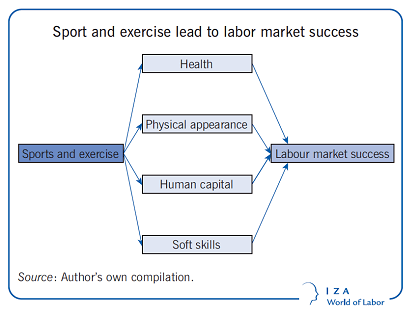
What does the literature say?
Almost all existing studies on the topic find a positive correlation between sports and labor market performance. There are, however, possible shortcomings when using surveys because people tend to overstate their activity levels, and surveys may not run long enough to establish causal links between exercising and labor market performance.
An experimental study for Sweden circumvents the problems of long-term impacts, positive selection, and measurement issues: 8,000 job applications were sent to employers, with information about different types of sports and exercise randomly added. The study showed that including a statement about being physically active increased call-back rates by two percentage points.
Using German panel data from the SOEP, researchers found that men who do sports at least once a week earn five percent more on average than men who do not. Women who were involved in sports at age 15 earn about six percent more later in life. Furthermore, a positive correlation between engaging in physical activity and moving from unemployment to employment for women with at least three years of work experience is established.
For other countries, similar results apply. The evidence for positive labor market effects of sports and exercise is strong, especially for earnings. Earnings effects range from about 4 to 17 percent.
What are the policy implications?
It is apparent that increasing the general level of physical activity is very likely to boost productivity among employees at all levels. Governments may also want to include among their active labor market policies encouragement of sports and exercise for unemployed people whose productivity is comparably low and whose participation in these activities is below optimum, in order to increase the re-employment chances for this group.
- See selected press coverage in German language:
BILD (Germany), Der Standard (Austria), Blick (Switzerland)
 Disruptions in family structure are suspected to impede the development of children’s personality, with far-reaching consequences for school performance and labor market success. An
  Along these trends, men’s and women’s wages and occupational structures have been converging. Research published in the
  Politicians, the media, and the public express concern that many immigrants fail to integrate economically. Research shows that the option to naturalize has considerable economic benefits for eligible immigrants, even in countries with a tradition of restrictive policies. An article by
  leaders. A
 Stress can be viewed as reflecting the limits on time and money that life imposes. Numerous studies have measured the money cost of having a child (close to
  Many factors influence the quality of decision making: importance, relevance, and even time of day can affect the degree to which we thoughtfully consider a decision. In a
  Cutting-edge macroeconomic research suggests that political uncertainty heavily influences private consumption. However, evidence on the individual level how households cope with uncertainty shocks is surprisingly scarce.
 European Commission collaboration with
  and breadth of coverage with recent, cutting-edge work in all the major areas of modern labor economics. The second edition, now available, has been substantially updated and augmented.