• Skip to primary navigation
  • Skip to content
  • Skip to primary sidebar

IZA Newsroom

IZA – Institute of Labor Economics

  • Home
  • Archive
  • Press Lounge
  • DE
  • EN

Mark Fallak

UK sugar levy effectively reduced calorie intake from soft drinks

August 5, 2021 by Mark Fallak

Concerns about the health burden of obesity have prompted governments across the world to introduce sugar taxes. In March 2016, the UK Government announced a national Soft Drinks Industry Levy (SDIL) which was enacted in April 2018. The levy was particularly steep, requiring the manufacturers of sugar sweetened beverages (SSBs) to typically pay £0.24 per litre of beverage.

The goal was to substantially raise prices and thus trigger a demand response by prompting consumers to reduce their purchases of fizzy beverages. At the same time, the SDIL contained a provision to trigger a supply response: Brands that reduced their sugar content below 5g/100ml would not be levied. In a recent IZA paper, Alex Dickson, Markus Gehrsitz, Jonathan Kemp went to the data to assess the effectiveness of the levy in reducing calorie intake.

All but a few brands cut their sugar content

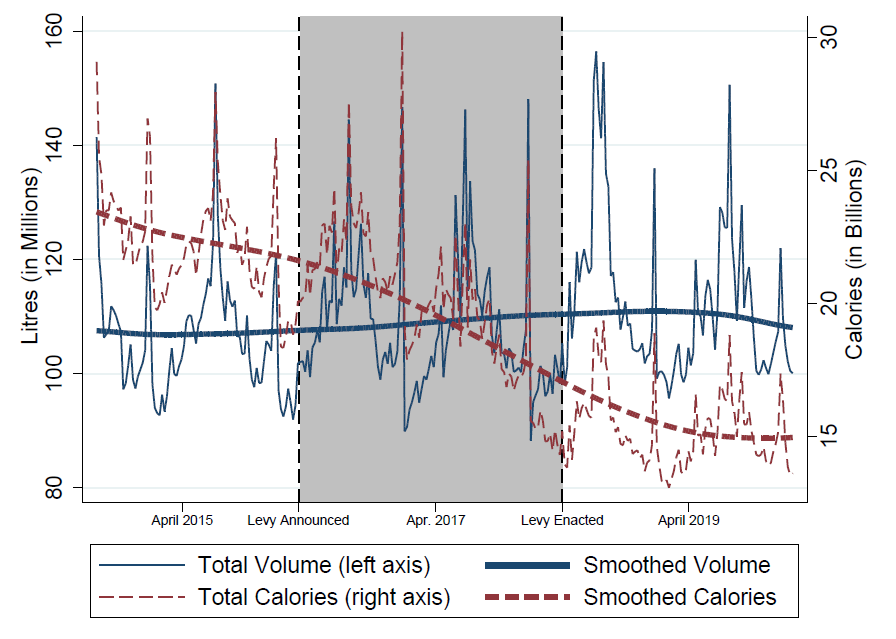
Their empirical results suggest that the levy led to massive reductions in the calorie intake and that, remarkably, most of these reductions were realized before the levy even went into effect. That is because many manufacturers used the two-year gap between levy announcement and enactment to change the recipes of their beverages. By substituting artificial sweetener for sugar, they cut their sugar content below the 5g/100ml threshold, thus avoiding the levy.

Among the 100 main brands and brand variants, which account for 73% of consumer spending in UK mainstream retailers, product reformulation was responsible for a reduction in calorie intake of about 5 billion per week. Consumers seem to barely have noticed the product reformulations as prices and volume sales held steady both before and after the enactment of the levy.

Figure 1: Aggregate weekly consumption for main UK soft drinks brands by volume (in millions of litres) and calories (in billions)
Brands that passed on the levy to the consumer paid a price for it

But not everyone changed their recipe. In particular, in the cola and energy drink segments of the market, full-sugar variants continued to feature prominently at the time the levy was implemented in April 2018. As the levy was passed on to consumers, prices shot up. In particular for colas, the price paid by consumers increased by more than the nominal tax and was over-shifted.

Figure 2: Pricing of levied and non-levied soft drinks
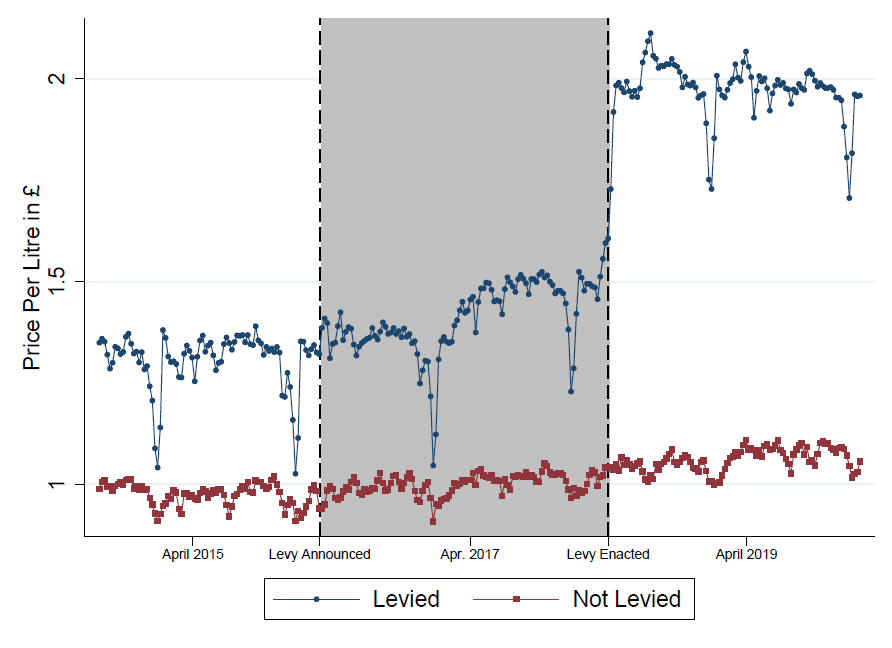
The consumer response followed quickly and took the form of about an 18% reduction in volume sales of levied brands. The sales response was most pronounced for large “take-home” containers of colas whereas, “on-the-go” purchases of energy drinks barely budged. At the same time sales of zero sugar diet versions increased, letting total soft drinks volumes continue its growth path. In total, levy-induced price increases and the subsequent substitution behavior took another 1 billion calories per week out of UK consumers’ diet.

Supply-side response trumps demand-side response

The authors conclude that the UK SDIL holds important lessons for policy makers. While the demand-response to higher prices is non-negligible, it is dwarfed by calorie reductions by way of manufacturers’ decision to cut the sugar content in their beverages. More than 80 percent of overall levy-induced calorie reductions were due to reformulation. As such, a tiered sugar levy that allows sufficient time between announcement and implementation, and sets a feasible target sugar level below which it can be entirely avoided through reformulation, will act as a massive accelerator.

Sugar intake from SSBs had been falling even before the levy was announced, mainly because changing consumer sentiment. Primarily because of reformulation incentives, the authors estimate that the levy sped up this process and ultimately led to an additional reduction of 6,500 calories from soft drinks per year per UK resident.

Filed Under: Research Tagged With: calories, health, nutrition, obesity, sugar, tax, UK

How social norms affect people’s willingness to fight climate change

July 27, 2021 by Mark Fallak

Many people contribute little to climate protection because they underestimate the willingness of others to fight global warming, according to a new IZA discussion paper by Peter Andre, Teodora Boneva, Felix Chopra and Armin Falk. In a survey experiment, the authors asked 8,000 adults, representative of the U.S. population, to allocate 450 dollars between themselves and a charitable organization that fights climate change.

While 6% indicated they would keep all the money for themselves, 12% were willing to donate the entire sum – enough to offset the annual CO2 emissions of a typical U.S. citizen. On average, participants were willing to contribute half of the total amount.

Economic preferences and moral values matter

The study also documents that patience, altruism, positive reciprocity, and moral universalism are among the fundamental human traits that are strongly correlated with individual willingness to fight climate change.

On average, women in the experiment donate $17 more to climate protection than men do. Democrats contribute $45 more than Republicans. Donations increase with household income, but decline with higher educational attainment, mainly for Republicans.

“Fighting global warming is a matter of cooperation. But people tend to cooperate conditionally: I’ll do it if you do it. That’s why it’s so important to uncover and correct misperceptions of prevalent climate norms,” says Armin Falk. The authors suggest that large-scale information campaigns could trigger a positive feedback loop where learning about the existing support for action against climate change could encourage others to follow suit.

Filed Under: Research Tagged With: beliefs, climate change, economic preferences, moral values, social norms

The impact of climate change on labor markets

July 23, 2021 by Mark Fallak

Climate change is increasing the frequency of extreme weather events such as heatwaves, floods, and hurricanes for the global population. In addition to causing damages to the environment and human health, global warming poses challenges for the functioning of labor markets. The First IZA Workshop on Climate Change and Labor Markets, organized by Andrew Oswald, Olivier Deschenes and Nico Pestel, brought together researchers working on the implications of global warming and climate change adaptation for labor markets.

In his welcome address, Oswald emphasized the urgency of the problem for the modern world, drawing attention to what had just been witnessed in the unprecedented temperatures recently in British Columbia in Canada. He also pointed to a comparative lack of research articles in the major general journals of Economics and stressed IZA’s commitment to help foster research in this important area.

“Changing Climate, Changing Economics”

The workshop was opened by a keynote address delivered by Lord Nicholas Stern from the London School of Economics on “Changing Climate, Changing Economics”. According to Stern, the central problem with respect to climate change is to stabilize the global average temperature by achieving net zero emissions of greenhouse gases by the mid of the 21st century. A global warming by two degrees Celsius would already provide large risks for humanity and a warming by three degrees or even more would be absolutely disastrous and make whole areas of the world uninhabitable, said Stern.

He pointed out that preventing such a climate disaster requires rapid change and tremendous investments particularly in energy systems. The contribution of economics and economic policy-making should mainly focus on overcoming market failures and should not stop at suggesting and implementing a global carbon price given that more systemic change is required.

Rainfall affects employment mainly in agriculture

The first session of the workshop focused on direct impacts of weather anomalies on labor market outcomes. A paper co-authored by Camilo Bohorquez-Penuela studies effects of municipality-level precipitation shocks on formal rural employment in Colombia. The results indicate that episodes of excessive rainfall have a negative impact on formal employment in rural areas for both the agricultural and non-agricultural sector, while episodes of lack of rainfall affect the formal rural labor market in the opposite direction. These findings are explained by substitution effects between water and labor inputs in agricultural production.

Droughts impact on migration decisions

Beyond direct labor market effects, climate change may have an impact on location decisions of workers and firms. The study presented by Fernanda Martínez Flores investigates the extent to which soil moisture anomalies have an impact on international migration from West Africa directed to Europe. The results show that drier soil conditions decrease rather than increase the probability to migrate. This effect is concentrated during the crop-growing season, suggesting that the decrease in migration is mainly driven by financial constraints, also because the effect is only seen for areas in the middle of the income distribution, with no impact on the poorest or richest areas who can never or always afford migration.

Adjustment to climate change is costly

Climate change will cause precipitation volatility to increase around the world, leading to economic damages in the face of adjustment costs. Jeffrey G. Shrader presented his co-authored work on estimating these damages for U.S. construction, an economically important, climate exposed industry. He showed that employment falls in response to predicted rainfall and more so as the forecast horizon increases. Firms anticipate and adapt to rainfall events through costly adjustment of their labor force. Higher adjustment costs reduce this adaptation, leading to greater damage from bad weather realizations. These results imply that firms value forecasts and would be willing to pay to learn about rainfall sooner.

See the online program of the workshop for more downloadable papers.

+++

For more research on environmental regulation and the labor market, see also the IZA World of Labor topic page.

Filed Under: IZA News, Research Tagged With: climate change

Rapid tests effectively contain COVID-19

July 9, 2021 by Mark Fallak

According to a recent IZA discussion paper by Janos Gabler, Tobias Raabe, Klara Röhrl and Hans-Martin von Gaudecker, rapid tests effectively broke COVID-19 infection chains in spring 2021. Using an agent-based simulation model focused on physical contacts between people, the research team found that rapid tests reduced the number of infections in Germany by more than 40 percent in May alone, while the sharply rising vaccination rates played a minor role, being responsible for only 16 percent of the decline.

The authors advocate further use of rapid testing as an important an relatively inexpensive tool to contain the pandemic as long as vaccination rates are still too low. They attribute its effectiveness to the fact that rapid tests reduced contacts in case of a positive result—in contrast to vaccinations. The seasonality of the virus, i.e. external conditions such as temperature and humidity and, consequently, the extent to which people meet outdoors rather than indoors—had a similar impact as testing.

Previous research from the IZA network

Several other IZA discussion papers have looked at the effects of antigen testing and provided encouraging results as well.

  • A study from Slovakia, where nearly the entire population was tested once, and only certain districts were re-tested later, found that repeated mass antigen testing reduced infections by about 25-30% and decreased R0 by 0.3 two weeks after the re-testing.
  • A case study for the German city of Tübingen, which set up a rapid testing scheme while relaxing lockdown measures, concluded that this “opening under safety” policy did not lead to a substantial increase in case rates. The authors also point out that more testing helps identify asymptomatic cases, which may otherwise have led to more infections.
  • When testing is voluntary, it is important for policymakers to understand what determines people’s willingness to get tested. A study from the South Tyrol region in Italy found that convenience—more test centers available in the community—was a key factor. Age, socioeconomic status and religiosity were also both positively related to greater testing. The authors suggest that similar patterns may hold for vaccination uptake.

Filed Under: Research Tagged With: antigen testing, COVID-19, rapid tests, seasonality, vaccination

How environmental pollution affects educational and labor market outcomes

July 1, 2021 by Mark Fallak

Climate change and environmental pollution are the central challenges of our time. The COVID-19 pandemic has also moved population health a top policy priority. To present and discuss new research on these issues, the 8th IZA Workshop on “Environment, Health and Labor Markets”, organized by Olivier Deschenes and Nico Pestel, brought together researchers analyzing the interaction between environmental factors, health policies, labor markets and education.

Central questions evolved around the impacts of environmental pollution on educational and labor market outcomes, the effects of environmental policies on employment, as well as health benefits of public policies.

Lead exposure spills over to classmates

It is well established that children exposed to lead are more disruptive and have lower achievement. In her paper, Ludovica Gazze studies how lead-exposed children affect the long-run outcomes of their peers by using new data on preschool blood lead levels matched to education data for all students in North Carolina public schools. Having more lead-exposed peers is associated with lower high-school graduation and SAT-taking rates and increased suspensions and absences.

School building quality important for student performance

Governments devote a large share of public budgets to constructing, repairing and modernizing school facilities. Juan Palacios presented evidence on the implications for student performance of poor environmental conditions inside classrooms by continuously monitoring the environmental conditions (i.e. CO2, fine particles, temperature, humidity) in the classrooms of 3,000 children over two school years, and linking them to their scores in standardized tests. The findings show that exposure to poor indoor air quality during the school term preceding the test is associated with significant performance drops. Changes in teaching time could be a potential mechanism.

Low-emission zones improve child health

Hannah Klauber examines the impact of early-life exposure to air pollution on children’s health from their in-utero period to school enrollment by using public health insurance records covering one-third of the population of children in Germany. The results indicate that children born just before and just after a Low Emission Zone, banning high-emission vehicles, was implemented in the county of birth exhibit persistent differences in medication usage for at least five years.

Management quality crucial for climate change mitigation

Cap-and-trade programs for CO2 emissions are being considered by governments worldwide to address the climate change challenge. The success of such a market-based climate policy at minimizing overall abatement cost and fostering low-carbon investment and innovation depends on participants fully understanding the system. Ulrich Wagner provides evidence on how management quality moderates responses to carbon pricing, by analyzing firms that participated in two of China’s regional pilot emissions trading schemes (ETS). The findings show that the launch of the pilot ETS has reduced consumption of coal and electricity, but only for well-managed firms.

+++

More papers are downloadable from the workshop homepage.

Filed Under: IZA News, Research Tagged With: environment, health

Machine learning in the welfare system

June 23, 2021 by Mark Fallak

A shock to the economy such as that wreaked by the COVID-19 pandemic can lead many to start receiving income support from the government. Some individuals may end up relying on government transfers for protracted periods of time. Such welfare dependency can have demoralizing effects on recipients and create large outlays for governments.

A new IZA discussion paper by Dario Sansone and Anna Zhu shows how machine learning algorithms can be used to predict which individuals are most at risk of becoming long-term welfare recipients. The fusion of high-quality big data and machine learning methods allows these researchers to provide better predictions than commonly used benchmark models. Specifically, they can predict the proportion of time individuals are on income support in the subsequent four years with at least 22% greater accuracy than standard early warning systems.

Machine learning can be successfully applied to large administrative data

Governments increasingly use machine learning to tackle social problems and to make resource-allocation decisions. For example, it has been used to help judges to improve bail-granting decisions, schools to identify students at risk of dropping out, and surgeons to screen patients for hip-replacement surgery. In this study, the authors use data on the full population of Social Security enrollees in Australia.

These data include daily information on the income support receipt patterns of millions of individuals and their household members, as well as other demographic and socio-economic information. The size and richness of the dataset makes it ideal for a machine learning application, allowing the algorithms to achieve high performance by detecting subtle patterns in the data and by identifying new powerful predictors.

The authors’ approach is aimed at complementing existing early intervention programs targeted to long-term welfare receipt. Before governments can implement these programs, they need to know which individuals are most at-risk – a role that can be ably fulfilled by machine learning algorithms. Additionally, these improved predictions may reduce conscious and unconscious biases common in human decision-making. Importantly, the approach is also relatively low-cost to implement since it exploits administrative data already available to practitioners.

Remaining challenges and next steps

Despite their growing popularity, there is still a large degree of skepticism about the impact of adopting such automated systems because of accuracy concerns and bias reinforcement. This is why the authors do not believe their algorithms should replace human expertise but rather act as its complement. For example, caseworkers could focus their attention and time providing personalized service and targeting the appropriate support to individuals that the algorithm identifies as most at risk.

Similarly, identifying individuals who are at-risk is only the first step. Policymakers intending to help suitable individuals promptly leave the welfare system also need to know which interventions work and on whom these interventions are most likely to work. Prediction alone cannot answer these questions: causal estimations such as those obtained from randomized controlled trials are required here, ideally combined with machine learning to identify the sub-population of interest.

Filed Under: Research Tagged With: algorithms, artificial intelligence, Australia, income support, machine learning, welfare dependency

More goals, fewer babies?

June 11, 2021 by Mark Fallak

Anecdotal evidence suggests that successful performance of a football team in major sports competitions sparks a baby boom among fans. International media reported various cases, such as a baby boom in Iceland nine months after the sensational EURO 2016 win against England, or an increase in births in Barcelona after a last-minute goal in the 2009 Champions League semi-final.

However, a new IZA discussion paper by Luca Fumarco and Francesco Principe seems to debunk this myth once and for all, at least as far as the UEFA European Championships and FIFA World Cups are concerned. The authors combine Eurostat data on country-level monthly birth rates for 50 European countries, over a period of 56 years, with national football teams’ performance in international football events. Performance is measured with the ELO rating system used by FIFA to compile the world national teams ranking.

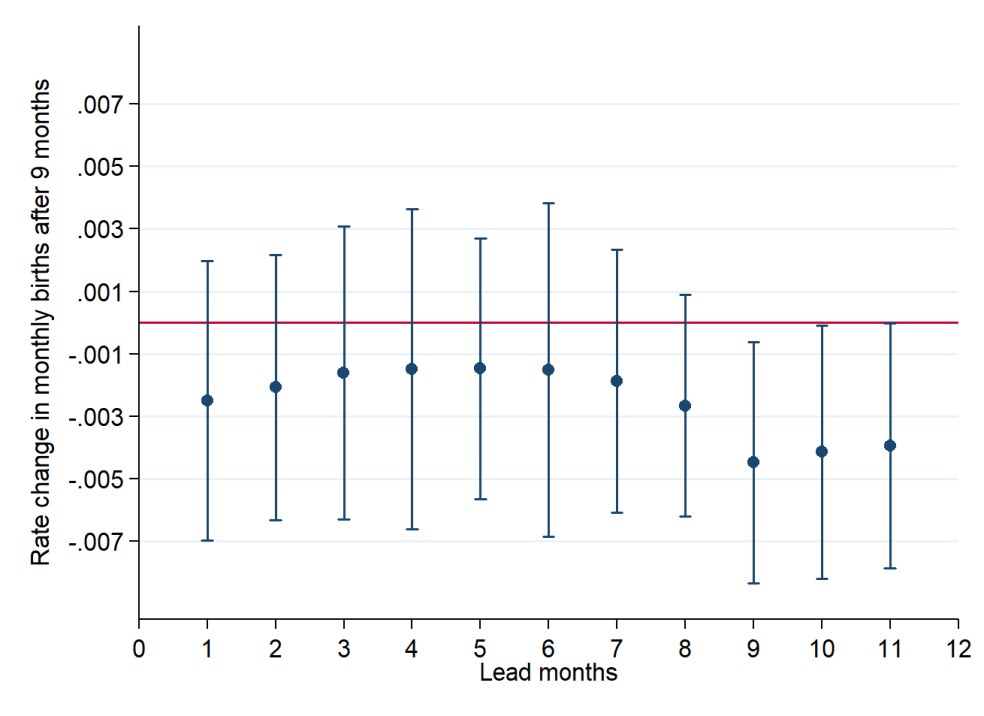
The analysis shows that an increase in national teams’ performance in major competitions does not lead to a baby boom, but is instead associated with a drop in births nine months after the event. As the figure below illustrates, the effect of performance on monthly births is highly statistically significant nine and ten months after the tournament.

Fig. 1: Effect of performance on monthly births

These results, which pass various robustness tests, are also economically significant. For example, in large European countries such as Italy and France, an average performance in an international competition could lead to a decrease by over 1,000 monthly births, nine months after the beginning of the tournament.

According to the authors, a possible explanation might be that a massive increase in the consumption of media and entertainment, followed by extensive celebrations with friends and compatriots, comes at the expense of “intimacy time.” Whether this will also hold for the EURO 2020, which starts today with one year delay and many Covid restrictions on public gatherings still in place, remains to be seen in about nine months from now.

Filed Under: Research Tagged With: baby boom, birth rates, entertainment, fertility, football, intimacy, sports

New research on the economic effects of migration policies

June 9, 2021 by Mark Fallak

In 2020, the number of international migrants across the globe reached a new high of 281 million, equal to 3.6 percent of the world’s population and affecting all regions of the planet. Research on the economic aspects of migration thus could not be timelier. In a new edition of a longstanding and successful series, IZA’s 17th annual migration meeting discussed new and cutting-edge research on a wide variety of migration topics in economics.

This year’s workshop, organized by George Borjas and Marc Witte, focused on the economic drivers and impacts of refugee migration, the integration of immigrants in their host societies, and the impact of migration policies on both sending and receiving countries. After the 2020 migration workshop was canceled due to the pandemic, this year’s edition was the first to be held entirely online.

Many of the 17 presenters analyzed various migration policies and/or natural experiments across the globe, from the US, Mexico, Colombia, to Portugal’s former African Colonies, as well as Italy, and Israel.

Several papers studied the effect of migration-curbing policies in receiving countries on development in the sending countries, as exemplified by Davide Coluccia’s work on “The Economic Effects of Immigration Restriction Policies”. Looking at the Italian mass migration to the U.S. at the beginning of the 20th century, he finds that the American 1921-1924 Immigration Acts led to a population increase in those Italian districts that previously showed large emigration to the U.S. As a consequence, Italian manufacturing firms located in those districts invested less in capital goods, while industrial employment rose due to an abundance of workers. A migration policy enacted in a destination country thus had potential long-run effects on growth and productivity in the sending country.

Obtaining citizenship boosts labor market integration

Another presentation by Yajna Govind analyzed the effect of naturalization of immigrants on their labor market outcomes. The paper exploits a French reform in 2006 that doubled the minimum years of marriage (to a French citizen) required before naturalization, from two to four. From this policy change it can be deducted that obtaining citizenship leads to an increase in annual earnings by almost 30%, driven both by rising working hours and hourly wages. Interestingly, the margins starkly differ by gender: while naturalized men work more hours, naturalized women earn more per hour. For both genders, in any case, naturalization boosts labor market integration.

The immigration experience to America is perhaps best described with a quote from an Italian immigrant in the 1900s:

“I came to America because I heard the streets were paved with gold. When I got here, I found out three things: First, the streets were not paved with gold. Second, they weren’t paved at all. Third, I was expected to pave them.”

In his keynote speech “Streets of Gold: Immigration and the American Dream over two Centuries”, Ran Abramitzky compares immigration to the U.S. one century ago with current immigration patterns. Characterizing the view of the past European mass migration as overly nostalgic, Ran showed that immigrants then and today only partially assimilate to their host country, both economically and culturally. Their children, however, cover a lot of ground to their US-born counterparts and catch up with them in most economic aspects, regardless of the sending country.

Other topics discussed in the workshop’s presentations included how taking the perspective of an immigrant affects natives’ pro-sociality, the impact of immigration on the top 1% income earners in the UK, or the influence of immigration on the creative arts in the US.

Filed Under: IZA News, Research Tagged With: Development, immigration policy, integration, migration

The burden of mandatory waiting periods for abortions

June 9, 2021 by Mark Fallak

Mandatory waiting periods for abortions have proliferated in the United States since the early 1990s. In recent years many states have begun requiring that initial counseling be provided in-person, causing women seeking abortions to have to make two trips to a provider at least one day apart. U.S. courts have opined that mandatory waits “may delay, but do not prohibit abortions” and “are surely a small cost to impose” and hence not an undue burden on women seeking abortions. Yet these opinions have been based on conjecture rather than empirical evidence.

Increase in second-trimester abortions

In a recent IZA discussion paper, Caitlin Myers provides the first empirical evidence on the causal effects of mandatory waiting periods based on thirty years of enforcement variation in the United States. The results suggest that short mandatory waiting periods that do not require two in-person trips have little effect on abortion obtainment, but that lengthier waits and two-trip policies in fact pose substantial obstacles.

The modal woman seeking an abortion is a low-income adult mothers who is credit constrained and experiencing a disruptive life event. The analysis shows that faced with a two-trip waiting period, many of these women experience substantial delays in obtaining an abortion and some are unable to obtain one at all. Two-trip mandatory waits are estimated to increase second-trimester abortions by 19%, reduce total abortions by 9%, and increase births by 2%.

“Burden” rather than “cooling-off period”

The analysis additionally shows that the delays and reductions in abortions caused by two-trip policies are greatest in counties that are far from abortion providers and experiencing high rates of unemployment and poverty. This is consistent with a “burden” interpretation of the result in which high travel distances amplify the costs of two required trips and poor economic conditions reduce the number of women who can afford them.

Filed Under: Research Tagged With: abortion

Loneliness and social isolation in Europe

June 4, 2021 by Mark Fallak

Concerns about loneliness are growing more than ever. Population ageing, the rising number of people living alone, global mobility, changes in working methods and the increased use of digital technologies for communication have led many to suggest that loneliness is becoming more prevalent. Since the outbreak of the COVID-19 pandemic, lockdowns, quarantines, curfews, distancing measures, the cancellation of community activities and events have magnified existing levels of loneliness and social isolation. With the pandemic entering its second year, there are fears that the toll on loneliness could have consequences long after the virus recedes.

The impact of loneliness on individual well-being and social cohesion should not be underestimated. Loneliness has been compared to obesity and smoking in the mortality risks that it entails. It is also associated with physical and psychological health problems. Lonely adults tend to suffer from higher levels of cortisol (the ‘stress hormone’), raised blood pressure, impaired sleep and cardiovascular resistance compared with non-lonely individuals, both in stressful situations and when at rest.

Over time, this translates into chronic inflammation and higher morbidity and mortality rates. Loneliness is also associated with depressive symptoms and with unhealthy behaviors such as smoking and a lack of physical exercise. In an increasingly connected world, lonely and socially isolated people face the double penalty of poorer health and being stigmatized as socially awkward.

Behavioral effects of loneliness create a vicious circle

What is more, feelings of loneliness and social isolation may themselves drive lonely individuals even further away from others, because loneliness affects behavior. Individuals suffering from loneliness and social isolation tend to display lower levels of empathy and feel more threatened by unexpected life situations compared with their non-lonely counterparts.

Although discussions about loneliness are prominent in political debates, and a growing number of newspapers are now talking about a ‘loneliness pandemic’, cross-national evidence on the incidence of loneliness is still limited. A recent IZA discussion paper by Béatrice d’Hombres, Martina Barjaková, and Sylke V. Schnepf  offers a comparative overview of the prevalence and determinants of loneliness and social isolation in Europe in the pre-COVID period.

One-fifth of the European population suffers from social isolation

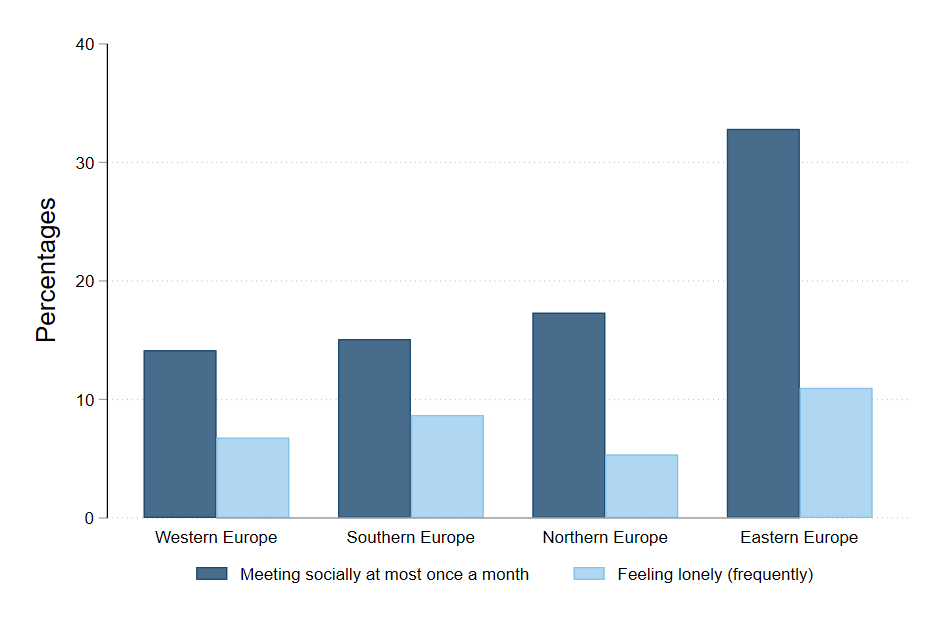
The empirical results indicate that 8.6% of the adult population in Europe suffer from frequent loneliness and 20.8% from social isolation, with eastern Europe recording the highest prevalence of both phenomena. Trends over time do not indicate any change in the incidence of social isolation following the widespread adoption of social media networks from 2010 onwards. The empirical analysis shows that favorable economic circumstances protect against loneliness and social isolation, while living alone and poor health constitute important loneliness risk factors.

Figure: Prevalence of Loneliness and Social Isolation in EU macro regions

Although social isolation increases with age, the elderly do not report more frequent feelings of loneliness than other age groups, all other things being equal. The authors show that the relative contributions of the different objective circumstances included in the empirical analysis — demographic characteristics, economic conditions, living arrangements, health status, religious beliefs and geographical location — to loneliness and social isolation vary substantially.

Forced social distancing may have long-term consequences

Data limitations precluded an investigation of the role of social media in protecting against or increasing the risk of social isolation and loneliness. The authors suggest this should be addressed in future pan-European studies on loneliness. Future research should also examine whether loneliness influences civic behavior and, more broadly, attitudes towards others and general trust, two important components in the functioning of liberal democracies.

Social connections are critical in our daily lives. The distress experienced worldwide over the past year is, in part, driven by limitations on social interactions. The forced social distancing experienced since March 2020 and the economic effects of the pandemic are likely to have long-term consequences. A forthcoming study will evaluate the extent to which the current situation has exacerbated the problems of those who were already lonely and whether the composition of the population most at risk of social isolation and loneliness has changed during this unprecedented period.

Filed Under: Research Tagged With: COVID-19, Europe, loneliness, social isolation

  • Previous Page
  • Page 1
  • …
  • Page 16
  • Page 17
  • Page 18
  • Page 19
  • Page 20
  • …
  • Page 30
  • Next Page

Primary Sidebar

© 2013–2025 Deutsche Post STIFTUNGImprint | Privacy PolicyIZA