• Skip to primary navigation
  • Skip to content
  • Skip to primary sidebar

IZA Newsroom

IZA – Institute of Labor Economics

  • Home
  • Archive
  • Press Lounge
  • DE
  • EN

Mark Fallak

What explains the unexplained gender pay gap?

September 24, 2020 by Mark Fallak

Across the developed world, women continue to earn substantially less than men. In the U.S. and Germany, for example, the gender pay gap amounts to roughly 20% of men’s average wages. While a substantial part of this gap can be attributed to gender differences in pay-relevant characteristics such as work experience or occupation, non-negligible pay differences between men and women remain unexplained by these factors.

This unexplained gender pay gap is of great importance for both the academic and the public debate as it potentially results from discrimination against women. To some extent, it may also be due to factors usually not included in statistical decompositions of the wage gap – either because they cannot easily be measured, like the importance of the working climate and ethical motives in the choice of workplace, or because theory has overlooked them so far as a determinant of wages.

A recent IZA discussion paper by Dorothée Averkamp, Christian Bredemeier, and Falko Juessen identifies the interaction between the careers of individual family members in multiple-earner households as an important factor in wage differentials between men and women.

Families actively prioritize one member’s career

The authors emphasize that the decisions of a family can contribute to wage differentials between its members. For example, moving to another city can boost the career of one family member but harm that of another. Whether the family makes such a move also depends on whose career is prioritized. If the family bases this decision on already existing differences in earnings prospects or promotion opportunities, then existing wage differences are reinforced because the family actively promotes the career of the member who already earns more, or is expected to do so in the future, at the expense of the other family member’s career.

The analysis of data on U.S. dual-earner couples finds that men’s wages are fostered by families prioritizing their careers. If incentives for households to prioritize men’s careers were smaller, men’s average wages would be up to 10% lower. The results further suggest that a substantial part of the wage gap can be attributed to reinforcement mechanisms within the family. If one accounts for career prioritization when breaking down the pay gap in an explained and an unexplained part, the share of the wage gap that cannot be explained by household characteristics is substantially smaller.

Even low levels of discrimination can create a vicious circle

These results suggest that the extent of discrimination against women in the labor market is smaller than the results of conventional methods would suggest. Still, even low levels of discrimination can cause significant pay gaps because they encourage families to prioritize men’s careers, thus widening pay gaps. This leads to a mutually reinforcing cycle of earnings differentials and family decisions. For the aim of gender equality, this relationship is, on the one hand, a vicious circle. On the other hand, policies that reduce the pay gap can lead to families weighing women’s career opportunities and thus have a double effect on the pay gap.
Filed Under: Research Tagged With: career, choice, discrimination, family, gender pay gap

When is the most productive time of day?

September 23, 2020 by Mark Fallak

The link between time-of-day and productivity on cognitive tasks is crucial to understand workplace efficiency and welfare. A new IZA paper by Alessio Gaggero and Denni Tommasi examines the performance of university students taking at most one exam per day in the final two weeks of the semester. Exams are scheduled at different time-of-day in a quasi-random fashion.

Analyzing data on half a million student-exam level observations, the authors find that peak performance occurs around lunchtime (1.30pm), as compared to morning (9am) or late afternoon (4.30pm). This inverse U-shaped relationship between time-of-day and performance (i) is not driven by stress or fatigue, (ii) is consistent with the idea that cognitive functioning is an important determinant of productivity and (iii) implies that efficiency gains of up to 0.14 standard deviations can be achieved through simple re-arrangements of the time of exams.

While previous research has shown that biological factors influence changes in productivity between day and night shifts, this study establishes that such a relationship is also important within a standard daylight shift.

The study also found that the time-of-day effects varied seasonally, depending on the sunlight-related circadian rhythm: Moving an exam from the morning to lunchtime in January increases a student’s performance twice as much as in June.

A simple back-of-the-envelope calculation applied to an external context that is likely to benefit from these results—elective surgeries—suggests that a different sorting of the cognitive tasks performed by surgeons may lead to an increase in the number of patients saved during surgery.

Read also an article about this paper in MONEY.

Filed Under: Research Tagged With: cognitive task, fatigue, productivity, stress, time

How a second chance in education influences labor market outcomes

September 21, 2020 by Mark Fallak

Across the OECD area, 20-30% of each birth cohort drop out of high school before graduating. An important policy challenge is how to provide a second chance to low-educated workers who face declining labor market prospects and widening earnings gaps relative to college-educated workers in both the United States and Europe.

A recent IZA paper by Patrick Bennett, Richard Blundell, and Kjell G. Salvanes examines how a second chance in the education system—returning to high school as an adult—impacts labor market outcomes as well as other major life decisions such as fertility. Focusing on adult education in Norway, a considerable fraction of high school dropouts return to complete high school after dropping out by age 20. The authors estimate the causal impacts of returning to high school exploiting variation in the exposure to two substantial policy changes which first extended the legal right to adult high school education and subsequently provided unconditional student financing to return to high school.

Returning to education increases labor market prospects

Using detailed Norwegian data and following adults prior to and after the introduction of these reforms, the authors find that those exposed to the policy reforms at younger ages see considerable increases in high school completion and higher education relative to those exposed to the same reforms at even older ages. While women return to education after the two reforms, male education remains unchanged. Such increases in education among women lead to higher earnings and increases in employment. The observed increase in earnings attributed to later life education is driven almost entirely by increasing female employment rather than increasing wages among women. At the same time, increases in education lead to decreases in fertility.

Returning to high school as an adult—either vocational or academic—within the formal education system improves the labor market prospects of high school dropouts. The approach examined requires real investment in human capital by attending courses (day time or evening as well as workplace training for the vocational track) within the formal education system and nationally graded tests externally verified by a third party. In addition, the timing of returning to academic high school, which includes an option for entering higher education, matters for how likely students are to enter and complete college education: early exposed women complete higher education at substantially higher rates than later exposed women.

Reducing the gender earnings gap

The paper also provides evidence that later life human capital accumulation through formal education has the potential to impact the gender earnings gap. As male education is unchanged after the education reforms, later life education improves the labor market conditions of women relative to men. Given the strong relationship which exists between children and employment, a considerable portion of the increase in employment observed among women can operate through the joint decision of fertility and employment. Indeed, previous studies have emphasized the importance of the child wage penalty as a factor behind the gender wage gap.

Understanding why individuals find it optimal to return to levels of education they previously dropped out of is of key importance. The paper suggests that financial constraints are an important factor in decision to return to school, as increases in student financing push women back into education. At the same time, important differences across factors such as gender, socioeconomic status, childbearing, and cognitive ability also matter for both the decision to restart education and the age at which adults return to education.

Filed Under: Research Tagged With: adult education, earnings, education, fertility, gender gap, human capital, labor market prospects

Research reveals ‘climate-change complacency’ across Europe

September 17, 2020 by Mark Fallak

Most European citizens do not particularly care about climate change. That’s the striking finding from a new IZA discussion paper by Adam Nowakowski (Bocconi University) and Andrew J. Oswald (University of Warwick) on the views of 70,000 randomly sampled European men and women.

Only 5% described themselves as ‘extremely worried’ about climate change. The climate and the environment ranked only 5th in people’s overall views about priorities. There was also scepticism that coordinated action, for example to cut personal energy use, would make much difference.

Andrew Oswald, who is special representative of IZA on climate change and labor markets, commented on the findings:

‘There is little point in designing sophisticated economic policies for combating climate change until voters feel that climate change is a deeply disturbing problem. Currently, those voters do not feel that.’

He also pointed out that the so-called desirability bias, which is the tendency for interviewees to feel compelled to shade their answers towards ‘politically correct’ ones, might mean the true level of worry about climate change is lower than indicated in the statistical surveys.

The authors analyzed data from two large-scale sources, the 2016 European Social Survey and the 2019 Eurobarometer survey. They found:

  • Europe’s citizens are more concerned with inward-looking issues seen as closer to home, such as inflation, the general economic situation, health and social security, and unemployment.
  • Europeans do not have a strong belief that joint action by energy users will make a real difference to climate change.
  • Women, young people, university graduates and city-dwellers show higher levels of concern about climate change.
  • People living in warmer European countries had higher levels of concern than those in the cooler North of the continent.

On the way to move forward, Oswald and Nowakowski suggest parallels with the original government campaigns to cut smoking. They argue that it will be necessary to change people’s feelings about the problem of rising global temperatures. Just as education about the risks of smoking went hand-in-hand with graphic warnings and tax increases, governments should consider doing more to educate and alter people’s perceived level of worry about climate change.

Adam Nowakowski commented:

‘We should not conclude that Europe does not care at all about climate change. However, our analysis of the data does suggest that European citizens are not ready for policies which would have strongly negative consequences on their day-to-day lives – not least because we have found a low level of confidence in the usefulness of joint action.’

Filed Under: Research Tagged With: climate change, feelings, global warming, policy interventions, public information

Coping with the COVID-19 labor market crisis: Views from Austria

September 15, 2020 by Mark Fallak

In a series of IZA Newsroom interviews, renowned international labor market experts comment on how their country has been coping with the COVID-19 labor market crisis and how they expect the situation to evolve. These experts have also contributed to the ongoing IZA Crisis Response Monitoring, which provides a detailed assessment of different policy measures. Austria has achieved tragic international fame when the virus spread from an Austrian ski resort across Europe, but the country has since then been coping relatively well with the crisis. We asked René Böheim and Thomas Leoni to share their inside views on the labor market impact of the pandemic in Austria.

How do you assess the current labor market situation in Austria and the role that government policies have played so far?

RB: We still have record numbers of unemployed persons and extensive use of short-time work, which has been extended at least until the end of March 2021. I am concerned that we might face a substantial number of firm closures which were somewhat postponed by the support programs. Certain sectors, e.g., tourism or cultural institutions, were particularly badly hit by the crisis. The summer season did not help.

We might face a substantial number of firm closures which were somewhat postponed by the support programs.

TL: Policies certainly played a major role in stabilizing employment, this is particularly true for the short-time work scheme, which was implemented at an unprecedented scale. The number of workers on short-time has dropped substantially in the last months and about half of those who lost their job during the lockdown are back in employment. These are encouraging signs. At the same time, flows back into employment have clearly been insufficient to compensate for the job losses during the lockdown and there is a backlog of persons who were already in search of a job before the start of the crisis.

What would you consider the most probable labor market scenario in the next six to twelve months?

RB: High unemployment rates and continued short-time work. The risk of unemployment will continue to be high, in particular for young people and those with little or no formal skills as well for workers with health problems.

TL: The economy and the labor market are recovering from the momentous lockdown shock, but this process is slow and uneven. Some sectors, such as tourism, transport and some manufacturing industries, will continue to struggle in months to come. Moreover, we see that vulnerable groups face additional challenges to find employment. Thus, even though the economy is headed in the right direction, it will be a very bumpy road and some groups risk being left behind.

What policies would be best suited to support the recovery of employment in Austria?

RB: In my view, we now need also well-targeted job creation programs (to avoid dead-weight loss); training and qualification programs. I am also in favor of coupling short-time work more with continued education programs.

The crisis should provide an opportunity to implement innovative schemes.

TL: I would add that the crisis should provide an opportunity to implement innovative schemes, including well-targeted forms of employment subsidies for vulnerable groups and attractive models to reduce working hours. It will be important to take a sectoral perspective and some measures could be set at the industry level as part of the collective bargaining process, which is very comprehensive in Austria. In a macroeconomic perspective, it will also be important to address the drop in investment which has already taken place in the private sector and is likely to take place at the local level, as municipalities are experiencing a severe fall in revenues which will constrain their budgets.

Which aspects of the crisis response in Austria do you find most remarkable?

TL: I am impressed by the speed and flexibility with which firms, organizations and individuals adapted to the circumstances during the lockdown and beyond. This concerns particularly the ability to transfer work processes from the real to the virtual world, an experiment that I think will have some lasting effects on how we organize work. On a more personal note, it was also interesting to witness how fast children have learned to meet with friends online.

Filed Under: Opinion Tagged With: Austria, COVID-19

Does economic development deter workers from leaving poor countries?

September 10, 2020 by Mark Fallak

As the world economy recovers from this year’s historic shock, millions of people will once again migrate each year from poorer nations to rich ones. Most come in search of work. Many richer countries seek to reduce the numbers of such migrants by encouraging economic development and opportunity overseas. “I want to use our aid budget [for] creating jobs in poorer countries so as to reduce the pressure for mass migration to Europe,” says British minister Priti Patel.

Will it work? When people in poorer countries get more economic opportunity, are they typically more likely to stay in their home countries? It may seem obvious. But two new IZA Discussion Papers reveal the opposite pattern: As people in poorer countries get richer, they are more likely to emigrate. In poor countries, sudden bursts of migration can be a sign of crisis. But sustained increases in migration are a sign of economic success.

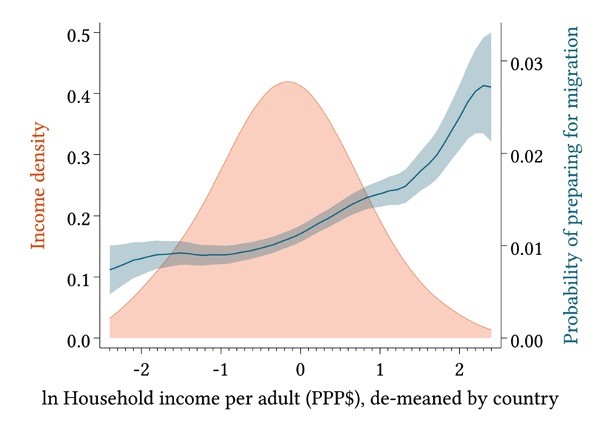
The first paper, by Michael Clemens and Mariapia Mendola, studies this question at the level of households. Using data on 653,613 people in 99 developing countries, they find that people in households with higher income per adult are more and more likely to be making final, costly preparations to permanently emigrate.

The figure below shows, in orange, the distribution of income for 120,420 people in the lowest-income countries of the world (left-hand axis). On top of that, in blue, is the probability that people at each income level are in the final stages of actively preparing to emigrate (right-hand axis).

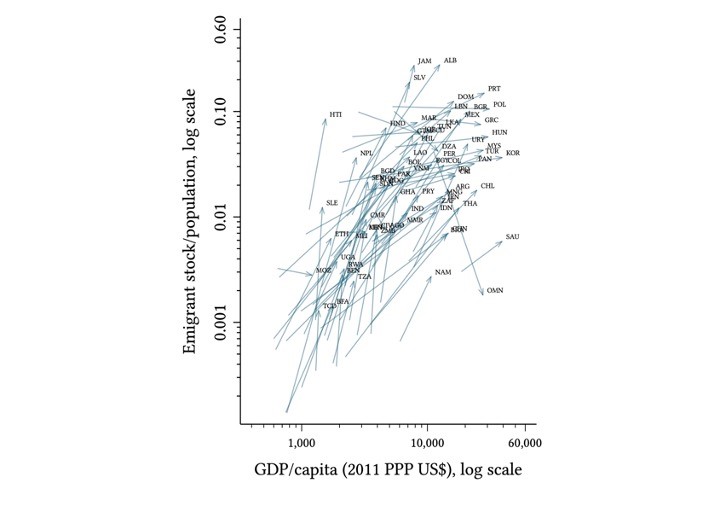
The second paper, by Michael Clemens, studies the same question at the level of nations. As poor countries get richer over time, larger fractions of their populations live outside them. The figure below shows emigration from poor countries to rich countries, on the vertical axis, and average income per capita on the horizontal axis. The arrows show how developing countries moved when they experienced economic growth between 1970 and 2019 (leaving out very small countries). Almost no developing countries have experienced sustained economic growth without a large rise in the emigrant fraction of the population.

These are only sketches of the results, on which the papers carry out numerous tests. For example, the first paper estimates positive self-selection—the greater migration tendency for people with higher earning power—on both observed determinants of earnings (like schooling) and unobserved determinants of earnings (like work ethic). It also checks whether emigration preparations reflect real emigration behavior. The second paper checks whether this pattern arises from differences in country traits that are fixed over time (like geographic location) or global changes that affect all countries (like improved transportation and communications technology).

The quantitative findings of the two papers, despite their different approaches, are strikingly similar. Across households within developing countries, a 100 percent rise in income per adult is associated with about a 30 percent increase in the propensity to be in the final stages of preparing to emigrate. Across developing nations, a 100 percent rise in average income per capita over time is associated with a 35 percent increase in emigration prevalence. In the very long term, economic development may substitute for migration, they find, but for the foreseeable future it is more likely to complement migration.

Why? Certainly it is not the case that workers prefer to stay in countries with less economic opportunity.

The easiest way to grasp the essence of this phenomenon, the authors write, is to think of migration as an investment in human capital. Moving to a new country, like investing in education, brings up-front costs with long-term benefits. Families with more money are more likely, not less likely, to send children to university even though they might have less ‘need’ for the income boost. The things that come along with higher incomes—more and better secondary schooling, and higher career aspirations, among others—produce higher university enrolment by richer families. Related forces are at work in migration. Economic development, too, brings changes of demography, schooling, urbanization, and other structural shifts that facilitate and inspire migration.

From a policy perspective, how should international development agencies engage with these facts? The authors caution against facile interpretation. The emigration of people from Africa is sometimes a sign of short-term crises, but it is simultaneously a sign of long-term economic success. Mass emigration from Scandinavia before 1914 was far from a sign of economic failure, but a sign of that region’s take-off into modern economic growth and the structural changes that came with it. Political debates that view development assistance as a migration deterrent—whether their arguments are pro-aid or anti-aid—may lack a basis in labor-market evidence.

Filed Under: Research Tagged With: aid, Development, migration

Coping with the COVID-19 labor market crisis: Views from Sweden

September 1, 2020 by Mark Fallak

In a series of IZA Newsroom interviews, renowned international labor market experts comment on how their country has been coping with the COVID-19 labor market crisis and how they expect the situation to evolve. These experts have also contributed to the ongoing IZA Crisis Response Monitoring, which provides a detailed assessment of different policy measures. Sweden’s less restrictive approach has been controversial, drawing both praise and criticism from international observers. We asked Lena Hensvik and Oskar Nordström Skans, who are both economics professors at Uppsala University, to share their insider views on the labor market impact of the pandemic in Sweden.

How have you been personally affected by COVID-19?

Lena: After the outbreak of the pandemic, all teaching in Swedish universities moved online. All university employees were instructed to work from home to the extent possible, and stay at home if experiencing any flu-like symptoms. In addition, kids should also be kept at home if showing any kinds of symptoms.

So I’ve been working home from March onwards. Being quite used to online meetings and remote work, I don’t think that the pandemic has changed the very nature of my job. However, working from home while my husband was at home on parental leave with our one-year-old son at the same time has been challenging. I also believe that being physically disconnected from the department for such a long time is costly – it’s just very hard to substitute physical contacts with PhD students and fellow scholars with online interactions.

It’s very hard to substitute physical contacts with PhD students and fellow scholars with online interactions.In terms of my own research, my co-authors and I had just started a randomized control trial on automatic job recommendations at Sweden’s largest job board (Platsbanken) when the pandemic hit, which encouraged us to start documenting the impact of COVID-19 on online job search behavior and vacancy listings. Working on the impact of the crisis has helped me to keep focus in these uncertain and scary times.

Oskar:  Like Lena, I have been confined to working from home throughout the period and been teaching on zoom. It has all worked out reasonably well, but from now on I will work from the office a few times a week – and it is just excellent. Workwise, the crisis has called for a lot of policy work and media attention, making it hard to progress with research. My children have been attending school throughout, which we all appreciated. Obviously, all holiday plans had to be cancelled.

Not being able to meet with older family members has been the hardest part of it all.

Personally, not being able to meet with older family members has been the hardest part of it all. When domestic travel was allowed at the onset of summer, we were able to travel to my parents who live in the north of Sweden and arrange to meet them outside, which was great. Since my wife’s family live in Finland, we have not yet been able to visit them, however.

How do you assess the current labor market situation in Sweden and the role that government policies have played so far?

Lena: The situation was very dramatic initially, in Sweden as elsewhere. One needs to understand that the Swedish restrictions, although formally presented as “recommendations that all must follow” rather than a legally enforced lockdown, had a massive impact on people’s behavior early on during the crisis. For example, restaurants remained open (with restrictions), but their sales dropped by 70 percent from one week to the next. This does not happen without a serious impact on the economy. But the situation is gradually improving.

Oskar: The short-time work scheme that was set up in response to the crisis seems to have helped a lot. Together with some other targeted policies and guarantees for loans (that often were not used), these policies seemed to have put firms in a position where they were able to wait and see how the crisis unfolded, rather than shredding their workers or going into bankruptcy.

In terms of the health impact, we have clearly fared worse than our closest neighbors.

In comparison with the rest of Europe, the Swedish economy seems to have fared slightly better, but on the other hand, the economic impact is not very different from that in our neighboring countries, where health restrictions were somewhat stricter. In terms of the health impact, we have clearly fared worse than our closest neighbors, although probably not as bad as the UK and some southern European countries that used even stricter measures than our neighbors. Overall, comparing these things – in particular the health part on which we are not experts – at such an early stage remains difficult, but it is clearly important to evaluate all of this when going forward.

What would you consider the most probable labor market scenario in the next six to twelve months?

Lena: We expect the market to gradually improve for the most part. Hopefully, many of the jobs that suffered from the impact of early recommendations can gradually resume business as usual. The resumption of activity is perhaps a more gradual process than in other countries, since restrictions are less formal.

The only hope for a swift labor market rebound is the resumption of previous businesses.

Oskar: We expect some sectors, such as event organizers, cultural workers, or travel agencies, to continue to suffer for an extended period of time, but there is some hope that other affected service sectors can fare better. This is important as the only hope for a swift labor market rebound is the resumption of previous businesses – creation of new jobs and restructuring is always more time-consuming.

What policies would be best suited to support the recovery of employment in Sweden?

Oskar: In our view, it is important to use more active support, in particular to firms. Just as when granting benefits to individuals, there is a tension between accurate targeting and incentives when subsidizing firms. Benefits, such as short-time work schemes, that grant money to firms if and only if they reduce production obviously risk prolonging the recession by subsidizing inactivity.

We would like to see targeted support to firms that leave the short-time work scheme prematurely.

Instead, we would like to see targeted support (e.g. lower payroll taxes) to those firms that leave the short-time work scheme prematurely. Similarly, we would like to see a resumption of the coinsurance and monitoring parts of the sickness insurance system for all except those with certified Covid-19 infection. This will help reduce absence, and increase the speed of recovery.

Lena: The same principles should apply to active labor market policies. Everything that encourages early resumption of productive economic activity should be prioritized.

Which aspects of the crisis response in Sweden do you find most remarkable?

Oskar: As in other countries, there were some remarkable and extremely costly public support systems for firms set up in just a few weeks. And there are some interesting examples where firms managed to retrain their staff (e.g. flight attendants) into health care staff in just one or two weeks. These are important lessons for the future.

Lena: It is also interesting to see the adjustments made on the worker side. As an example, there has been a 30 percent increase in applications of prospective students to nursing programs at universities, which is very good news as this is a profession where the lack of skilled workers is particularly salient.

Job-seekers’ willingness to search for other jobs than in “normal times” is encouraging.

Similarly, together with some co-authors I published a recent IZA Discussion Paper which shows that job-seekers seem willing to make job search adjustments by directing their search efforts towards vacancies from the more resilient occupations. This willingness to search for other jobs than in “normal times” is encouraging because it means that workers will respond to policies aiming to bring workers and available jobs closer together.

Filed Under: Opinion Tagged With: COVID-19, Sweden

Graduating in a pandemic may lead to long-term income losses

August 31, 2020 by Mark Fallak

In 2019, times were rosy for job seekers. Employment reached a record high in Germany since 1990, and the U.S. job market was the strongest in 50 years. Then the coronavirus hit the world and caused the most severe economic crisis in modern times. Jobs disappeared at an unprecedented rate, with U.S. unemployment rising to 14.2 percent in April and only slowly recovering to about 10 percent at the end of July. Even in Germany, which has so far weathered the crisis fairly well, almost 635,000 jobs have been lost year-on-year in July 2020.

For young people unfortunate enough to graduate during the pandemic, this is a bleak outlook. Fewer job opportunities will make school-to-work transitions difficult, possibly imposing large and long-lasting losses. IZA research has repeatedly shown that graduates who leave school in a recession earn substantially less in their first jobs. Although earnings tend to recover after a few years when labor market opportunities improve again, a large gap in lifetime income remains. For example, an earlier IZA paper based on Canadian data from the 1980s and 1990s suggests that a 3-4 percentage points higher unemployment rate at the time of graduation results in average losses of 5 percent in lifetime earnings.

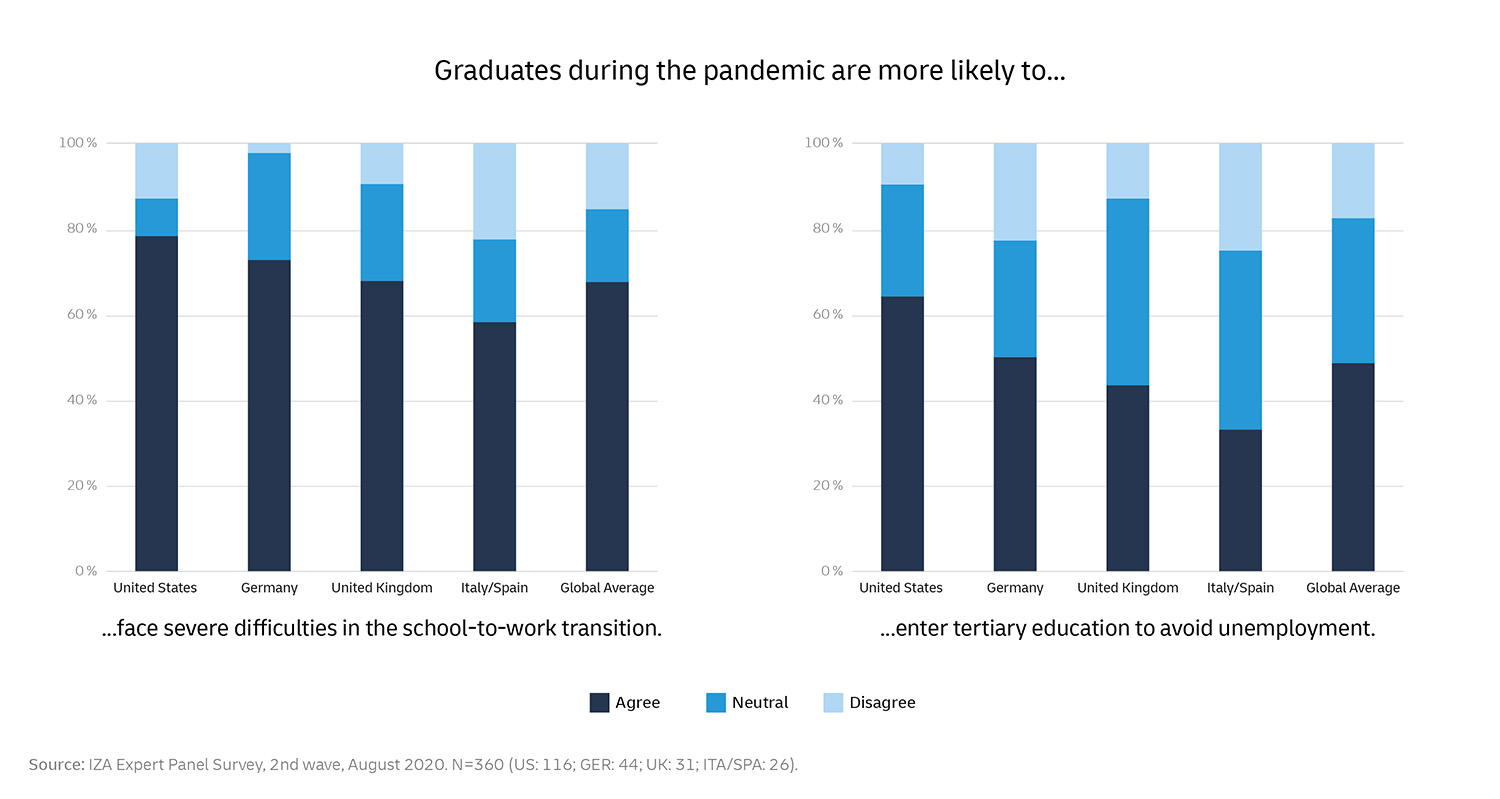
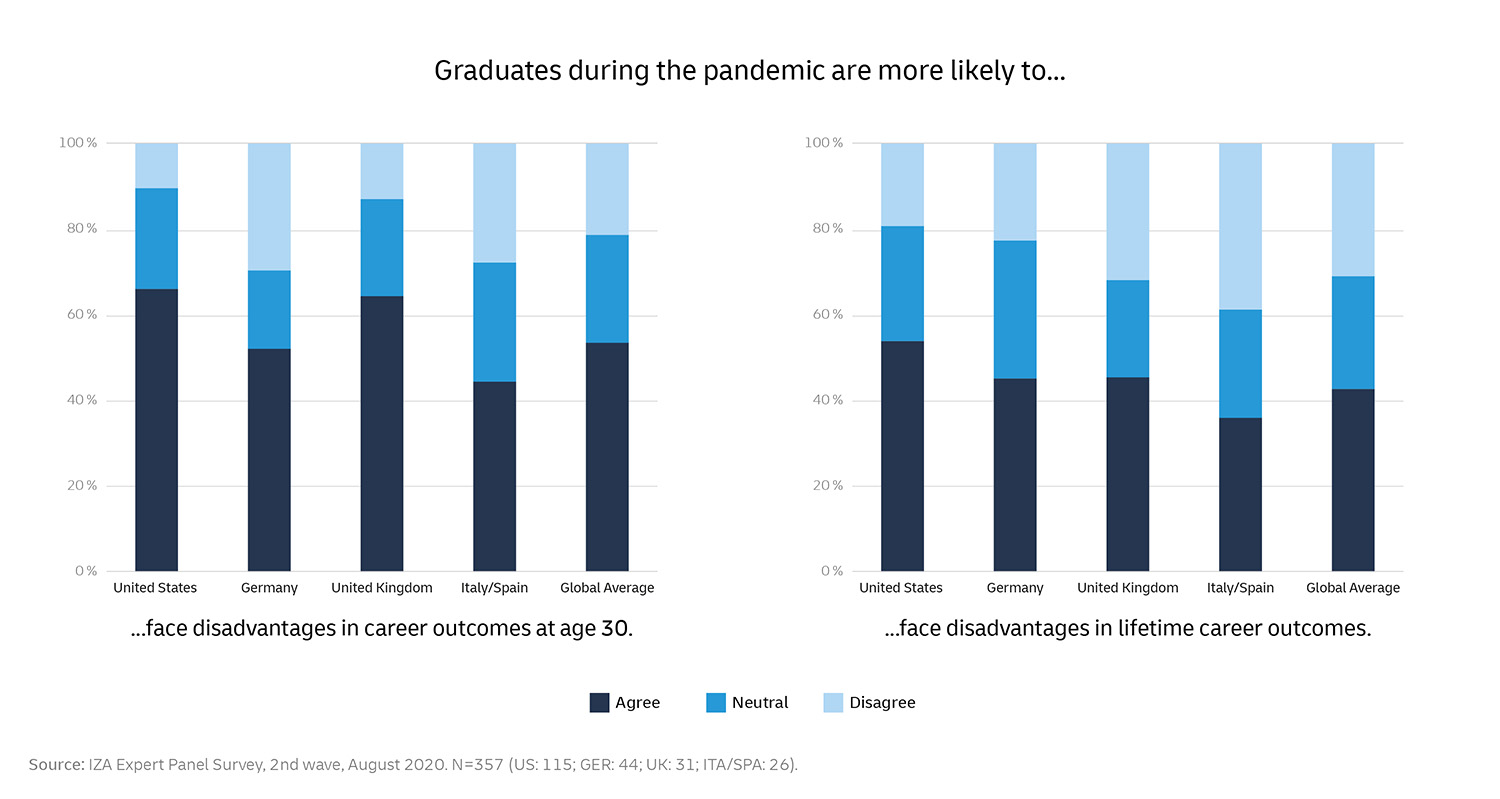
What are the expected effects of the current pandemic on recent graduates? The latest wave of the IZA Expert Panel asked labor economists from about 50 countries how they believe the COVID-19 crisis will affect labor market entrants in their countries.

The analysis shows that more than two-thirds of the experts expect 2020 graduates to have greater difficulties in the important school-to-work transition than previous cohorts. Remarkably, both U.S. and German experts are more pessimistic than the average, whereas labor market researchers in Italy and Spain provide a slightly more optimistic outlook. While the survey does not shed light on the reasons for these country differences, a possible explanation may be that the latter countries had already faced high youth unemployment rates before the crisis. In contrast, U.S. and German job markets for graduates were exceptionally strong in previous years, which could make a larger drop appear more likely.

Moving on to tertiary education is an option for young people to avoid unemployment in a tight job market while at the same time investing in their human capital to improve future earnings prospects. This option seems to be particularly relevant in the UK, where more than 60 percent of the surveyed experts believe that secondary school graduates will be more likely to enter tertiary education.

Regarding the longer-term impact on career outcomes, the experts (particularly those from the US and UK) expect significant disadvantages at age 30 for those who graduate during the recession. These negative effects are expected to fade over time, as reflected in the somewhat more favorable outlook on lifetime career disadvantages. Once again, respondents from Italy and Spain are less likely to expect large negative effects. As suggested above, this may to some extent be due to country differences in pre-crisis labor market conditions.

What can graduates in a pandemic do to make the most out of their situation? IZA Research Fellow Philip Oreopoulos from the University of Toronto provides some advice in a recent IZA World of Labor opinion piece. In addition to staying in education, he suggests volunteering as a way to apply one’s skills and gain experience that may prove useful in future job interviews. Nonetheless, recent graduates will likely need to be more mobile and flexible in their job preferences than previous cohorts.

+++

Read more about previous findings from the IZA Expert Survey:

  • High-skilled workers expected to suffer less from the COVID-19 crisis
  • U.S. experts favor income support to mitigate the COVID-19 labor market crisis

Filed Under: IZA News, Research Tagged With: career, COVID-19, education, graduate, school-to-work, youth unemployment

Does the dream of home ownership rest upon biased beliefs?

August 19, 2020 by Mark Fallak

For many people, home ownership is a long-cherished dream. Particularly in times with low interest rates, many tenants consider buying an apartment or a house. But this decision not only entails a major financial commitment. It also involves many trade-offs with significant long-term consequences, such as foregoing leisure in order to be able to save more, or longer commutes due to reduced mobility. If beliefs about the imagined benefits were biased, this may result in sub-optimal investment decisions.

A new IZA discussion paper by Reto Odermatt and Alois Stutzer assesses whether people correctly predict the well-being benefits of moving from a rented to a privately owned home. They analyze data on predicted and realized life satisfaction of more than 800 prospective home owners in a sample of 25,000 individuals from the German Socio-Economic Panel (GSOEP).

Predicted and realized life satisfaction

In this annual survey, participants are asked about their individual life satisfaction on a scale from 0 (not satisfied at all) to 10 (very satisfied), as well as how satisfied they expect to be in five years’ time on the same scale. Comparing predicted life satisfaction with the actual realizations allows the authors to assess the accuracy of home owners’ prediction of their future well-being.

The analysis provides evidence that is consistent with the idea that home ownership positively contributes to people’s life satisfaction. However, the study also finds that people are overly optimistic about the extent of the positive long-term satisfaction gains. This provides support for the speculation that in the decision-making process people rely on biased beliefs regarding the long-term benefits of home ownership.

Status seekers prone to misprediction

In order to additionally and more directly test the relevance of beliefs for people’s accuracy of their predictions, the authors consider heterogeneity in people’s life goals as a proxy for different underlying beliefs. The results show that individuals who value things like income, success, and the ability to buy goods relatively highly commit significant errors, while the others do not. This suggests that the risk of biased beliefs is particularly high for those who consider buying a home also for status reasons.

Role of beliefs in economics and public policy

The study questions the ancillary role that is ascribed to beliefs in most economic applications as well as in public policy. Importantly for economics, in cases where people’s decisions in life are based on biased beliefs, individual behavior would not reveal true preferences, but rather beliefs about preferences. This would undermine a key tenet of traditional economics, which holds that preferences can be inferred from observed behavior.

From a public policy perspective, the authors argue that the focus should be more on the forces and actors that influence people’s beliefs, for example with regard to images and narratives offered by the media or the advertising industry. If these actors pursue private interests, influence might translate into attempts at manipulation. The researchers thus point at the importance of identifying the conditions under which biased beliefs evolve and influence decision-making processes – an account that economics has not offered so far.

Filed Under: Research Tagged With: behavior, beliefs, bias, happiness, home ownership, life satisfaction

Do refugee classmates affect the educational attainment of native students?

July 20, 2020 by Mark Fallak

With about one million refugees coming to Europe at the height of the refugee immigration in the mid-2010s, European societies faced a range of both opportunities and challenges. A major concern among policymakers and the public was that large shares of refugee children with language barriers in the classroom would put an additional strain on the already scarce time resources of teachers.

A new IZA paper by Colin P. Green and Jon Marius Vaag Iversen examines what happens to the educational attainment of primary school children in Norway when they attend school with more children from a refugee background. Norway provides an interesting setting due to relatively recent dramatic increases in immigration, and historically a very low immigrant base.  For instance, while only 3.5 percent of the total population of Norway in 1990 were immigrants, they now account for 14.7% of the total population. A substantial share of this increase is refugees, who make up roughly one in four recent immigrant arrivals to Norway.

Like other Scandinavian countries, Norway exercises a range of controls on the location decisions of these refugees. In practice, this leads to children from a refugee background being quite spread across Norway, and across Norwegian schools.

Lower math scores among native school children

To identify a causal effect of higher refugee shares in the classroom, the authors compared Norwegian siblings exposed to different shares of refugees at the same time of their educational careers. They find a negative effect of refugee classmates on the math test scores of non-immigrant Norwegian students: An increase in the refugee share by five percentage points reduces the math test scores of each Norwegian student in the school grade by an average amount that is equivalent to three percent of an expected year’s progress. In contrast, the share of economic immigrant students without a refugee background does not affect the educational performance of native students.

Since boys and children from lower educational backgrounds are found to be especially vulnerable, this may exacerbate educational inequality. The authors provide evidence that these negative effects may reflect a lack of compensatory inputs at the school level in terms of class size, instruction hours per student, and student-teacher ratios.

Filed Under: Research Tagged With: education, math, Norway, refugee, schooling

  • Previous Page
  • Page 1
  • …
  • Page 20
  • Page 21
  • Page 22
  • Page 23
  • Page 24
  • …
  • Page 30
  • Next Page

Primary Sidebar

© 2013–2025 Deutsche Post STIFTUNGImprint | Privacy PolicyIZA