• Skip to primary navigation
  • Skip to content
  • Skip to primary sidebar

IZA Newsroom

IZA – Institute of Labor Economics

  • Home
  • Archive
  • Press Lounge
  • DE
  • EN

“We need to talk about Mechanical Turk”

August 25, 2022 by Mark Fallak

In academia, researchers use statistical thresholds to decide whether a hypothesis is likely to be true. An unintended consequence of statistical thresholds is that they may lead to p-hacking. The term p-hacking refers to research choices being made in such a way as to artificially inflate statistical significance. Approaches to p-hacking can take various forms, including in the way data is cleaned, variables defined, and specifications chosen.

Concerns about the propensity for p-hacking to undermine research credibility in recent years have led to increased interest in pre-analysis plan and pre-registration, among other tools (see a new IZA discussion paper for more on this).

In another new IZA discussion paper, Abel Brodeur, Nikolai Cook, and Anthony Heyes investigate the extent of p-hacking for studies using the online platform Amazon Mechanical Turk (MTurk). This platform has seen an unequaled increase in use in economics and management research over the past decade, partly due to giving researchers the ability to build large samples at low cost. However, in parallel with the growth in use of MTurk has come a growing suspicion in some research communities about the reliability of results from studies using it.

Substantial p-hacking and publication bias found

The paper provides the first systematic investigation of the statistical practices of the research community itself when using MTurk, and the extent to which those practices render MTurk-based empirical results untrustworthy. The practices under study are those that have become focal in recent assessments of research credibility elsewhere, namely (1) p-hacking, (2) publication bias (or selective publication), and (3) the presentation of results from plausibly under-powered samples.

The authors analyze the universe of hypothesis tests from MTurk papers published in all journals categorized as either 4 or 4* in the 2018 edition of the Association of Business School’s Academic Journal Guide between 2010 and 2020, around 23,000 in total. Their findings suggest that the distribution of test statistics (see figure below) from MTurk exhibits patterns consistent with the presence of considerable p-hacking and publication bias.
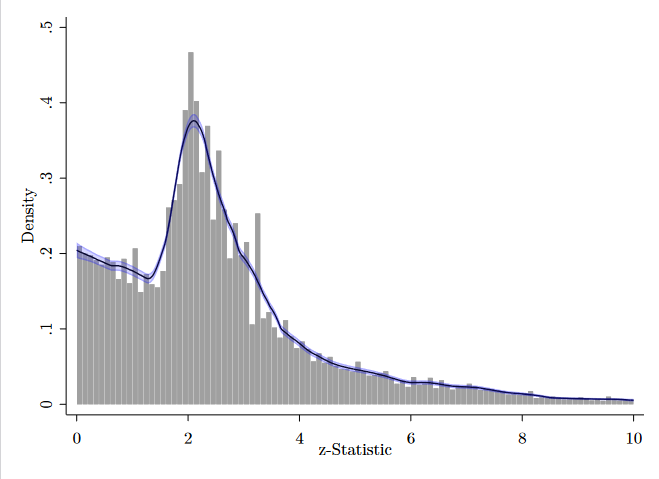
It exhibits a pronounced global and local maximum around a z-statistic value of 1.96, corresponding to the widely accepted threshold required for statistical significance at the 5% level, or a p-value of 0.05. This maximum is coupled with a shift of mass away from the marginally statistically insignificant interval, indicative of p-hacking.


This pattern of test statistics is persistent over time and roughly as present in papers published in elite (rank 4*) and top (rank 4) journals.
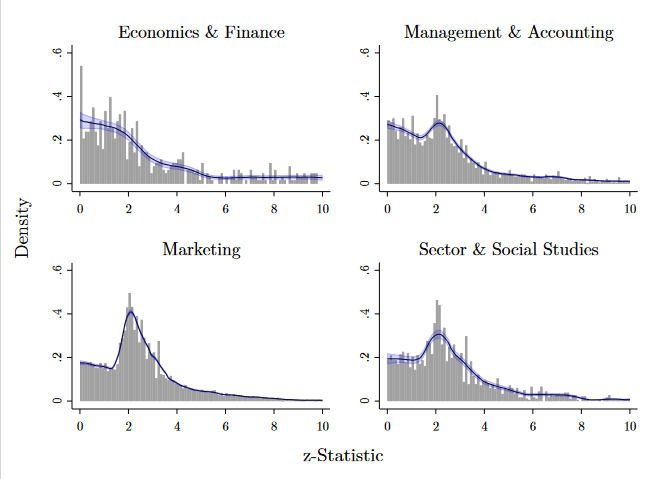
The extent of the problem varies across the business, economics, management and marketing research fields (with marketing especially afflicted).
Underpowered studies with small sample sizes

The power of a statistical test is the probability of detecting an effect (rejecting the null hypothesis of no effect) if a true effect is present to detect. The appropriate choice of sample size, and therefore level of power, is a central element of experimental research design.

However, most MTurk studies use small sample sizes (with a median number of 249  subjects per experiment) without giving justification as to how a particular sample size was chosen. Cost does not seem to be the reason as the average cost of an additional data point (in the analyzed sample of studies) is 1.30 USD – and less than 1 USD in 70 percent of cases.

More rigorous attention to statistical practice needed

The authors describe their findings as “in one sense pessimistic and in another optimistic.” On the one hand, they find the credibility of results contained in the existing corpus of research using the MTurk platform to be substantially compromised: “If a reader were to pick at random a study from our sample, our analysis points to this result being unlikely to be replicable.”

On the other hand, the flaws they identify relate to the way in which MTurk experiments are conducted, and results selected for publication, by the research community, rather than flaws inherent to the platform itself. This distinction is important as it suggests that there is no reason – at least from this perspective – for researchers to discontinue to use MTurk and other similar platforms.

Instead, the authors call for more rigorous attention to statistical practice. In particular, the use of larger samples to provide appropriately powered experiments should become more common – which seems feasible, given that this is an area of research where data points can be purchased on the cheap.
Filed Under: Research Tagged With: Amazon Mechanical Turk, crowd sourcing, online platforms, p-hacking, publication bias, research credibility, statistical power

Who is more productive from home?

August 23, 2022 by Mark Fallak

The COVID-19 pandemic generated a sharp increase in the number of remote jobs. The future of teleworking ultimately depends on its impact on workers’ productivity and well-being, yet the effect of remote working on productivity is not well understood: Some studies report an overall improvement in productivity whereas others document the opposite.

An explanation for this mixed evidence may lie in the transmission channels linking teleworking and productivity. In addition to direct mechanisms, such as the quality of ICT infrastructure or the change in managerial oversight, teleworking can affect productivity through well-being. On the one hand, remote work grants workers a larger autonomy, positively contributing to job satisfaction. It also reduces stress and fatigue associated with commuting. On the other hand, isolation and difficulties to separate work and private life can have the opposite effect. A recent study by the German trade union federation highlights both sides of the coin.

Overall, the balance of these pros and cons can greatly vary across individuals. The existing literature emphasizes the importance of gender and occupation for the productivity of teleworking, but a large share of this heterogeneity remains unexplained.

Conscientious workers are more productive when working from home

A new IZA discussion paper by Nicolas Gavoille and Mihails Hazans investigates the link between personality traits and workers’ productivity when working from home. The authors exploit a survey that provides measures of the “Big Five” personality traits for more than 1700 individuals in Latvia who worked only or mostly from home during the COVID-19 pandemic.

The results indicate that personality traits do matter for productivity in a remote work setup. In particular, conscientiousness plays an important positive role for productivity in teleworking and the willingness to work from home in the post-pandemic period. These relationships are statistically significant but also economically meaningful: Controlling for a battery of factors, the difference in probability to report a higher productivity from home than in office between individuals at the 75th percentile of the Conscientiousness score and those at the 25th percentile is 8.4 percentage points. This is a relatively large change given the average probability of 31%.

This important role of conscientiousness is in line with many previous studies documenting positive correlation between conscientiousness and key labor market outcomes. Similarly, Openness to Experience is also positively correlated with the productivity measure and willingness to work remotely post-pandemic.

Concerns about adverse self-selection seem unfounded

These results suggest that pro-teleworking employers will observe selection on personality traits into their workforce. Given that conscientiousness is desirable to all employers, while openness to experience is desirable at least to employers in growing and/or innovative firms and organizations, this selection is positive from the employer perspective, mitigating employers’ concern about adverse self-selection in flexible working arrangements.

Observing that highly conscientious workers are more willing to work from home, where they are more productive, suggests that firms do not need to exert a very strict control on their employees choosing to telework. This finding contrasts with the results of an earlier IZA paper from Belgium, claiming that individuals with a higher level of conscientiousness find job offers allowing for work remotely less attractive. The authors of the new study suggest that conscientious workers who already have (positive) experience with remote work may have found some of their prejudices overthrown.

In addition, their study uncovers a negative relationship between Extraversion and preference for teleworking, suggesting that employers practicing remote work should invest in socialization measures to compensate the negative effect of teleworking on well-being of more extravert workers.

Overall, the findings of this study suggest that a one-size-fits-all policy is unlikely to maximize firms’ productivity nor workers’ satisfaction. Individual workers’ characteristics are indispensable when estimating firm-level ability in switching to remote work.

Filed Under: Research Tagged With: personality, productivity, remote work

Children benefit from longer parental leave

July 25, 2022 by Mark Fallak

Most young children in Western societies spend a considerable amount of time in institutional care. But because of different parental leave policies and different preferences among parents, the age at which children enter institutional care ranges from anywhere between shortly after birth to several years later. Though early psychological studies and attachment theory suggest that separating a young child from their primary caregiver may affect their development, little causal evidence exists on whether the duration of parental leave influences child development and well-being in the long run.

In a recent IZA discussion paper, Mikkel Aagaard Houmark, Cecilie Marie Løchte Jørgensen, Ida Lykke Kristiansen, and Miriam Gensowski investigate this by exploiting the implementation of a reform in Denmark that increased paid parental leave from 24 to 46 weeks. Using a nearly universal survey of the well-being of elementary school children, the authors construct different measures of socio-emotional skills. These are distinct from the cognitive skills (e.g., IQ and school performance) more commonly studied in the economic literature, but are equally important for a happy, healthy and wealthy life.

The authors find that children of mothers who took longer leave because of the reform have better outcomes measured at adolescence (grades 7 and 8). For each additional month of leave, the children have 4.7 percent higher well-being, 3.5 percent higher conscientiousness, and 2.8 percent higher emotional stability. In addition to these self-reported improvements, the children also have 2.7 percent fewer days of school absence.

Consistent with a theoretical model that they develop, the authors go on to show that the children who benefit the most from an increase in parental leave are those who would otherwise have entered daycare at a very early age. Not only do these children report significantly higher socio-emotional skills and well-being – they also have less school absence and receive better grades from their teachers.

Finally, the authors show that the children who benefit the most from additional parental leave are those who tend to be worse off on all their measures. This means that the increase in parental leave also reduces socioeconomic inequality in child development.

Together, these findings show that parental leave policies can affect both the level and distribution of a range of educationally relevant child outcomes. This study from Denmark thus provides a more positive assessment of longer parental leave than an earlier IZA paper from Norway and a study from France, both of which found parental leave extensions (though more generous extensions than those analyzed in Denmark) to run counter the intended social policy goals.

Filed Under: Research Tagged With: adolescence, early childhood, parental leave, personality, skill formation, socio-emotional skills, well-being

Cutting disability insurance benefits may come at a cost

July 8, 2022 by Mark Fallak

The share of working-age adults receiving long-term disability insurance (DI) benefits has increased rapidly over the last few decades and DI programs currently account for over 10% of social spending in OECD countries. This development has led to a search for effective policies that help reduce the public cost of disability insurance.

One way that policy makers try to limit the take-up of DI benefits and incentivize work is setting earnings limits: Once beneficiaries earn above a certain level, they lose their benefits. The rationale behind earnings limits is the presence of asymmetric information: As the government cannot observe applicants’ true health status or work capacity, it must rely on a screening mechanism. The screening mechanism is supposed to ensure that only workers who are unable to earn above a certain level will apply for benefits, while potential applicants with higher working capacity will find it advantageous to forego benefits and remain employed instead.

While a tight earnings limit might thus be a suitable screening device that keeps entry into the program low, it may also create strong work disincentives for benefit recipients. This may especially be the case in labor markets with high earning risks where the benefit provides a stable source of income for recipients.  When setting the earnings limit, policy makers thus face a tradeoff between the selection (or screening) effect of the earnings limit and the labor supply effect.

Selection and labor supply effects

In a recent IZA Discussion Paper, Judit Krekó, Daniel Prinz and Andrea Weber first formalize this idea in a theoretical framework that explains what happens if the government decreases the earnings limit in the DI program. In this case, the set of workers who apply for benefits shrinks as only less-productive workers will prefer benefit receipt and limited work.

At the same time, another effect is at play: Conditional on receiving benefits, a lower earnings limit means that beneficiaries will set their labor supply lower in order to remain eligible for benefits. The authors call these two effects of changing the earnings limit the selection and labor supply effects. At the optimal earnings limit, the selection effect and labor supply effects of moving the earnings limit will balance each other out for the marginal entrant. For policy design it is thus important to estimate these effects empirically.

Reform in Hungary

In the second part of the paper, the authors study a reform that reduced the earnings limit form 80% of the pre-disability wage to 80% of the minimum wage in Hungary’s Regular Social Assistance (RSA) program for the moderately disabled. Importantly, the reform only applied to new entrants taking up benefits as of January 1st 2008, while it remained the same for beneficiaries who were already approved.

The paper exploits this policy change to understand how selection into the program and labor supply once in the program changed. To this end, the study compares the evolution of various measures of labor supply relative to the start of benefit receipt among beneficiaries who enter before (“old entrants”) and after (“new entrants”) the reform date.

Empirical findings

The empirical analysis results in three main findings. First, the authors find that the decrease in the earnings limit only had a small impact on selection into the program. There is no evidence of decreased program entry rates. But consistent with the screening mechanism, individuals who entered the program after the reform had worse pre-entry labor market outcomes than beneficiaries who entered earlier.

Second, though exit from DI benefits is not common even among the moderately disabled beneficiaries, a further margin that could have been potentially affected by the earnings limit is the probability of staying on the program. There is no evidence that new entrants were more likely to exit the program than old entrants.

Third, it is found that individuals who entered the program after the earnings limit was reduced had meaningfully lower labor supply post-entry. While new entrants were as likely to be employed as old entrants, they worked less conditional on being employed. This labor supply response is driven by beneficiaries with higher pre-disability earnings, who were most affected by the change in the earnings limit.

Forth, to examine the impact of the lowered earnings limit on beneficiary health, the authors consider mortality, an imperfect measure of health. Their results suggest no change in mortality which means that the primary effect of the reduction of the earnings limit on beneficiaries was through reduced work.

Policy implications

Overall, the results suggest that decreasing the earnings limit only led to a moderate improvement in screening efficiency. This evidence is consistent with a scenario where the earnings limit and benefit level before the reform were already sufficiently low to deter potential entrants who are well-positioned to find higher-paying jobs in the labor market.

At the same time, the reform substantially distorted the labor supply of program participants. Viewed through the lens of the model, the empirical findings suggest that the overall impact of the reform on efficiency and welfare was negative. The authors conclude that the reform failed to yield sizable cost savings from benefit expenditures for the government, but left moderately disabled individuals with lower earnings, resulting in lower tax revenues in turn. At the given benefit level, a higher earnings limit would therefore be optimal.

Filed Under: Research Tagged With: disability insurance, Hungary, labor supply

Increased wage transparency in job postings has no effect on gender pay gap

July 1, 2022 by Mark Fallak

The gender pay gap has gradually narrowed over the last decades, with the remaining gap due in part to gender differences in occupation, industry, and firms. Several recent studies confirm that differential sorting between men and women into high-paying firms is a major contributor to the gender pay gap in various countries.

Pay transparency has recently received significant attention as a policy tool to narrow the gender wage gap. These efforts presume that female workers, who tend to earn lower wages, are unaware of these differences and will choose different jobs or bargain more if wage transparency increases. Most of the existing transparency laws require firms to reveal wages or compile wage reports about the current employees. This helps coworkers to compare their pay but the data are often less accessible to outsiders.

In a new IZA Discussion Paper, Omar Bamieh and Lennart Ziegler study an alternative policy that requires firms to provide at least a lower bound for wages already in their job ads. Linking Austrian vacancy data to information on eventual hires, they show that such wage postings do not change the probability of women working in higher-paid jobs.

Since the gender wage gap is precisely estimated and remains constant during the period of observation, even smaller reform effects can be ruled out. Further analyses of job-to-job transitions show that a lack of worker mobility cannot rationalize the null effect. Many job seekers find new employment at firms and in occupations that differ in pay from their previous job. The authors interpret the absence of effects as evidence that missing wage transparency is not the root of persistent gender differences in the labor market.

It seems that financial gains from switching to a better-paid job may not outweigh preferences for a specific employer or occupation. Previous studies show that other non-pecuniary amenities such as flexible working hours or short commuting times are more important for female workers, especially if additional child care responsibilities exist. Hiring discrimination of employers might additionally limit a shift towards better-paid jobs even when preferences change due to increased transparency.

Filed Under: Research Tagged With: Austria, gender pay gap, job search, wage transparency

Minimum wage increases lead to substantial declines in vacancy postings

June 24, 2022 by Mark Fallak

Since the last federal minimum wage increase in the US in 2009, many states have enacted state-level changes to their minimum wage laws. Most recently, on January 1st 2022, twenty states increased their minimum wage, while the US Congress debates a similar federal-level increase. A broad-based minimum wage increase might appear as an attractive labor market policy tool to boost wages and lower poverty among low-wage earners. However, economic theory predicts that, in a competitive labor market, a minimum wage hike might lead to a decline in employment. This issue has motivated a long-lasting, at times contentious, debate in the literature on the effect of minimum wage increase on employment.

In a recent IZA discussion paper, Marianna Kudlyak, Murat Tasci and Didem Tuzemen study the effect of minimum wage increases on vacancies. They combine occupation-specific county-level vacancy data from the Conference Board’s Help Wanted Online at a quarterly frequency with the data on minimum wage changes at the state level. The authors separately estimate the effect of minimum wage increases on existing vacancies (stock) and new vacancies, i.e., less than 30-day old (flow).

Occupations that typically employ lower-educated workers affected most

The study finds a statistically significant and economically sizeable negative effect of the minimum wage increase on vacancies. Specifically, a 10 percent increase in the level of the effective minimum wage reduces the stock of vacancies in at-risk occupations by 2.4 percent and reduces the flow of vacancies in at-risk occupations by about 2.2 percent. At-risk occupations are such occupations with large shares of employed workers at or near the state-level effective minimum wage. Accordingly, vacancies in occupations that typically employ workers with lower educational attainment (high school or less) are affected more negatively than vacancies in other occupations.

So far, most studies have found relatively small or non-existent effects of minimum wage hikes on employment. How can this be reconciled with the findings of the new paper? Vacancies reflect the quantity of labor demanded by firms and serve as one of the adjustment margins that firms can use to reach their optimal level of employment. In contrast, employment is an equilibrium object, determined jointly by labor supply and labor demand; therefore, changes in employment reflect a combination of various margins of adjustment to a policy change.

Minimum wage hike might lead to a decline in turnover

The effect of the minimum wage on hiring is ambiguous because while vacancies decline, job seekers’ input increases—either due to the increase in the number of job seekers or search efficiency. Even though on impact one might expect a higher rate of separations due to the dissolution of some marginal matches, a higher minimum wage forces all new matches to satisfy a higher threshold for productivity. This, in turn, makes these new matches more durable relative to an environment with a lower minimum wage. One implication of this is that a minimum wage hike might lead to a decline in turnover as employees stay longer with one employer but possibly no change in the stock variables such as unemployment and employment.

By analyzing vacancy postings, the authors provide more insight into firms’ behavior as they adjust to minimum wage changes. Understanding these different margins of adjustment may provide more context for policymakers and researchers on the contentious debate of the employment effects of minimum wage increases.

Filed Under: Research Tagged With: hiring, minimum wage, search and matching, vacancies

Minimum wage contributed to rise in solo self-employment

May 23, 2022 by Mark Fallak

The share of “solo self-employed” individuals – those who operate on their own account without any employees – is on the rise in most developed countries. This coincides with a more general trend towards alternative work arrangements, such as agency workers, on-call workers, contract company workers or independent contractors.

Understanding the consequences of this development is important because many of these jobs are characterized by less favorable working conditions. For instance, solo self-employment typically does not offer the same employment protection, social insurance or pension entitlements as dependent employment. Accordingly, solo self-employed individuals share important characteristics with underemployed workers, such as lower earnings and working hours, a higher incidence of part-time and a higher risk of income loss. These atypical jobs may therefore not be entirely voluntary. Yet, little is known about the drivers of such alternative work arrangements, especially the role of policies and regulations.

In a new IZA paper, Angelika Ganserer, Terry Gregory and Ulrich Zierahn investigate the impact of minimum wage policies on solo self-employment. They exploit a quasi-experimental setting: Germany introduced its first minimum wages on an industry level, starting with main construction, roofing, electrical trade, and painting. No other industry was subject to a minimum wage regulation at that time, providing the opportunity to compare a set of treated industries with all other comparable but uncovered industries, using on a long time series of data.

To identify self-employed individuals, defined as firm owners without employees, the authors exploit a micro-level firm data set (Mannheim Enterprise Panel) that comprises the universe of active firms in Germany and contains detailed industry codes for the level on which the first minimum wage regulations were introduced. They match this data with industry-level workforce data prepared from a two percent random sample of all workers in Germany that are subject to social security contributions (i.e., excluding self-employed and public servants).

Strong increase in solo self-employment in German minimum wage industries

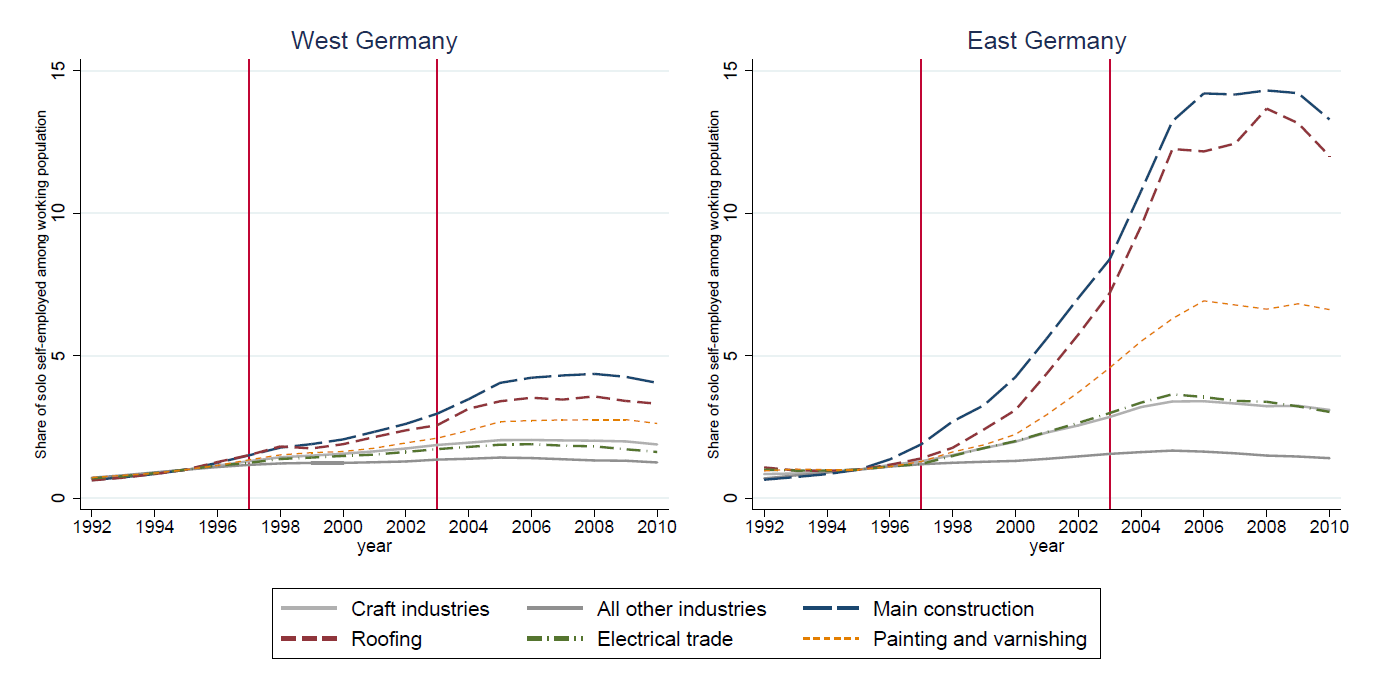
For Germany, the authors find that the share of solo self-employed individuals among the workforce increased from 2.3% to 4.9% during the observed time period 1992-2010. The figure below demonstrates that the increase occurred very heterogeneously across industries and between the eastern and western parts of the country. Most strikingly, the increase was significantly stronger in the minimum wage industries, compared to all other industries.

Trends in Solo Self-Employment

To investigate the causal impact of the policy reform, the authors apply a synthetic control group approach, which allows them to compare a set of treated industries with all other comparable but uncovered industries. The results suggest that the minimum wage induced a substantial increase in solo self-employment: Depending on the industry and region, the first-time adoption of a minimum wage increased the share of solo self-employed individuals between 1.1 and 8.5 percentage points. For some industries, this meant a sixfold increase in solo self-employed individuals compared to pre-treatment years.

High-skilled workers involuntarily search for alternative income sources    

The increase in solo self-employment can be explained by a decline in earnings perspectives of potential solo self-employed (due to the German Meisterzwang, which requires a master craftsman certificate to start an own firm in the industries under study, these comprise only high-skilled workers). In line with a substitution-scale model, the authors show that while the minimum wage induced a substitution of low- by high-skilled workers (positive substitution effect), at the same time all skill groups suffered equally from an overall decrease in labor demand in response to the minimum wage-induced labor cost shock (negative scale effect). As a result, net high-skilled labor demand substantially decreased, pushing them into solo self-employment.

The study indicates that the decision of high-skilled workers to become solo self-employed was not entirely voluntary. The theoretical model suggests that a high minimum wage pushes high-skilled workers with less favorable characteristics into self-employment whenever they face worsening perspectives in dependent employment. In line with this hypothesis, the authors find declining revenues (i.e., incomes) of solo self-employed individuals, especially among those who started their business in reaction to the policy reform. As argued by other studies, this could reflect that firms outsource work by re-grading their employees as independent self-employed contractors or using other alternative work agreements to buffer the cost shock induced by the minimum wage.

How transferable are the results?

Whereas the authors’ study focuses on selective industries in Germany, these effects generally occur whenever the scale effect (overall decline in industry employment) exceeds the substitution effect (substitution towards high-skilled workers in reaction to the change in relative input prices).

Then, high-skilled workers face lower labor demand and become solo self-employed. This can happen, for instance, in situations where the bite of the minimum wage is large or whenever the economy faces a downturn, forcing increases in wages and prices and triggering declines in demand and output.

For instance, the authors show that the magnitude of the effects significantly increases with the size of the Kaitz index (the ratio of the minimum wage to the median wage). At the same time, all industries investigated experienced a long-lasting economic downturn. Another situation that makes such effects likely is when tasks performed by low-skilled workers differ substantially from the tasks performed by high-skilled workers. In such cases, substitution towards high-skilled workers, which generally benefits those workers, becomes less likely.

Finally, it is worth mentioning that in the specific case of Germany, only high-skilled workers can become solo self-employed, due to industry regulations (Meisterzwang). However, even in cases where also low-skilled workers can become solo self-employed, one would expect an increase in solo self-employment, which might even be stronger due to the large decline in demand for those workers.

Filed Under: Research Tagged With: Germany, minimum wages, solo self-employment, synthetic control method

Employer market power in Silicon Valley

May 17, 2022 by Mark Fallak

“We rarely hear… of the combinations of masters, though frequently of those of workmen,” writes Adam Smith, “But whoever imagines… that masters rarely combine [to lower wages], is as ignorant of the world as of the subject.” Today such behavior is difficult to study because it is typically illegal, giving firms powerful incentives to hide it from both government officials and researchers. In a recent IZA working paper, Matthew Gibson studies the 2005–2009 “no-poach” agreements among Silicon Valley technology firms, which provide a rare opportunity to examine the clandestine exercise of employer market power.

Illegal agreements

The following firms were party to at least one no-poach agreement: Adobe, Apple, eBay, Google, Intel, Intuit, Lucasfilm and Pixar. Concluded at the highest levels of management, including boards and CEOs, the agreements prohibited participating firms from recruiting or hiring each other’s employees. Prompted by a whistleblower, a US Department of Justice (DOJ) investigation began to unravel the no-poach agreements in early 2009. National media revealed the antitrust investigation on June 3, 2009 and the DOJ filed its civil complaint in US v. Adobe Systems on Sept. 24, 2010. This was followed by a civil class action in 2011, with settlements in 2015 and 2018.

Primary findings

By comparing employees at colluding firms to others in the tech sector, before and after the no-poach agreements dissolved, the paper estimates effects on salaries, stock bonuses, and ratings of job satisfaction. This research design relies on the plausibly random timing of the DOJ investigation, which forced defendant firms to end the agreements. The study’s findings are important because the information technology sector is a large and growing part of the US economy. From 1997 to 2019, value added in this sector rose from $232 billion to $1.7 trillion. These findings may assume more general significance because recent evidence suggests growing scope for employer market power in the US. Workers in a majority of US occupations face labor markets that are “highly concentrated” under DOJ guidelines.

The paper’s primary data come from Glassdoor, an online aggregator of wage and salary reports from workers. Reports cover employer, work location, job, salary, and years of experience. Some users report non-salary compensation variables, including stock and cash bonuses. The paper finds that the no-poach agreements reduced salaries at colluding firms by approximately 4.8 percent on average. Salaries rose following the abandonment of the agreements in 2009, converging to non-colluding comparison firms like Amazon and Microsoft by 2012. Glassdoor data on non-salary compensation are much less complete, but the study estimates that stock bonuses were approximately 48 percent lower during the no-poach agreements.

Significance and worker losses

The author argues that the magnitude of these no-poach effects is striking because affected workers are well educated and highly paid. Thirty-one percent have a graduate degree and the average salary is $93,158 (2009 US$). One might expect these characteristics to make them less vulnerable than other workers to employer market power.

The study approximates worker losses based on salary alone. According to the plaintiffs’ expert report from the class action, affected earnings were $52 billion. Earnings in the absence of the agreements would then have been $54.56bn and worker losses were $2.56bn. The author contends this estimate should be viewed as a floor. It excludes not only non-salary compensation, but also additional job search costs incurred by affected workers. Even ignoring such omissions, this damage estimate is substantially greater than the $435 million the defendants paid to settle the case. This gap raises the question of whether civil penalties will meaningfully deter future exercise of employer market power in the US.

Filed Under: Research Tagged With: collusion, employer market power, labor earnings, monopsony, no-poach agreements, oligopsony, Silicon Valley

How attractive is telework?

March 31, 2022 by Mark Fallak

COVID-19 has made telework an integral part of many people’s daily lives. Many employers are currently wondering to what extent they should keep offering the option to work from home in the post-pandemic future – and how to compensate workers if they cannot offer this option.

Unfortunately, when it comes to the attractiveness of telework, employers cannot rely on existing global scientific findings as they are not specific or causally interpretable. A new IZA discussion paper by Eline Moens, Stijn Baert, Elsy Verhofstadt and Luc Van Ootegem therefore aims to provide answers to the questions: How much pay are people prepared to give up for more telework? What type of employees are attracted to telework? And why?

The Ghent University researchers had a representative sample of 500 Flemish employees participate in an experiment in which they had to evaluate job offers, with respect to general attractiveness and other job perceptions. These offers differed in several respects, including pay and the degree of teleworking offered.

Is a job offer with more telework more attractive?

The study shows that a job with more telework opportunities is perceived as more attractive. If the number of possible teleworking hours increases by 10 percentage points, for example from 20% (one day in a full-time week) to 30% (one and a half days), people are satisfied with 2.3 percentage points less pay increase.

A full-time employee appreciates one extra day of teleworking almost as much as a 5 percentage points higher pay raise in the new job. In other words, if in a new job the salary would normally increase by 10%, an increase of only 5% would be just as acceptable if the difference is offset by an extra day of teleworking.

The study is the first to demonstrate that the link between telework opportunities and job attraction is more or less linear: each (half) day of more telework opportunity leads to more attraction to the job. So there is no ceiling above which more teleworking opportunities are no longer seen as extra attractive.

Why is teleworking so attractive?

The attractiveness of teleworking is explained in particular by expectations of a better work-life balance, more autonomy in terms of work planning and more autonomy in terms of work methods in jobs with more teleworking opportunities.

The authors thus suggest that in jobs where telework is less feasible, it is particularly important that employers communicate their efforts to facilitate work-life balance, work-planning autonomy, work-method autonomy and decision-making autonomy.

However, the researchers also put forward a negative expectation in connection with increased teleworking opportunities, namely in terms of the quality of the relationship with colleagues.

Who appreciates telework more?

The research also shows that employees who are more conscientious are generally less attracted to better telework opportunities. A possible explanation for this finding is that in some jobs it is not possible to perform tasks from home as efficiently as from the central work location, so more dutiful employees may find teleworking less attractive.

According to the authors, employers should thus keep a close eye on the self-selection of less conscientious employees into jobs with more telework to avoid lower productivity.

Filed Under: Research Tagged With: Belgium, job attractiveness, pay, telework

How COVID-19 affects educational choices in high school

March 29, 2022 by Mark Fallak

The economic disruptions caused by the COVID-19 pandemic had a particularly negative impact on sectors that typically employ many young people. Earlier research suggests that young people adjust their educational choices in response to worsening labor market prospects: During downturns, more students enroll in university studies and choose fields of study with more secure labor market prospects.  In contrast, there is little evidence on how economic disruptions affect field-of-study choices at the high school level despite the fact that high-school major choices can have important consequences for future labor market outcomes.

In a recent IZA discussion paper, Aino-Maija Aalto, Dagmar Müller and J. Lucas Tilley analyze whether high school applicants responded to the COVID-19 crisis by adjusting their field-of-study choices. The authors focus on Sweden, where high school applicants choose between different academic (Humanities, Natural Science, etc.) and vocational (Child & Recreation, Hotel & Restaurant, etc.) programs, but similar field-of-study choices are made by the majority of high school students in Europe.

In Sweden, the admission process consists of a preliminary round in which applicants initially rank programs in order of preference and a final round in which they can alter their preliminary rankings. In 2020, the timing of the two rounds happened to provide unique pre- and post-crisis snapshots of the field-of-study choices of high school applicants.

In order to conduct their study, the authors contacted local admission centers and obtained school-level information on the number of top-ranked applications to each specific program for both admission rounds. The self-collected data includes information on field-of-study choices for the years 2016-2020 and covers more than 90% of applicants. By comparing the difference in top-ranked applications between the preliminary and final application rounds with the same difference in previous years, the results are less likely to be caused by other factors besides the pandemic that could affect program choices.

The authors find that the COVID-19 pandemic did not affect demand for academic programs but led to a decline in top-ranked applications to several vocational programs. The declines in demand are most pronounced for several service-oriented programs, in particular those related to the hotel and restaurant sector, which was the most adversely affected industry during the crisis. Demand for these programs decreased by 8% during the first year of the pandemic. This finding suggests that labor market considerations influence the study choices made by relatively young students.

Filed Under: Research Tagged With: career, COVID-19, education, field of study, high school

  • Previous Page
  • Page 1
  • …
  • Page 10
  • Page 11
  • Page 12
  • Page 13
  • Page 14
  • …
  • Page 69
  • Next Page

Primary Sidebar

© 2013–2025 Deutsche Post STIFTUNGImprint | Privacy PolicyIZA