• Skip to primary navigation
  • Skip to content
  • Skip to primary sidebar

IZA Newsroom

IZA – Institute of Labor Economics

  • Home
  • Archive
  • Press Lounge
  • DE
  • EN

Why don’t we sleep enough?

November 20, 2019 by Mark Fallak

Despite sleep deprivation being an emerging public health challenge, little is known about the behavioral determinants of sleep choice. Estimates suggest that 50-70 million US adults have a sleep or wakefulness disorder. Some scholars consider it the most prevalent risky behavior in modern societies, and evidence suggests that in many countries people may be sleeping between one and two hours less than what their ancestors used to sleep a hundred years ago.

A new IZA discussion paper by Mallory Avery, Osea Giuntella, and Peiran Jiao investigates sleep choice and the role of commitment devices and monetary incentives to promote healthier sleep habits. The researchers conducted a field experiment among college students and collected data from wearable activity trackers, surveys, and time-use diaries. Eliciting preferences and randomizing incentives to go to bed earlier and sleep longer, they shed light on the role of present bias, overconfidence, commitment, and habit formation in sleep.

College students as a major risk group

Sleep deprivation among college students is increasingly becoming a reason for concern. According to recent statistics published in a report of the National Institute of Health, more than 70% of college students sleep less than eight hours a day, 60% say they are “dragging, tired, or sleepy” at least three days a week, and more than 80% say loss of sleep affects their academic performance.

Understanding the behavioral mechanisms behind sleep choice within this population may help design educational programs and interventions aimed at improving sleep duration and quality, with non-negligible effects on students’ mental health and potential long-lasting effects on both habits and health.

Experiment with wearable activity trackers

The authors recruited 319 participants at the University of Oxford and the University of Pittsburgh. The subjects were given wearable devices to collect data on their sleep, physical activity, and heart rate for 8 weeks.

In the incentive treatments, subjects set bedtime and sleep duration targets for themselves each Monday of the three treatment weeks and were rewarded for each night (Monday through Thursday) that both targets were achieved based on the collected data. The researchers elicited subjects’ time and risk preferences, and integrated the data collected from wearable devices with weekly surveys, time-use diaries, and a follow-up survey conducted three months after the end of the experiment to examine how behavioral mechanisms, such as present bias and overconfidence, affect sleep choice.

Present bias and overconfidence

In total, 63% of the subjects took up some form of commitment. More present-biased subjects reported less sleep at baseline and were more likely to take up commitment devices (+28%). Among present-biased individuals, commitment devices reduced insufficient sleep by at least 25%.

Meanwhile, many subjects were overconfident about their achievement rates, overestimated their own bedtime and sleep duration, over-placed their own sleep duration and quality among peers, and understated personal risk associated with sleep deprivation relative to the risk they predicted for peers. Overconfident subjects were more likely to be sleep deprived at baseline and selected overly optimistic targets. Present-biased individuals were more likely to achieve their targets if they were less overconfident.

Monetary incentives work

The participants responded to monetary incentives by sleeping longer. They were 19% more likely to sleep the recommended number of hours (between 7 and 9) and 23% less likely to sleep less than 6 hours.

By following individuals for eight weeks and surveying them three months after the end of the experiment, the study documents a persistent improvement in sleep, suggesting that temporary incentives could lead to long-run lifestyle changes in the sleep domain. Even after the intervention was removed, the subjects were 16% less likely to sleep less than 6 hours.

The intervention also had effects on sleep regularity, reducing sleep, bedtime, and (more weakly) wake-up time variance. Furthermore, there is suggestive evidence that the intervention improved academic outcomes through positive effects on heart rate efficiency, physical activity, and self-reported health and academic achievement.

Reduced screen time

Based on time-use diaries before, during, and after the intervention, the authors examined how individuals in the treatment group allocated their time when receiving incentives to go to bed earlier and sleep longer. They find no evidence of significant changes in time spent on studying, working, personal care activities, exercising, or socializing.

The only activity that systematically and significantly declined during the intervention was screen time (such as watching TV or videos). Interestingly, among those who complied with the treatment, evening screen time (after 8 pm) declined by 48% during the intervention with respect to baseline, and by about 28% after the incentive was removed.

The authors see these results as particularly noteworthy given the growing evidence that digital temptations and the use of blue light technologies near bedtime severely impair sleep.

In sum, the study shows that commitment devices can effectively help people, particularly those with self-control problems, improve their sleep habits.

+++

For more information about the motivation, findings and relevance of the paper, see also Osea Giuntella’s Twitter thread.
Filed Under: Research Tagged With: behavior, commitment, field experiment, habits, overconfidence, self-control, sleep

How traffic pollution affects children’s academic performance

November 15, 2019 by Mark Fallak

Over 6.4 million children in the U.S. attend public school within 250 meters of a major roadway. Despite a growing body of research on air pollution, academic achievement, and human capital formation, little is known about how a few years of exposure to traffic pollution during childhood might affect educational outcomes.

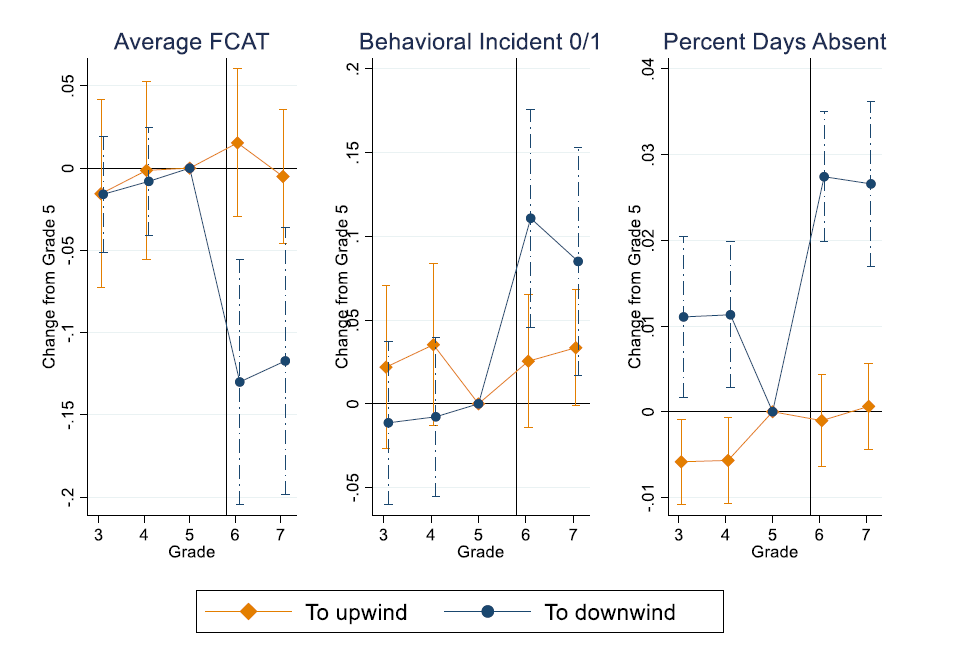
A new paper by Jennifer Heissel, Claudia Persico and David Simon shows the negative effects of traffic pollution on children’s health, absences, test scores and behavioral incidents. The authors follow children who must switch schools from elementary to middle school (or middle to high school) where the first school is upwind of a highway and the second school is downwind of the highway. Both schools are within 0.4 miles of the highway, but one gets more pollution.

The analysis finds that students who move from an elementary/middle school that feeds into a “downwind” middle/high school in the same zip code experience decreases in test scores, more behavioral incidents, and more absences, relative to when they transition to an upwind school (see figure).

The authors suggest that policymakers should think more about where to build schools. Even if the land is cheap, there are large hidden costs to children’s health and development. Also, even within zip codes, microclimates can contribute to inequality in children’s outcomes due to school placement.

Filed Under: Research Tagged With: absences, academic performance, education, pollution, school, test scores

Effects of banning the Islamic veil in public schools

November 14, 2019 by Mark Fallak

Immigration from Muslim countries is a source of tensions in many Western countries. Several countries have adopted regulations restricting religious expression and emphasizing the neutrality of the public sphere. A recent IZA discussion paper by Eric Maurin and Nicolas Navarrete explores the effect of one of the most emblematic of these regulations: the prohibition of Islamic veils in French schools.

In September 1994, a circular from the French Ministry of Education asked teachers and principals to ban Islamic veils in public schools. In March 2004, the parliament took one step further and enshrined prohibition in law.

The paper provides evidence that these new regulations contributed to improving the educational outcomes of female students with a Muslim background and to reducing educational inequalities between Muslim and non-Muslim students.

High school graduation rates improve for Muslim girls

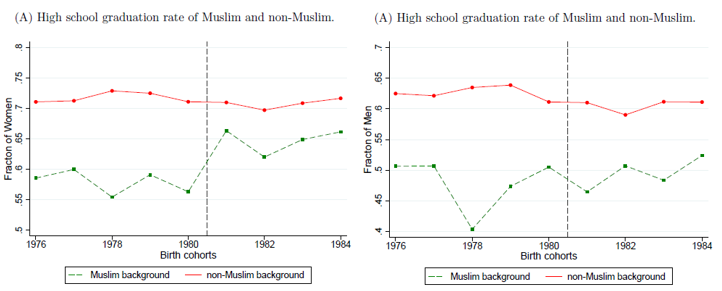
In particular, comparing women with and without a Muslim background shows a marked increase in the proportion of high school graduates in the Muslim group for cohorts born in 1981 and after, namely for cohorts who reached puberty (and the age of wearing the veil) just after the 1994 circular.

A comparison of men with different religious backgrounds shows no similar increase in the proportion of high school graduates in the Muslim group for cohorts born in 1981 and after, consistent with the assumption that the increase observed for women is driven by a policy targeting female students.

The figure below illustrates these trends in high school graduation rates for girls (left panel) and boys (right panel) with and without a Muslim background.

French secularism (laïcité) is often accused of going too far in upholding the principle of the neutrality of the state and the public sphere (including public schools), to the detriment of the exercise of freedom of religion. The findings of the study call for a more nuanced view, suggesting that the very implementation of more restrictive policies in public schools ended up promoting the educational empowerment of some of the most disadvantaged groups of female students.

Nonetheless, the authors point out that the stricter 2004 law did not generate any additional improvements. They also stress that such policies may not have the same effect in other countries.

Filed Under: Research Tagged With: education, freedom, Islam, public schools, religion, veil

Economic causes and consequences of mass shootings

November 6, 2019 by Mark Fallak

From 2000 to 2015, there have been approximately 175 mass shootings in the U.S. leading to more than 900 fatalities and thousands of injured people. While there is a growing number of mass shootings, the economic causes and consequences of mass shootings remain unclear. A new IZA discussion paper by Abel Brodeur and Hasin Yousaf documents the socioeconomic determinants of shootings and the economic consequences for targeted areas.

The researchers tracked down the socioeconomic backgrounds of individuals involved in mass shootings. They find that the perpetrators are less likely to have graduated high school than American men aged 20-50. Also, approximately 40% of shooters were in financial distress and 45% were unemployed or out of the labor force at the moment of the shooting, suggesting that economic distress may trigger the rise in mass shootings.

These results suggest a possible role for job-market interventions aimed at high-risk individuals. Notably, non-socioeconomic risk factors such as mental illness and social rejection remain key in predicting violent crime.

Economic consequences

The study finds mass shootings reduce the number of jobs and total earnings in targeted counties by about 2%. Furthermore, housing prices decrease by 2.5% in the years following a mass shooting. The estimated effects persist for several years after the shooting.

The authors explore several mechanisms that may explain the effect of mass shootings on local economies. For instance, they show that mass shootings lead residents of targeted counties to pessimistic views of their own personal financial conditions and local business conditions. Furthermore, they show that residents of targeted areas are more likely to report being unable to do their usual activities such as working because of poor health. These results provide suggestive evidence that mass shootings may impact local businesses and jobs by increasing absenteeism and possibly decreasing productivity through poor mental health.

Moreover, the authors explore the possibility that media coverage of these shootings might exacerbate the economic impacts of mass shootings. They show that additional coverage of mass shootings in the national media (e.g. ABC or NBC) does increase the number of jobs lost following the incident. These findings raise questions on how mass media should cover these kinds of incidents.

Taken as a whole, the results suggest that the economic consequences of mass shootings are quite significant for targeted areas, confirming the need for public policy efforts towards financial support and examining how to best mitigate the associated risk.

Filed Under: Research Tagged With: crime, distress, education, unemployment

Why the German police deserve your trust

November 5, 2019 by Mark Fallak

In Germany, more than 80 percent of citizens trust the police, which is more than in most other European countries. But are police officers in Germany really more trustworthy than normal citizens? An IZA discussion paper, just published in the November issue of the American Economic Journal: Microeconomics, presents evidence suggesting that this is indeed the case.

In general, it cannot be assumed that public servants’ incentives are fully aligned with the interests of the government or the public. In many countries, there is much concern about police misconduct and abuse of authority. What can be done to improve the situation?

Police seems to attract people with the right motivation

Guido Friebel and Michael Kosfeld from Goethe University in Frankfurt and IZA, together with Gerd Thielmann from the German Police University, found that young people who apply to the German police are more trustworthy than non-applying students in the same high schools the police applicants went to. This suggests that the police manages to attract people with the right motivation: in a democratic society, police agents should be trustworthy and willing to spend their resources on enforcing the law and norms of cooperation. It would be hardly imaginable that such behavior could be induced only by training and monitoring, so inducing self-selection may contribute importantly to have the right type of police agents.

In the study, police applicants were compared with a control group of non-applicants in two behavioral experiments. The first experiment was a trust game, the second a reward-and-punishment game. Not only were police applicants more trustworthy, they also invested more of their resources into rewarding trustworthy behavior and punishing the abuse of trust. Police applicants were also found to have a higher risk tolerance and to be more proactive.

Academic education for police professionals may promote trust

The authors argue that reforms that have made the police profession a more academic one may have contributed to making this positive self-selection possible. In both states of Germany (Hesse and Rhineland-Palatinate) that cooperated in this research, every police applicant must follow a three-year bachelor program, which is in stark contrast to other countries in which the police enjoys less trust. Making police forces more educated may contribute to a shift in equilibrium from a low-trust situation between citizens and the police to a high-trust one.

Filed Under: Research Tagged With: behavior, cooperation, experiment, norm enforcement, policy, punishment, Trust

Does pay-for-performance in education work at scale?

October 18, 2019 by Mark Fallak

Teacher quality is key for student achievement. Individuals exposed to better teachers perform better in school, and are more likely to attend college and earn higher salaries. However, the payment schemes in most educational systems are based on lifetime job tenure and flat salaries that are usually linked to teachers’ seniority, providing little incentives for excellence in teaching.

Academics and policymakers have proposed tying teachers’ pay to their students’ performance in an attempt to increase teacher motivation, effort, and ultimately student learning. While pay-for-performance programs in education have been implemented in several developing countries such as India, Kenya, China, Chile, Brazil, Mexico, and more recently in Peru, evidence on their effectiveness is scant and inconclusive. In a recent IZA discussion paper, Cristina Bellés-Obrero and María Lombardi address this question in the context of Bono Escuela (BE), a nationwide teacher pay-for-performance program implemented in 2015 in all public secondary schools in Peru.

About Bono Escuela

BE is a collective teacher incentive in which all public secondary schools compete within a group of comparable schools on the basis of their annual performance. There are 409 groups in total, and the average BE group has 36 schools. Every teacher and the principal in schools ranked in the top 20% within their group obtain a fixed payment amounting to over a month’s salary.

The incentives provided by the BE are collective (at the school level), as all teachers are rewarded if their school wins, although the main performance measure used to rank schools is their average score in a 2015 nationwide math and language standardized test, taken only by 8th graders. This feature of the program, which the authors exploit in their identification, implies that a school’s probability of obtaining the bonus hinges on the achievement of 8th grade students in 2015.

Identifying the causal effect

The study relies on a novel administrative database which covers the universe of Peruvian students in 2013-2015. This database contains annual information on the grades awarded to students by their teachers in every subject (their “internal grades”), the main outcome variable in the study. Internal grades have the advantage of capturing the skills of students which are targeted by the program (i.e., their basic competencies in math and language) without directly influencing teachers’ likelihood of obtaining the bonus, thus making them less prone to manipulation. Importantly, teachers’ grading tactics should not be influenced by the incentive, since internal grades have no direct impact on a school’s BE score.

The availability of achievement measures for students in all grades allows to compare the changes in internal grades of 8th graders to those of 9th grade students attending the same school, before and after the incentive was introduced, providing difference-in-difference estimates of the effect of BE on student achievement. Using data on the overlap of teachers in 8th and 9th grade, the authors assess whether the BE had an impact on student achievement in their comparison group, and discard the existence of any spillovers which could bias the estimates.

No impact on student achievement

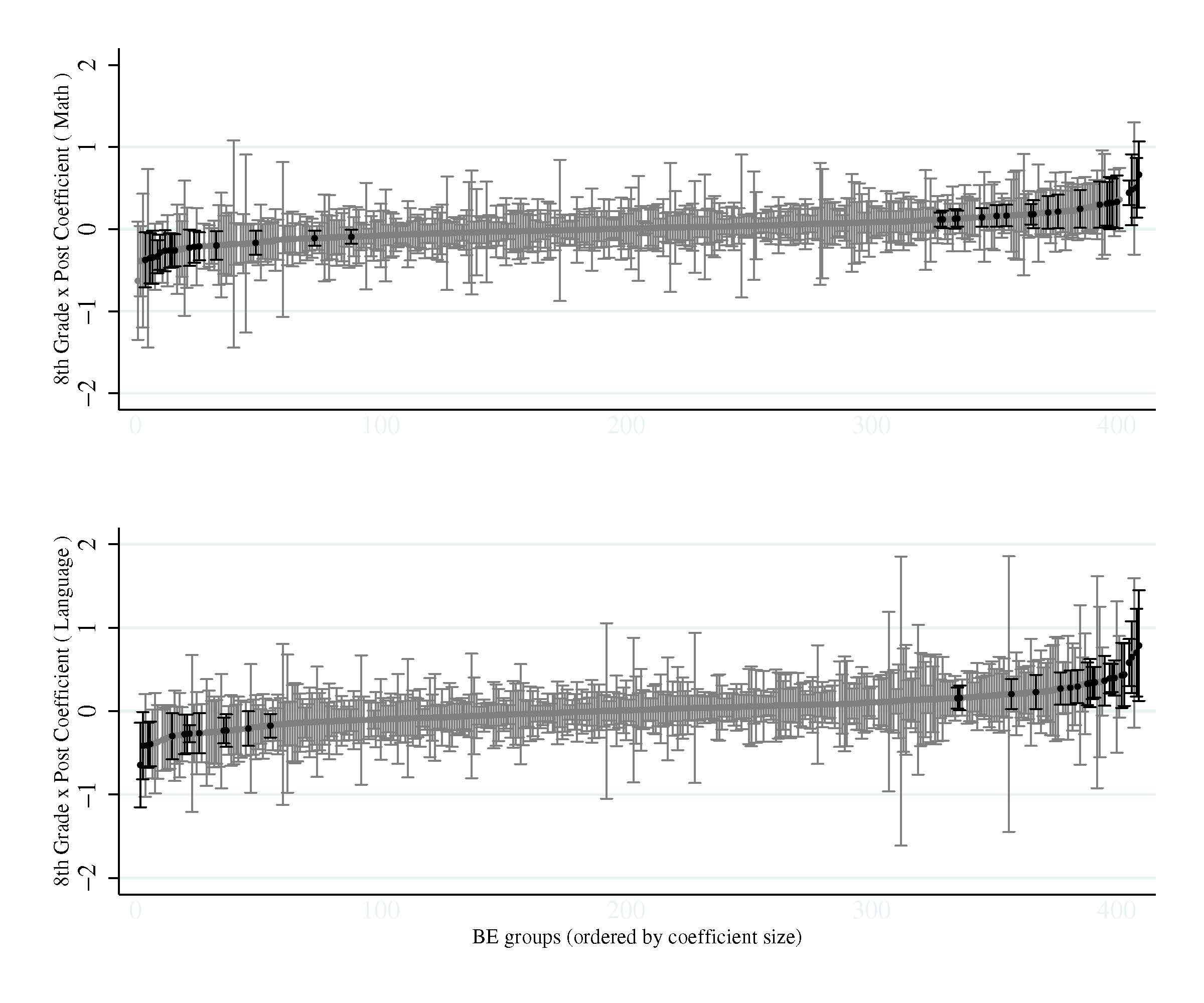
Despite the fact that the incentive was large, BE had no impact on students’ math and language internal grades. The coefficients are precisely estimated, allowing the authors to reject effects larger than 0.010 standard deviations (SD) in math, and 0.017 SD in language, well below the treatment effects found in previous studies on monetary incentives for teachers in India and Chile. When separately examining the impact of the program in each of the 409 BE tournaments (Figure below), the study finds little variance around the zero average effects, providing additional evidence of the null effect of BE on student achievement.

The figure displays the estimated effect of BE in each of the 409 different groups of schools competing for the bonus. The graph plots the coefficients and 95% confidence intervals of the interaction term (8th Grade x Post) from the difference-in-difference regression, separately estimated for each BE group in math and language, respectively. Coefficients and confidence intervals in black are statistically significant at the 5% level, whereas those in grey are not.

Why didn’t student learning increase?

The study provides suggestive evidence that the null effect is not a result of the size or collective nature of the incentive, or driven by teachers being uninformed about the BE, or only focusing on increasing standardized test scores – the incentivized outcome – without influencing their students’ learning in a meaningful way. The authors argue that certain features of the standardized test linked to the bonus might have hampered teachers’ ability to boost student performance in terms of this measure, potentially discouraging them from exerting higher effort.

Since the standardized test tied to the bonus was implemented for the first time in secondary schools in 2015, teachers might not have known what pedagogical practices result in higher test scores. Given that they had no prior experience with the standardized test tied to BE, this is not unlikely. The fact that students had no stakes in these evaluations might also have played a role in weakening the mapping between teachers’ effort and their chances of winning the bonus, as suggested by the findings of a teacher performance pay program in Mexican high schools.

Policy implications

Most of the existing studies on teacher pay-for-performance tackle this topic using relatively small interventions led by NGOs. While these experimental studies provide proof-of-concept of whether performance pay is an adequate tool for increasing student achievement, their findings are not necessarily generalizable to a scaled-up program. Budgetary constraints and opposition from teacher unions make several features of these types of interventions unfeasible in a nationwide program. It is thus crucial to better understand the role played by the features of teacher pay-for-performance programs in their success.

Filed Under: Research Tagged With: pay-for-performance, Peru, schools, student achievement, teacher quality

What happens when you deregulate the teacher labor market?

October 15, 2019 by Mark Fallak

Teacher markets, like most public sector labor markets, are often characterized by a large bureaucracy and lack of flexibility. Teacher pay typically follows schedules tied to tenure and does not reward teaching performance. What happens when such heavily regulated labor markets for teachers are deregulated? A recent IZA discussion paper by Simon Burgess, Ellen Greaves, and Richard J. Murphy uses a dramatic policy change in England to examine how deregulation affected teacher pay and whether it had effects on student performance.

In September 2013, the UK Coalition Government ended the use of tenure-tied pay scales in all schools in England and required state-funded schools to introduce Performance Related Pay (PRP) schemes. In doing so, the reform completely changed the basis for setting pay, affecting the whole labor market of close to half a million teachers in the public sector, while not changing the way schools were financed.

The authors use the reform to address three key questions. First, how do schools change pay when given the freedom to do so? Second, how do these decisions affect the number of teachers employed? Finally, and possibly most importantly, does the decentralization of pay affect student performance?

Analyzing data on all the teachers in state schools in England since 2010, the researchers computed the counterfactual expected wage growth, i.e., what teachers would have earned under the old scale point system if the reform had not been introduced.  

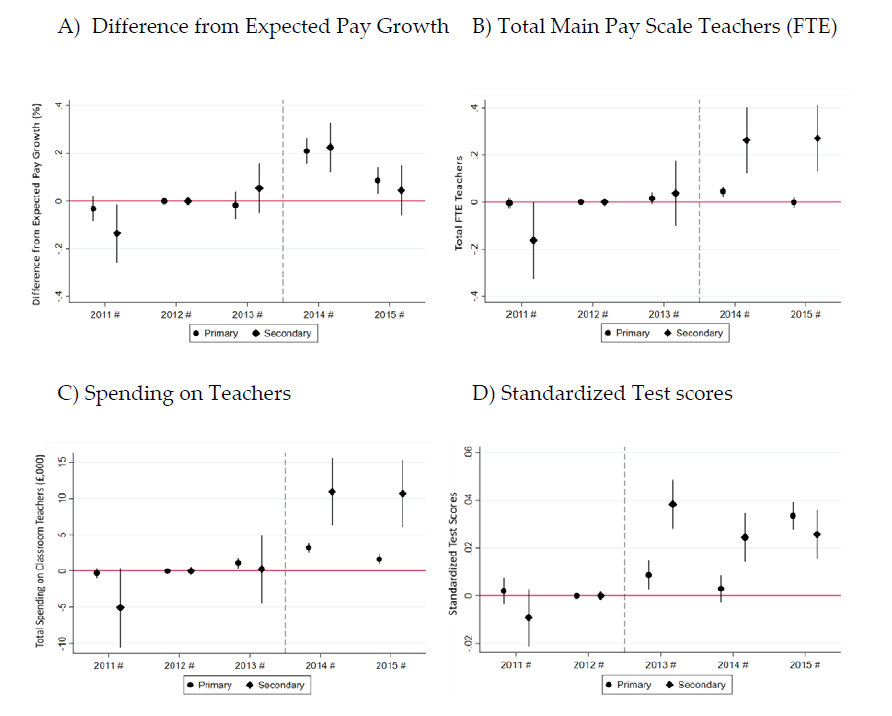
Based on the difference between this counterfactual and the post-reform actual wage growth, the authors find that schools used their new flexibility to respond to local labor market conditions. Accordingly, teachers’ salaries grew relatively faster in high-wage labor markets (Panel A). Further, freed from the constraints of the pay scales, some schools were able to offer relatively higher salaries and to become more attractive as a place to work (Panel B).

These schools in high-wage areas attracted relatively more teachers than those in low-wage areas. Finally, the authors find that schools in high wage areas also experienced larger gains in student test scores (Panel D), especially for disadvantaged students

The results have important policy implications. National pay scales (despite their undisputed benefits of providing certainty to teachers and preventing favoritism or discrimination) might prevent local managers from allocating resources efficiently. Given autonomy, schools in high wage areas depart from the salaries determined by the national pay scales in order to increase pay and pay dispersion. This helps them retain experienced staff and ultimately improve student performance.

Filed Under: Research Tagged With: pay dispersion, performance pay, schools, student achievement, teacher pay, wage growth

Identifying policy levers in education settings

October 14, 2019 by Mark Fallak

Although it might not appear to be the most obvious topic for an economist to work on, the analysis of determinants of educational success has become one of the fastest growing subfields of economics. The IZA program area on the Economics of Education connects many of the leading researchers in this area and its 4th annual workshop, held in Bonn recently, has again proven to be a major success story.

Organized by Ian Walker and Ingo Isphording, this years’ workshop brought together 25 international researchers to present state-of-the art advances that reflected the broad range of policy-relevant topics economists care about in understanding the production of human capital, starting from what makes parents choose the right school for their offspring, to incentivizing teachers to bring out the best in their students, to how exposure to violence can affect student performance.

The keynote speech was given by John N. Friedman, who demonstrated the potential behind using big data approaches on tax data to dig into spatial variations of intergenerational mobility, and the role of higher education in shaping opportunities to leave poverty.

Why schools are segregated

Sándor Sóvágó presented evidence on school segregation in the Netherlands. Based on administrative data from Amsterdam secondary schools, he identified the assignment of students to schools based on their ability, and differences in the preferences of households as the main sources of segregation. His results imply that while quotas for minority students would reduce segregation, this effect would come at a large expense of student welfare by assigning students to schools against their preferences.

How student fees affect study behavior

Jan Marcus analyzed how the introduction of student fees in Germany affected the study behavior of current students. His results showed that even modest fees have important incentive effects on students and shorten their duration of studies. Students who have to pay fees increase their study effort and time investment. For students not yet enrolled though, student fees very well have negative effects by discouraging them from undertaking tertiary education.

Taken together, the presentations (see the workshop program for a full list) led to lively discussions and exchange among the mix of junior and senior researchers, highlighted the importance of education as the main driver for labor market success later in life, and pointed to important but often under-utilized policy levers.

Filed Under: IZA News, Research Tagged With: education

Legacy and athlete preferences at Harvard

October 10, 2019 by Mark Fallak

The admissions advantages of privileged applicants have gone up over time at Harvard University. Privileged applicants currently make up 43% of white admits at Harvard, but less than 16% of admits of other ethnicities.

Competition for slots at elite universities in the United States has become increasingly fierce, with admit rates below 6% for schools like Harvard University, Princeton University, Yale University, and Duke University. Records made public in the Students for Fair Admissions, Inc v. Harvard University lawsuit revealed how one elite university makes admissions decisions, which, up until now, remained a closely guarded secret.

Elite universities offer legal advantages to those who come from higher socioeconomic backgrounds. These include advantages to legacies (i.e. children of alumni), relatives of donors, and children of faculty. Admissions advantages for athletes may also benefit those who come from higher socioeconomic backgrounds (depending on the sport).

In two IZA discussion papers, Peter Arcidiacono, Josh Kinsler, and Tyler Ransom investigate what has been happening to legacy and athlete admissions over time at Harvard University. They also quantify the extent of admissions advantages for recruited athletes, legacies, relatives of donors, and children of faculty (ALDC) relative to their non-ALDC peers.

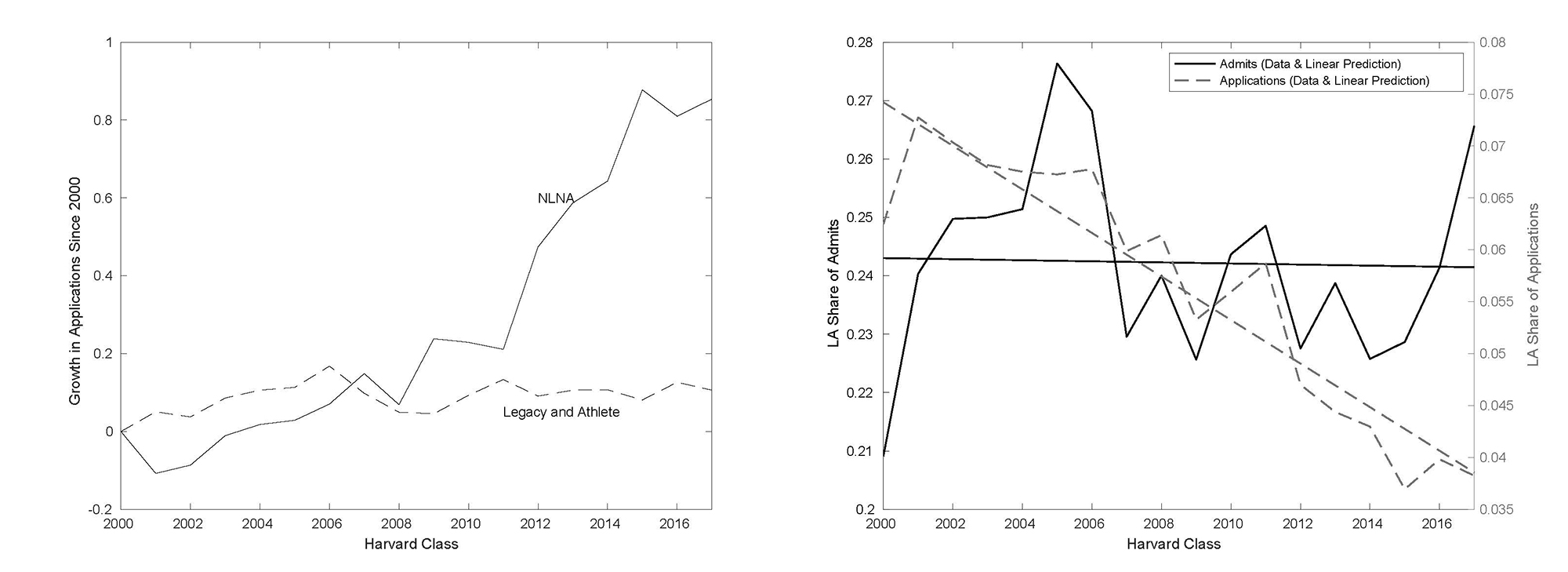
In “Divergent: The Time Path of Legacy and Athlete Admissions at Harvard,” the authors show that, over an 18-year period, applications for legacies and athletes (LA) have remained constant, while applications for non-legacy non-athletes (NLNA) have skyrocketed. At the same time, the share of admitted students who are legacies or athletes has remained roughly constant at just under 25% of the admitted class.

In fact, admissions advantage for legacies and athletes (relative to non-legacy, non-athlete applicants) has increased from four times higher to nine times higher over the 18-year period. Moreover, the matriculation rate for legacies and athletes has increased from 80% to 90%, suggesting that their academic strength has declined. (Matriculation rate is the likelihood that an admitted student will enroll at the university; a lower matriculation rate for a group of students indicates that they have better options of where to enroll than those with higher matriculation rates.)

The authors then show that, if the admissions advantage for legacies and athletes were held fixed, Harvard would have enrolled a more ethnically diverse student body.

In “Legacy and Athlete Preferences at Harvard,” the authors describe in detail Harvard’s admissions process and examine the frequency of ALDCs by race, as well how much more or less academically qualified ALDC applicants and admits are relative to non-ALDC applicants and admits.

Following so-called “holistic” or whole-person admissions practices employed at many elite, private universities in the United States, Harvard admits students based on academics, as well as extracurricular experiences, athletic prospects, personal qualities, recommendations from secondary school teachers and administrators, and an in-person interview with a Harvard alum.

Among admitted Harvard students who are white, 43% are ALDC, compared to less than 16% of admitted non-white students. Legacies are the largest group of special applicants, followed by recruited athletes and relatives of donors. Children of faculty make up a very small fraction of special applicants.

The authors compute that nearly three out of four admitted ALDCs who are white would not be admitted if they were treated the same as their non-ALDC peers. The authors also show (similar to the above-mentioned findings) that the racial composition of the admitted class would be more diverse if Harvard abandoned admissions advantages for legacies and athletes.

Holistic admissions practices have come under increased scrutiny in the United States. The authors show that Harvard’s holistic admissions work to make the racial distribution of admitted students look more like the racial distribution of the United States. However, within racial groups, holistic admissions may lead to more inequality, depending on which non-academic characteristics universities value.

Filed Under: Research Tagged With: education, elite, inequality, privilege, students, university

Do workers discriminate against female bosses?

October 9, 2019 by Mark Fallak

Women have overtaken men in educational attainment and score higher on leadership competencies. Yet, only 37% of managers at the mid-level, 26% at the senior-level and 5% of CEOs at S&P 500 companies are female. Why then are women less likely to climb the corporate ladder?

In a recent IZA discussion paper, Martin Abel investigates the role of gender discrimination by subordinates. He hires 2,700 U.S.-based workers for an online transcription task and randomly assigns the name of a (fictitious) female or male supervisor.

Workers react more negatively to critical female bosses

Results show that criticism has a much larger negative effect on both female and male workers’ attitudes if it comes from a female boss, which leads to a 70% larger reduction in job satisfaction and a doubling of the share not interested in working for the firm in the future. Both female and male workers discriminate against female bosses.

This has important implications for the success of women in leadership as the ability to provide critical feedback is a key tool in changing behavior of subordinates. If using feedback is more likely to backfire for female bosses, they may adopt less effective management strategies or become altogether less interested in holding leadership positions.

Gendered expectations of managers matter

Why do workers discriminate against female bosses? A few key findings from the study shed light on these questions. Female bosses are not simply being ignored. Workers in fact spend slightly more time processing feedback from female managers. Neither can implicit biases explain these findings. While workers are on average more likely to subconsciously associate men with career and women with family, this tendency does not predict whether they discriminate against female bosses.

Instead, what seems to drive results are gendered expectations of management styles. Workers are three times more likely to associate giving praise with female managers and twice more likely to associate giving criticism with male managers. People react negatively if something violates their expectations – case in point: critical female bosses.

Potential remedies 

Recently, some firms started employing “feedback coaches”, teaching workers to focus on the content of feedback rather than the identity of the person providing it. There is also evidence that informing people of their biases may affect their behavior. Other research suggests that highlighting specific credentials of women in leadership such as positive evaluations or reference letters may be an effective remedy – although there is evidence that gender discrimination is still present in high-skill professions such as medicine or academia.

It remains unclear to what extent results from this study generalize to more traditional work settings. Yet, the “gig economy” and other remote work arrangements are a rapidly expanding part of the economy. It has been argued that these jobs offer more flexibility and thus particularly benefit women. However, findings from this study highlight additional concerns about discrimination due to lack of regulatory oversight and equal opportunity protections in these jobs.

Filed Under: Research Tagged With: discrimination, female leadership, gender bias, gig economy, job satisfaction, workplace

  • Previous Page
  • Page 1
  • …
  • Page 20
  • Page 21
  • Page 22
  • Page 23
  • Page 24
  • …
  • Page 69
  • Next Page

Primary Sidebar

© 2013–2025 Deutsche Post STIFTUNGImprint | Privacy PolicyIZA