• Skip to primary navigation
  • Skip to content
  • Skip to primary sidebar

IZA Newsroom

IZA – Institute of Labor Economics

  • Home
  • Archive
  • Press Lounge
  • DE
  • EN

Matching workers and jobs online

October 8, 2019 by Mark Fallak

Leveraging the internet as a data source of social science, and labor economics in particular, is the main research mission of IDSC, IZA’s research data center.

Market transactions, including the labor market (e.g. job boards) but extending into the marriage market (e.g. Tinder), the transportation (e.g. Uber) or the information market (e.g. Google) and beyond, take place online because information and communications technology naturally optimizes the main purpose of markets: the matching of supply and demand.

While for market participants (end users) participation is non-invasive through the adoption of personal technology (smartphones bring markets in their pocket), digital technology allows market operators to experiment live and to seamlessly record transactions with rewind and replay capabilities so that studying and understanding markets depends heavily on access to such transaction data.

Organized by Nikos Askitas and Peter J. Kuhn, a two-day workshop brought together economists and computer scientists from academia and practice to showcase research with data from internet job boards, one of the main modes of matching facilitation in labor markets worldwide today. The workshop, jointly organized and financed by the IDSC of IZA and the Center of Advanced Internet Studies (CAIS), was hosted by CAIS in Bochum.


Future work
Past work

Participants had a chance to interact and program industrial robots and other intelligent industry 4.0 means of production during a visit of the University of Bochum’s Learning Factory, which is a real industrial production site as well as a multidisciplinary training and education site. They were also given a guided tour of the German Mining Museum in Bochum, which hosts several generations of functioning mining technologies in a tunnel system 17 meters below the earth.

See the workshop program for a full list of presentations, some of which are summarized below.

As markets thicken, so does the plot

In her presentation on “Search, Selectivity and Market Thickness in Two-Sided Markets,” Jessica Yu reported results from field experiments on an internet dating platform that manipulate the participants’ perceptions of market thickness.  As expected, participants raise their matching standards in response to increases in participation on the “other” side of the platform (e.g. men versus women, or firms versus workers), and reduce their standards when participation on their own side increases.  Estimates from a two-sided search model suggest that increases in overall participation raises welfare.

Changes in the supply and demand for skills

Alicia Modestino presented joint work using a novel database of 87 million online job postings aggregated by Burning Glass Technologies. The authors test and verify the hypothesis that changes in skill requirements within some occupations have reduced the matching efficiency within some classes of jobs, which contributed to the outward shift in the Beveridge Curve since 2007, i.e., higher unemployment coinciding with more vacancies.

Labor market tightness and wages

Reamonn Lydon and his co-author found that “big” data from Indeed closely track vacancy data from firm-level official surveys while they are delivered in a more timely fashion. Moreover, they are more granular in the information they contain about what jobs employees search for, what skills employers want, and what the wage levels of various roles are. Controlling for observable job characteristics and traditional tightness measures, such as regional unemployment, the paper finds that the number of clicks on a posting is a strong predictor of wages posted in job vacancies.

+++

The 3rd IDSC of IZA workshop on matching jobs and workers online, co-financed by and organized with the University of Luxembourg, will take place at IZA in Bonn on September 18-19, 2020.
Filed Under: IZA News, Research Tagged With: internet data, labor demand, labor supply, matching, online job boards

Indoor air pollution hampers cognitive performance

October 4, 2019 by Mark Fallak

Poor air quality not only affects population health but also human cognition, according to a new IZA discussion paper by Steffen Künn, Juan Palacios, and Nico Pestel. The study investigates the impact of air quality on the performance of chess players at tournaments over a three-year period under different levels of air quality.

Similar to the tasks of high-skilled office workers, chess requires intensive use of cognitive skills and strategic decision-making. To measure players’ cognitive performance objectively, the researchers compared the quality of about 30,000 moves made by 121 players in 596 games with those proposed by a chess computer. Measurement sensors recorded the variation of indoor air quality to which the players were exposed during the tournaments.

The analysis shows that an increase in the indoor concentration of fine particulate matter (PM2.5) by 10 μg/m3 increases a player’s probability of making an erroneous move by 26.3%. The impact is most pronounced when players are acting under time pressure.

The researchers conclude that the societal cost of air pollution may be substantially underestimated as exposure to poor air quality may also have harmful immediate and lasting impacts on the human brain, with negative effects on productivity.

Read also an article about this paper in The Times (Oct. 4, 2019).

Filed Under: Research Tagged With: air quality, cognitive skills, decision making, fine particulate matter, pollution

Low Emission Zones in Germany improve population health

September 27, 2019 by Mark Fallak

Air pollution is a major threat to human health. Vehicle exhaust fumes are particularly harmful as they are emitted close to the ground. To reduce emissions from inner-city traffic, Germany has implemented Low Emission Zones (LEZ). These are signposted areas in cities where high-emitting vehicles, as indicated by a windshield sticker, are banned from entering. The health impact of this policy, however, remains controversial because it is methodologically difficult to prove that improved population health can be causally attributed to LEZs.

A new paper by IZA researchers Nico Pestel and Florian Wozny uses panel data from German hospitals from 2006 to 2016 with precise information on the location and catchment areas of hospitals, as well as the annual frequency of diagnoses. The analysis exploits the variation in timing and geographic coverage of LEZs, which have been rolled out across cities since 2007. Air quality data comes from air pollution monitors, which are assigned to LEZs.

Fewer air pollution-related diagnoses

The findings indicate that LEZs substantially improve air quality. Concentrations of particulate matter (PM10) and nitrogen dioxide (NO2) are significantly reduced. Importantly, these improvements translate into fewer air pollution-related diagnoses, especially diseases of the circulatory and the respiratory system, among hospitals whose catchment areas are covered more by an LEZ.

The authors provide some evidence that these results appear to be driven by reductions in non-emergency diagnoses of chronic diseases, not so much by emergency cases. Given the large literature showing that air pollution has negative consequences for labor supply and productivity on the job, the direct health effects of LEZs may be complemented by indirect benefits for human capital and economic growth.

Filed Under: Research Tagged With: air pollution, emission, environment, health, traffic

Mothers’ employment encourages children to work more as adults

September 19, 2019 by Mark Fallak

For several decades, the intergenerational correlation of labor market outcomes has been a subject of interest among both academics and policymakers. Much of the economics literature has focused on the correlation of labor earnings, in particular on the transmission of earnings potential. In a recent IZA discussion paper, Gabriela Galassi, David Koll and Lukas Mayr document that not only the potential to earn is transmitted across generations but also the willingness to work.

Using U.S. data from the National Longitudinal Survey of Youth 1979 (NLSY79) and the NLSY79 Children and Young Adults (CNLSY79), the authors document that the fraction of individuals’ working-age life spent in employment is considerably correlated across generations: an increase in lifetime employment of mothers by one year is associated with an increase in the employment of her child by around eleven weeks.

Employment status matters more than earnings or hours worked

The correlation in employment between mothers and children remains substantial also after controlling for the main determinants of the earnings persistence across generations, i.e. ability, education and wealth. This “residual correlation” corresponds to an incremental employment of children of around six weeks when maternal employment is one year higher. The result is robust to a variety of specifications and variables used to measure lifetime employment.

A different picture emerges when considering the intensive margin of labor supply, i.e. hours worked. While there is a substantial correlation of working hours across generations, it does not survive after controlling for education, ability and wealth. This, together with the fact that the literature on earnings transmission generally restricts the analysis to individuals and periods in which earnings (and hence hours) are positive, shows the importance of looking at the intergenerational correlation in employment, a novel outcome in the literature on intergenerational transmission.

Stronger correlation for low-educated mothers

The authors further document that the employment correlation between mothers and their children is heterogeneous across several dimensions. First, it is significantly higher for daughters than for sons, but remains positive and statistically significant even for sons. The latter suggests that the result is not entirely driven by gender roles. Second, the intergenerational correlation of employment decreases in maternal education, being significant only when the mother did not obtain any college education. Finally, the correlation is highest in the bottom quintile of the income distribution and tends to decrease in maternal family income.

The paper also explores potential mechanisms that might explain the high residual intergenerational correlation of employment. In particular, the authors document that whether or not mother-child pairs share the same industry, occupation or local labor market does not significantly affect the correlation in employment. These observations rule out network effects, occupation-specific human capital or conditions within local labor markets as main causes.

Building a positive attitude towards work

By contrast, the authors provide suggestive evidence favoring the existence of a role model channel. In particular, they show that the residual correlation remains unchanged after controlling either for work preferences of the mother or their work behavior when the child is not living with her. This finding suggests that preferences are not directly transmitted. Instead, it seems to be important for the child to observe her mother working in order to build a positive attitude towards work herself.

The positive and strong intergenerational correlation of employment has important implications not only for the analysis of social mobility but, potentially, also for the optimal design of tax-transfer policies. In particular, in-work benefits aimed to move individuals with children and low socio-economic status into the labor force may turn out to trigger revenue increases from following generations, thus reducing their fiscal costs.

Filed Under: Research Tagged With: female employment, intergenerational transmission, role model, social mobility, working mom

How wage expectations differ by gender

August 30, 2019 by Mark Fallak

Despite increasing policy efforts to achieve gender-based equality of opportunity, convergence in male-female wages remains slow, particularly among college graduates. A recent IZA paper by Lukas Kiessling, Pia Pinger, Philipp Seegers and Jan Bergerhoff suggests that gender differences in wage expectations play an important role.

Based on a survey of over 15,000 students and recent graduates in Germany, the researchers document a significant and large gender gap in wage expectations that closely resembles actual wage differences. Their findings indicate that sorting and negotiation styles affect the gender gap in wage expectations much more than prospective child-related labor force interruptions. Given the importance of wage expectations for labor market decisions, household bargaining, and wage setting, the results may explain much of the persistent gender inequalities.

Gender gap in wage expectations amounts to nine years of extra work experience

The overall pattern of the results confirms previous findings on the importance of sorting into certain majors, industries or occupations, and a female preference for jobs with flatter wage schedules. In terms of relative magnitudes, females would need to work on average around four hours more per week in the same occupation and industry, or major in other fields (e.g. in medical sciences rather than humanities) to catch up with the starting wages of their male peers. Similarly, in expectation, it would take them about nine years more of accumulated work experience to make up for the gender penalty.

Moreover, reluctant negotiation behavior seems to lead to lower reference points and lower subsequent wage expectations. The data show that women plan to enter wage negotiations with more modest wage claims relative to their reservation wage. Expected wages are thus likely to drive actual wage differences and persistent gender wage gaps.

Women underestimate the long-term motherhood wage penalty

The results suggest that women are aware of the career cost of having children early, which may explain the observational tendency to delay childbirth among highly-educated women. However, aside from considerations of timing, women underestimate the child-related dampening in their wage trajectories, with potential implications for household bargaining and the distribution of child-rearing tasks. Thus, women may stay home at a higher rate not only because they expect lower labor market returns than their spouses, but also because they underestimate the wage loss associated with raising children.

In terms of policy implications, the authors suggest that negotiation trainings – rather than encouraging more negotiations per se – might be an effective measure to improve female labor market outcomes and reduce the gender wage gap. Also, information treatments on child-related wage penalties might help women to gain a more realistic view of the career costs of raising a family, leading them to bargain for a more equal distribution of child-rearing responsibilities within households.

Filed Under: Research Tagged With: gender gap, graduates, household bargaining, motherhood, wage expectations, wage negotiations

Incentivizing learning-by-doing

August 9, 2019 by Dajan Baischew

Pay-for-performance compensation schemes are used across a wide range of industries and occupations. Even contracts that offer a fixed salary may be implicitly tied to performance by promotion and termination incentives.

Firms offer performance-based pay to motivate workers to supply costly effort, but they may accomplish more than simply inducing employees to work harder in applying their existing skill set. Indeed, such contracts may also induce workers to acquire new skills that make them better at their job, a much more desirable outcome from the firm’s perspective.

In a recent IZA discussion paper, Joshua Graff Zivin, Lisa B. Kahn and Matthew Neidell provide the first empirical evidence on the impacts of performance-based compensation schemes, and particularly the use of bonus payments, for on-the-job learning.

Evidence from grape and blueberry farms

The researchers analyzed data from a grape and blueberry farm that utilizes two distinct contracts to compensate workers for their efforts. Fruit picking provides an ideal setting to evaluate the effects of incentive schemes because workers’ individual productivity can be measured precisely.

The contract for grape pickers paid a fixed wage up to a productivity target and a piece rate thereafter. The contract for blueberry pickers paid a fixed wage up to a productivity target, a bonus for reaching the target, and a piece rate thereafter. The focus of the study was on whether the stronger incentives embedded in the second contract, the one for the blueberry pickers, translated into more or faster learning on the job.

Bonus payment led to faster learning

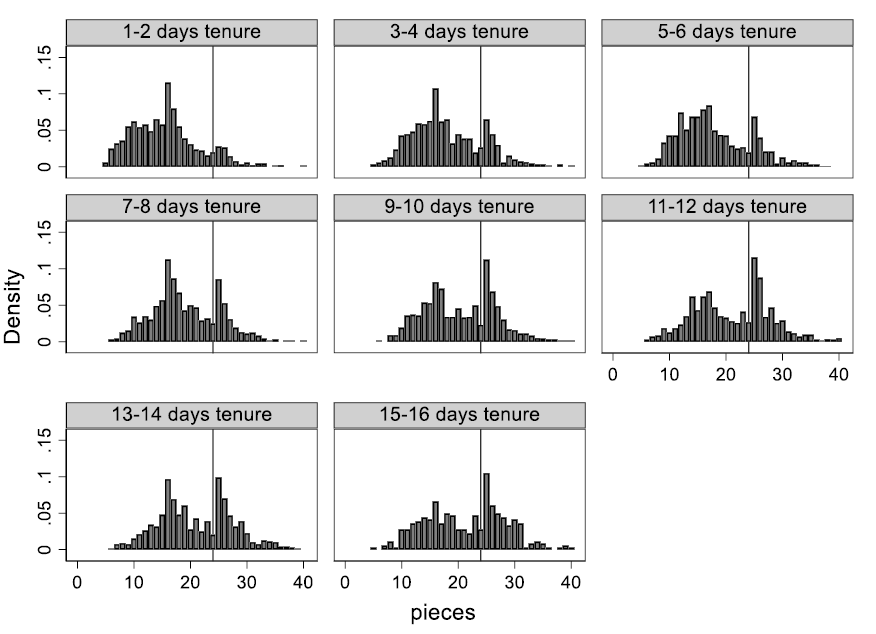
Consistent with the literatures on salespeople and executive compensation, the authors find that the contract that included a bonus led to “strategic heaping” around the threshold: workers raise their productivity just enough to qualify for the bonus. Importantly, heaping becomes more likely as workers gain more experience and are better able to reach the threshold (see Figure 1).

For workers under the commission-only contract (the grape pickers), such heaping or changes in heaping were not observed (see Figure 2). While blueberry pickers increased their likelihood of hitting the piece rate threshold by 15 percentage points (80%) over their first 10 days on the farm, grape pickers saw very little improvement.

Figure 1: Blueberry productivity by tenure: Histograms of daily output for the indicated number of days tenure. The vertical lines show the threshold at which workers cross from the minimum wage to the piece rate regime.
Figure 2: Grape productivity by tenure.

Costly bonus contracts pay off for the employer

In essence, the contracts with bonuses tied to productivity targets generate faster learning-by-doing than those induced by a simple commission scheme. Moreover, these productivity improvements were not simply limited to those close to the bonus threshold. Instead, learning occurred throughout the productivity distribution.

Overall gains in productivity from those well below the bonus threshold more than offset the costly bonus payments: A simple back of the envelope calculation based on empirical estimates of learning-by-doing under the blueberry contract suggests that the learning induced from day 3 to day 10 of tenure generates an additional $60 in net revenue per worker, or approximately $8.50 per day.

Compensation schemes designed to incentivize effort thus also play an important role in learning and skill acquisition by workers. According to the authors, this suggests such incentives may be an important tool to improve firm productivity also in different settings.

Filed Under: Research Tagged With: bonus payment, contracts, heaping, learning-by-doing, productivity

Talk about performance – or pay for it?

August 6, 2019 by Dajan Baischew

Economists have traditionally stressed the importance of performance pay to align employees’ behavior with the objectives of employers. However, organizations also adopt non-monetary practices to guide the behavior of employees. In particular, in recent years many larger companies have revised their practices to manage employee performance – often reducing the role of individual rewards and focusing more on establishing regular conversations about performance between supervisors and subordinates.

In a recent IZA discussion paper, Kathrin Manthei, Dirk Sliwka and Timo Vogelsang study whether introducing regular conversations about a specific outcome variable can indeed raise performance, and how the effect of these conversations compares to and interacts with effects of performance pay tied to the same outcome variable. The research team analyzed the supervision between district managers and their store managers of a nationwide retailer, operating discount supermarkets in Germany.

The key result is that performance reviews indeed increased profits by approximately 7-8 percent. Yet, this positive effect of the performance reviews vanished when it was accompanied by performance pay, which alone had no significant effect on profits. Thus, in contrast to the researchers’ expectations, performance pay did not only reduce the marginal effect of introducing performance reviews – it even reduced the absolute effect of this practice.

Performance pay undermines reputational incentives

The authors explain that the use of monetary rewards can reduce the power of the “reputational incentive” mechanism, especially when reputational incentives are strong. Performance reviews generate more transparency about the managers’ activities to raise profits, facilitating the signaling of motivation which leads to higher powered incentives. Performance pay, on the other hand, may undermine the reputational incentives triggered through the review meetings and, in turn, can affect the quality of the interaction between supervisor and subordinate.

On a broader level, these results show that different organizational practices may interact in non-trivial ways. The performance effect of introducing a specific management practice may be contingent on the use of other practices. Whether and how specific practices interact depends on the interplay of different economic motives and behavioral mechanisms.

Filed Under: Research Tagged With: feedback, field experiment, incentives, management practices, monitoring, performance pay, performance review

The Newest Revolution? Happiness!

July 18, 2019 by Dajan Baischew

The emergence and evolution of modern science since the 17th century has led to major breakthroughs in the human condition. The first, the Industrial Revolution, started in the late 18th century and is based chiefly on developments associated with the rise of the natural sciences and brought a marked advance in material living conditions. The second, the Demographic Revolution, began in the latter half of the 19th century, and is largely the result of progress in the life sciences. It is the shift from high to low levels of mortality and fertility. 

IZA Prize laureate Richard Easterlin, pioneering researcher on the relationship between demographic developments, economic outcomes and subjective well-being, develops in a recent IZA discussion paper the rationale for a third revolution, the Happiness Revolution. He also notes the implications of this perspective for the interpretation of international cross-section studies.

Objective circumstances vs. self-reported feelings

Whereas the two prior revolutions are embodied in markers of people’s objective circumstances, real GDP per capita and life expectancy, the principal measure of the Happiness Revolution is people’s self-reported feelings about their lives as a whole, captured in survey questions about their overall happiness and satisfaction with life in general.

The basis of the Happiness Revolution is the development of the social sciences, Easterlin argues. The first and foremost achievement of the social sciences has been to establish widespread public recognition that circumstances like unemployment, poor health, and poverty are the result chiefly of forces beyond an individual’s control, and that collective action is required to help those suffering from such circumstances. Prior to the 20th century, the common belief was that these problems were the result of an individual’s character flaws – laziness, failure to save, dirtiness, drunkenness, gambling, and the like.

Social science and the creation of the welfare state

Economics initially supported such beliefs through its advocacy of laissez-faire, that government should be small and that to intervene in people’s lives would only promote dependency. After severe financial crises and major depressions, however, as the problems of the free market economy became clearer, social sciences put forward policies aimed at stabilizing the economy. At the same time, social policy took shape, eventuating in policies comprising what is now called the “social safety net“. This consists of programs encompassing such things as income support (unemployment insurance, social security, social assistance, and disability benefits), health care, infant and childcare, education including preschool programs, maternity and paternity leave, elderly care, and old-age pensions. 

These economic and social policy initiatives, which are still evolving, are most fully realized in today’s welfare state. The cradle-to-grave safety net of the welfare state addresses the concerns most important, according to national surveys, for personal happiness over the life course—employment and income security, a fulfilling family life, and good health. The extent of a nation’s success in addressing these concerns is captured in measures of happiness—hence the “Happiness Revolution.” 

Happiness as guidance for public policy decisions 

Happiness has begun to nudge aside GDP per capita as a measure of social progress. Easterlin further argues that happiness, unlike GDP, can capture in more comprehensive fashion the varied contributions the social sciences are making to advancing personal well-being. 

The positive cross section relationship between happiness and GDP per capita is sometimes cited as demonstrating that economic growth causes greater happiness. It is hard to reconcile this assertion with the fact that Costa Ricans, whose government introduced safety net policies as early as the 1950s, are as happy as Americans despite a GDP per capita only one-fourth as great. It is also hard to square this view with the nil time series relationship between trends in happiness and GDP per capita. In the United States happiness today is no greater than 70 years ago when real GDP per capita was one-third of its current level; in China life satisfaction in 2015 was about the same as in 1990 despite a roughly fivefold multiplication of real GDP per capita.

The World Happiness Report

The annual World Happiness Report, produced under the auspices of the United Nations, presents happiness estimates for over 150 countries worldwide. The geographic differences in happiness are much like those observed for the Industrial and Demographic Revolutions. On a scale from zero to ten, Western European countries and their offshoots are highest with values reaching as high as 7.5 or more and Sub-Saharan African nations lowest, in the range of 3.0 to 4.0. 

+++

Easterlin’s IZA Prize Volume on “Happiness, Growth, and the Life Cycle” presents his key papers in happiness economics.

Read also an interview in Brain World Magazine:

  • Happiness Economics: Does Wealth Provide Happiness?

Filed Under: Opinion, Research Tagged With: happiness, life satisfaction, social science, social security, subjective well-being

Higher absence rates in the public than the private sector

July 12, 2019 by Mark Fallak

Public sector employees are often said to have excessive rates of absence from work, which gives rise to the stereotype of the “malingering bureaucrat”. To find out whether this is correct, a recent IZA discussion paper by Stephanie Prümer and Claus Schnabel analyzed representative survey data for Germany in 2012. The authors find that absenteeism seems indeed to be more prevalent in the public sector.

Whereas only 53 percent of private sector employees report having been absent at least once in the past 12 months, this figure is 9 percentage points higher for public sector employees. On average public sector employees record one more day of absence per year compared to workers in the private sector. These differences showing up in descriptive statistics are substantially reduced and partly disappear when taking account of individuals’ socio-demographic characteristics, health status, professional activities, and workplace-related factors. Even then, however, the probability of staying home sick at least once a year is still 5.6 percentage points higher in the public sector.

“Malingering bureaucrat” stereotype seems exaggerated

This finding refutes assertions that differences in absence rates between the sectors are mainly due to structural factors like different compositions of the workforce. The study shows that the same observable factors play a role for absenteeism in the public and private sector. It cannot rule out that employees in the two sectors differ in unobservable factors like motivation, commitment, and loyalty towards their employer and their co-workers. It could also be the case that public employers exert less pressure on employees not to call in sick (for instance because they are not so exposed to market pressure).

Nevertheless, since the difference in the probability of sickness absence between similar public and private sector employees is less than 6 percentage points, the authors conclude that the stereotype of the “malingering bureaucrat” seems to be an exaggeration, at least for Germany.

Filed Under: Research Tagged With: absenteeism, private sector, public sector, sickness absence

How parents pay for their unemployed adult children

July 9, 2019 by Mark Fallak

Parents who financially help their unemployed adult children offset such costs by adjusting their behavior, particularly by spending less money on food, working more and reducing retirement savings, according to a new article published in the IZA Journal of Labor Economics.

It is known that parents are increasingly helping their adult children, including by letting them live at home and providing them money and other assistance. Little, though, has been documented on the economic impact of such decisions on parents themselves.

This study by RAND researchers Kathryn Edwards and Jeffrey Wenger sheds light on exactly how parents curb own behavior – to their own financial detriment – when they provide financial assistance to an unemployed adult child.

“One may assume that since parents willingly help their children, they are not worse off because of that decision,” said Edwards. “But our research shows that that these decisions may not result in the best financial outcome for the parent.”

The authors examined the effect of a child’s unemployment (of at least one week) on parents’ financial assistance to the child, as well as the parents’ household food consumption, income and savings.

When it comes to financial assistance, parents are more likely to give cash to a child once they lose their job, the study found. The analysis also showed that parents spend less money on food once a child becomes unemployed and maintain this drop in consumption for a two-year period.

Also striking is the change in parents’ work and saving habits. Parents work more the year their child becomes unemployed. Some parents also decrease savings for retirement.

“On the individual level, most of the changes were small,” Edwards said. “The problem is what this means in the aggregate. When the labor market risk of one generation is informally insured by another, the older generation may be putting their retirement security at risk, while the younger generation has insurance that depends on how willing and wealthy their parents are. This is a trademark of basic economic inequality.”

The study is based on an analysis of 4,500 mother-child pairs gleaned from the Panel Study of Income Dynamics, a longitudinal sample of U.S. households. The researchers were able to match mothers at a higher rate than fathers and most of the matched fathers were in households with previously matched mothers.

Filed Under: Research Tagged With: adult children, consumption, household, income, parents, savings, unemployment

  • Previous Page
  • Page 1
  • …
  • Page 21
  • Page 22
  • Page 23
  • Page 24
  • Page 25
  • …
  • Page 69
  • Next Page

Primary Sidebar

© 2013–2025 Deutsche Post STIFTUNGImprint | Privacy PolicyIZA