It is often thought that a goal just before half-time serves as a morale-booster and will increase a team’s chances of winning. However, a new IZA Discussion Paper by Ghent University researchers Stijn Baert and Simon Amez suggests that the effect may actually work in the opposite direction: If a home team scores just before half-time, it often scores less after half-time and ends up, on average, with a lower goal difference.
Analyzing 1,179 games played in the UEFA Champions League and the UEFA Europe League between September 2008 and May 2014, the authors show that this football myth does not stand up to the data. For a given score at half-time, a goal just before half-time does not have any statistically significant effect on the chances of winning.
“Furthermore, when a home team scores a last goal between the beginning of minute 45 and the end of the first half, instead of any different moment, they see the final goal difference at the end of the game drop, on average, by half a goal”, says Stijn Baert. For an away team the effect of a goal just before half-time on the final goal difference is statistically insignificant.
Decompression, overestimation and wrong decisions
In the search for clarification of these surprising findings, the results were evaluated by national and international sport psychologists. They seemed less surprised. A first possible explanation is that a goal just before half-time leads to what is known as “decompression.” The healthy pressure of the game ebbs away, consciously or unconsciously, and causes a loss of concentration, resulting in less tension, and thus less effort put forward by the players.
This first explanation is corroborated by further findings in the paper. Simon Amez notes, “A home team that scores a goal just before half-time—all other elements kept equal, including the score at half-time—has less chance of scoring another goal after half-time and, specifically, less chance on being the first team to score one.”
A second explanation has to do with a growing confidence and self-awareness that a (home) team can experience when, applauded by the (home) audience, it can go to the dressing rooms with a goal that was just scored. This can lead to overestimation. Furthermore, this higher level of self-awareness can result in more (negative) pressure.
A final explanation is linked to tactical changes that the coach suggests during half-time. The positive emotions after a goal possibly obscure his evaluation of the level of competition between the teams.
A different and less common football myth is that another ideal moment to score is just after half-time. This would hypothetically give a boost to the scoring team, and provide a great confirmation of the strategy made during half-time. Likewise, this myth cannot be backed up by the data. For a given score after 50 minutes in the game, the scoring or not scoring of a goal within five minutes after half-time has no effect on the victory and the goal difference of a team.
Football and economics
Football is big business. In 2015, the English Premier League sold the television rights to its games for the period 2016–2019 for 1.712 billion pounds per year, or 10.190 million pounds per game to be shown live.
But economists are not only interested in financial matters. Researchers also benefit from the excellent development in the availability of data on individual and team performance, which allows them to analyze the factors that actually make the difference between winning and losing. This has important implications for personnel economics, particularly with regard to motivation, teamwork and performance incentives.
Previous IZA papers have shown, for instance, that a red card does not have any effect on the chances of victory and that the replacement of a coach does not necessarily lead to improvement of the team’s performance. Others looked at goal-scoring in the “dying seconds” of international football matches, or the influence of social pressure on football referees. More recently, IZA research found that air pollution has a significant effect on player performance.
 formation of new businesses and to create favorable circumstances for them to flourish. In doing so, policies must strike the right balance between supporting the newly founded enterprises and keeping them competitive enough to survive in the long term. Several recent IZA articles deal with conditions and strategies that policymakers should bear in mind when promoting the creation of new businesses.
  sections of the public to press for closing borders and raising fences and walls. Based on evidence presented in a number of IZA World of Labor Articles, managing editor
 When a U.S. state passes a medical marijuana law (MML), effectively lowering the costs of obtaining marijuana for both patients and non-patients, part-time college students in the state spend significantly less time attending and studying for class. Moreover, this reduction in educationally productive time is approximately offset by an increase in time spent watching television.
 In most OECD countries, general practitioners (GPs) play several fundamentally different roles. Clearly, on the one hand, they are responsible for their patients’ health and physical well-being. On the other hand, they also play an often unforeseen, but economically important role: acting as the arbiters of sick leave. This latter capacity is of great fiscal relevance because doctors act as “gatekeepers,” deciding which types of social insurance expenditures and medical treatments are ultimately necessary for their patients.
 Despite the remarkable increase of female participation in education, the labor market and political life that has taken place over the past several decades, women are on average still paid less than men and are largely underrepresented in supervisory, managerial and executive positions. As research has shown, firms profit from establishing gender balance throughout their workforce for several reasons, for example, through promoting a more cooperative work environment.
 People have different propensities to tell the truth, particularly when there is an incentive to lie. According to an experiment conducted with soldiers and civilians in Israel, researchers found that it’s not the differences in religious, economic or social background that determines who is more willing to lie or tell the truth. Instead, the analysis by
 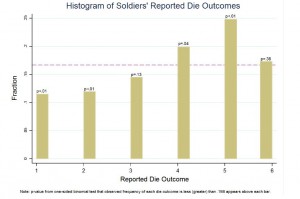 The truth-telling experiment was conducted with a group of 427 Israeli soldiers and repeated with 156 random passersby in an Israeli shopping mall. After a survey about individual characteristics, the participants were asked to roll a six-sided die in private and then state the rolled number. Higher reported numbers were rewarded with spare time for the soldiers and small monetary incentives for the civilians.
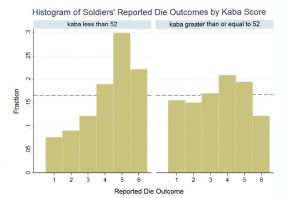 This result is somewhat surprising in that rewards for lying in this experiment are clear and straight-forward (rewards in spare time/money). Still, however, there are costs associated with lying, for example, through later detection and/or an eroded self-image of honesty. The authors suggest that higher cognitive-ability subjects are able to think through these costs and, as a result, resist the temptation to inflate their die reports.
 Anti-discrimination legislation has been largely ineffective at improving the employment prospects of the disabled. A new report, just published by
  “There is no consistent evidence that anti-discrimination legislation has improved the labor market outcomes of disabled individuals.”
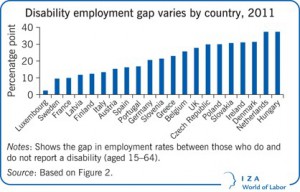 Understanding the work-related well-being of disabled workers is not only important in its own right, but also because of its likely contribution to the employment and earnings gaps via the impact on the recruitment, retention and productivity of disabled individuals. It is also important to note that differences in the type, severity and chronicity of disability are fundamental to the pattern of disadvantage experienced, and are therefore also critical to the design of effective support mechanisms.
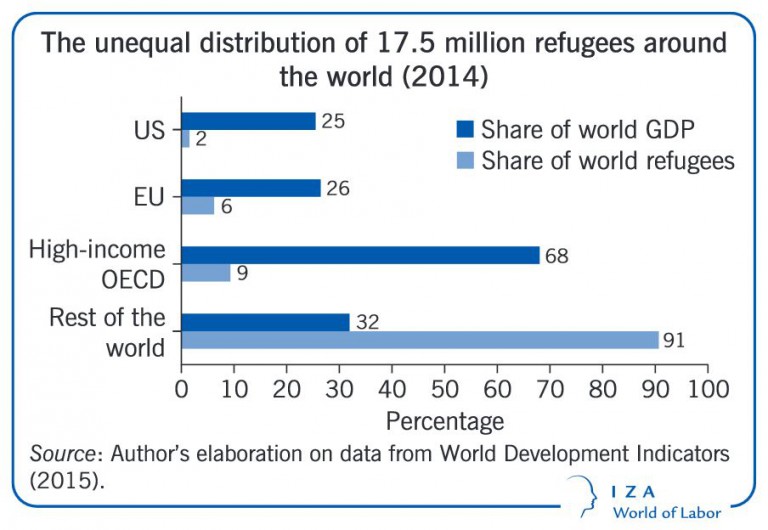
 As the flow of asylum seekers reaching Europe’s shores is rising again with the onset of spring, the European Union is increasingly forced to address a number of challenges. Disagreements over the unequal distribution of refugees across the EU have hindered a common policy response, placing strain on existing support structures, and potentially threaten to unravel the entire international refugee protection system.
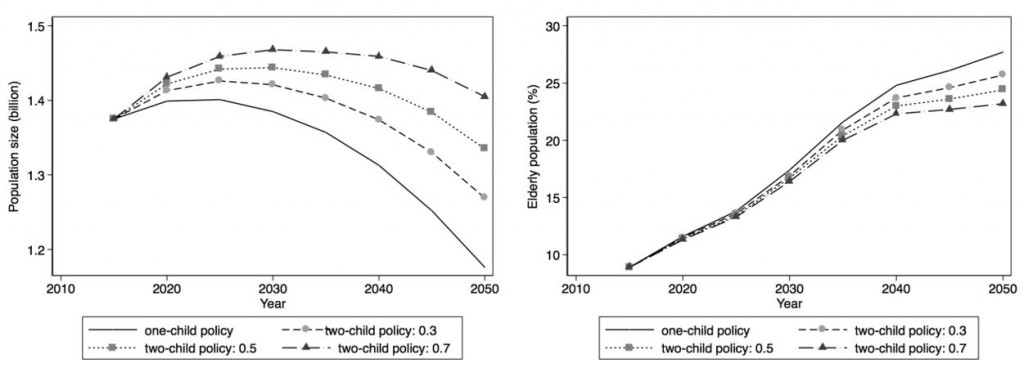
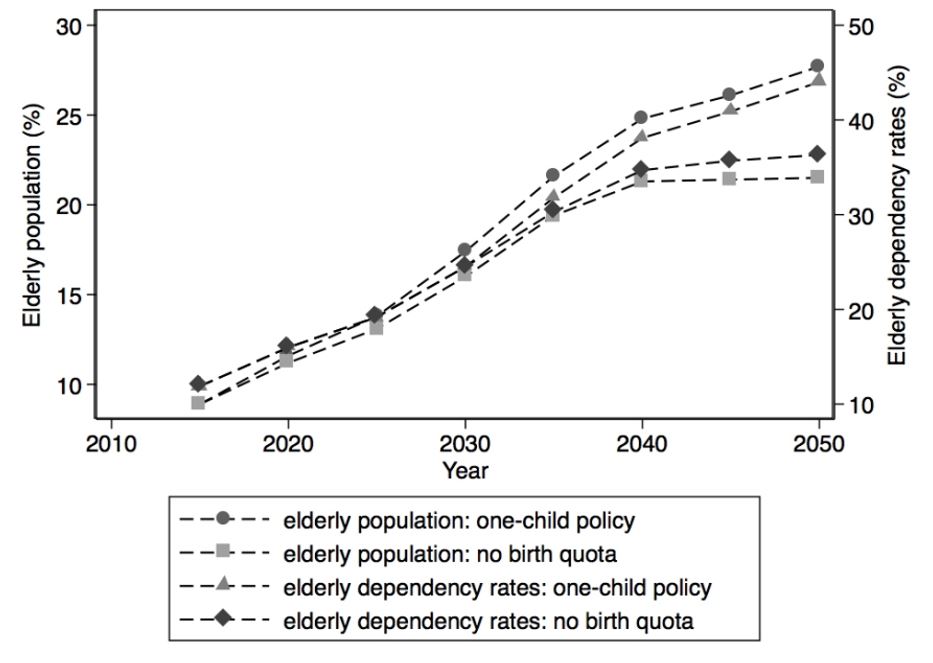
 In January 2016, China formally changed its one-child policy, now allowing all couples to have two children.