• Skip to primary navigation
  • Skip to content
  • Skip to primary sidebar

IZA Newsroom

IZA – Institute of Labor Economics

  • Home
  • Archive
  • Press Lounge
  • DE
  • EN

Mark Fallak

“Some market interventions are efficient”

October 10, 2022 by Mark Fallak

On October 1, 2022, Germany raised the nationwide minimum wage to 12 euros. In an interview with Frankfurter Allgemeine Zeitung, IZA’s new CEO Simon Jäger explains why he thinks that was the right thing to do – and why the shortage of workers may not be such a big problem after all. Below is an English translation of the  German interview.

Mr. Jäger, as of October 1st, the statutory minimum wage will increase to 12 euros per hour. What consequences do you expect for the labor market?

Despite the energy crisis, the circumstances are favorable in several respects: With 45 million people in work, employment in Germany is higher than ever, and at the same time labor demand is very strong. On the other hand, employees are currently experiencing massive losses in real wages due to inflation – across all groups of workers the loss is more than 4 percent compared to the previous year. This is something that hasn’t happened in the past 50 years.

At 12 euros, the minimum wage is 25 percent higher than a year ago. Is it the right thing to do now?

Predictions are always difficult, especially in these uncertain times. But past experience and recent research can give us clues. My expectation is that, on balance, we don’t need to fear major job losses. But we are likely to see a reallocation of jobs from less productive to more productive firms. How to judge this trend is ultimately a political question.

How exactly does this reallocation occur?

Let’s take small restaurants or corner shops, for example. Their business model might no longer work above a certain minimum wage level. Such firms would then disappear. At the same time, however, more workers are available for other firms in other sectors, such as manufacturing, that can afford to pay higher wages. Whether that’s good or bad is for society to decide. The question is, to what extent should firms still exist if they cannot pay a minimum wage?

When the minimum wage of 8.50 euros was introduced in 2015, Germany was in the midst of an economic upswing. Now we are at the brink of recession. Doesn’t this make a difference?

More recent minimum wage research actually suggests that a moderate minimum wage won’t have major employment effects, even in times of higher unemployment. Besides, unemployment in Germany is still rather low by historical and international standards.

Passing a law to raise the minimum wage must be seen as an insult to the minimum wage commission, which had previously been considered free and independent. You don’t think that’s a problem?

That’s a political rather than an economic question. Essentially, setting minimum wages is always political, regardless of whether or not you have a commission with representatives of employers and unions. But legislative intervention seems justified also in light of the fact that Germany still has one of the largest low-wage sectors in Europe. The problem is not just that many people have low labor incomes. On a macroeconomic level, the negative externalities are huge.

What do you mean by “negative externalities” of the low-wage sector?

A prime example of negative externalities is the 49-euro flight ticket to Mallorca, but the same goes for the purchase of cheap Russian gas over many years: The prices do not correspond to the true costs, here in terms of climate and security policy, and that distorts both our way of life and our economic structure in a harmful way.

What does the low-wage sector have to do with it?

If it is too easy for firms to succeed with business models based on low wages, then too many resources are allocated to less productive sectors – while at the same time there is a shortage of workers in productive sectors. A higher minimum wage can help avoid such misallocation. We also know from research that people with good jobs are more committed to society and less susceptible to political extremes. The dogma used to be that the labor market is efficient when left alone. Today it can be said that certain government interventions are also efficient.

Is it efficient for the state to set wages because then unions and employers no longer have to engage in agonizingly long collective bargaining?

It’s not a matter of either/or and conflicting goals. Collective bargaining coverage has decreased significantly in Germany over the past few decades. And most importantly, the labor market has become increasingly segregated: On the one hand, there are highly productive firms that are bound by collective agreements and pay good wages. But while cleaning staff and porters used to be employed directly by those firms, their work is now being outsourced to cleaning and security services, with less favorable collective agreements, working conditions and profit-sharing opportunities. A higher minimum wage reduces the incentive to outsource these activities.

But these service industries are exactly where unions have a hard time recruiting new members in order to push through better collective agreements. Why is that?

The structures for a functioning collective bargaining policy are often lacking. Where employers do not form employers’ associations, trade unions find it difficult to negotiate with them on sectoral collective agreements. And the rise of precarious work, for example through short-term contracts, makes it more difficult for people to commit to a common cause.

Should employers offer collective agreements if employees do not even organize themselves into unions?

Of course, both belong together. And I don’t want to assign any blame. I only note that there is a change in the institutional framework that has contributed to the decline in collective bargaining coverage. This applies, for example, to the instrument of declaring collective agreements to be binding for the entire sector.

Should the state compensate for the organizational weaknesses of the trade unions?

This is primarily a political question. Let me just say that up until the 1990s, for example, it was common practice to declare collective agreements in the very large retail sector to be generally binding. After conflicts among employers, this system broke down. That’s one of the causes of reduced collective bargaining coverage.

The biggest problem of the German labor market is the lack of skilled workers and service personnel. How can this be remedied?

I beg to disagree with that diagnosis.

Why? There is hardly any café or bakery that’s not looking for staff.

Right. But don’t forget that we currently have more employees than ever before. So the workforce hasn’t disappeared, it’s just somewhere else. Workers have left places where working conditions are poor or wages are low.

So it’s economically efficient if the wait staff at the café is reduced from five to two and the service is poor?

Possibly, yes. This creates pressure to increase wages, to automate certain activities and to align working conditions with the needs of employees. In Bonn, for example, a hairdresser has been flooded with job applications after offering a four-day workweek, even though many hairdressers are desperately looking for staff. This may lead to an upward pressure on consumer prices, but it doesn’t have to be bad for society if we previously had conditions that could only exist with a huge low-wage sector and all the associated externalities.

With the recession, unemployment is likely to rise again. Should employees be kept in their jobs with short-time work benefits like in the pandemic?

When the house is on fire, you grab the fire hose. In the current situation, I consider the short-time allowance to be a very important tool for securing jobs. But we shouldn’t overlook the considerable costs.

Such as?

Some companies take advantage of the short-time allowance even though they don’t need it at all. It also tends to inhibit structural change. Positive and negative forces have to be cleverly balanced. Unfortunately, that’s not so easy in Germany: We are flying blind when it comes to economic and labor market policy.

And why is that?

We simply don’t have the necessary data to analyze these important questions. In Switzerland or Italy, for example, data from official labor market statistics can be linked with firm-level data. And it turns out that in areas with a lot of short-time work, less productive firms survive, while more productive firms experience slower growth. This is hardly surprising if you consider that the software developer whose job at a medium-sized automotive supplier is saved with short-time work benefits is not available to any start-up. My policy advice: As the largest industrialized country in Europe, we must end this blind flight. We have a lot of data in different silos. But the federal government must create the legal basis so that they can finally be brought together. This is the prerequisite for excellent research and thus also for evidence-based policymaking.

The government is trying to make progress with a new “opportunity card” to attract more foreign skilled workers to the country. Does Germany even stand a chance in competing with the U.S. and other countries?

I think so. Many people want to live where there is strong social cohesion and where the rule of law is still largely intact. This is where Germany has a locational advantage. And Germany is also attractive when it comes to science, research and innovation.

Apparently attractive enough for you to interrupt your scholarly career at MIT in your mid-30s to head the IZA Institute of Labor Economics in Bonn.

This is an exciting and important task. Almost all major social debates of our time are also reflected in the labor market. Thanks to new research methods, we can now provide much better answers than 20 or 30 years ago and thus provide valuable input into social and political debates. With this in mind, I am very excited to lead an institute which does excellent research and has an outstanding international network. We want to build bridges between scientific research and policymaking. That’s why we will also set up a branch in Berlin.

With Ulrike Malmendier, another top researcher is coming back from America, at least as a member of the German Council of Economic Advisors. Is it a new trend that excellent young researchers also want to have more influence on practice?

I think there is a lot of interest because the challenges of our time are gigantic. Many truths about the stability of liberal democracies are being shaken. In my generation, I see a strong motivation to not just do basic research, “l’art pour l’art”, but also contribute directly to tackling social challenges with relevant research.

Filed Under: Opinion Tagged With: collective bargaining, employment, Germany, labor shortage, low-wage sector, minimum wage

Job matching in online markets

September 26, 2022 by Mark Fallak

As markets increasingly (and often exclusively) take place online, they generate both new types of data as well as new challenging research questions. The Internet as a data source for research in labor economics is therefore a focal point of IZA’s research data center, IDSC. Organized by Nikos Askitas and Peter J. Kuhn, the two-day workshop showcases innovative multidisciplinary research with data from internet job boards, one of the main modes of matching facilitation in labor markets worldwide today.

Algorithmic hiring

On the heels of both technological hype and techno-optimism, as well as aiming at more tangible benefits such as cost reduction and speed, a market emerges in which firms offer algorithmic matching services to hiring firms. In the workshop’s first keynote, Manish Raghavan presented the current state of affairs in this algorithm-driven job matching market with a focus on compliance with anti-discrimination law in the US.

Firms offering algorithmic hiring services have to consider and filter both on the quality of the training data used by the algorithms as well as the prediction targets and evaluate risks and trade-offs, a new and complex problem. Among the risks involved is the emergence of a monoculture: While in the pre-algorithmic hiring world there is a variation of (possibly error-prone) manual hiring procedures, in an algorithmic universe all hiring firms using the same algorithms commit the same errors – to the potential detriment of the labor market and society at large.

Recommender systems in two-sided markets

In the workshop’s second keynote, Thorsten Joachims, who also works on the border of computer science and economics, discussed research designed to produce fair rankings from biased data in two-sided markets. Search engines and recommender systems have become the dominant mode of matchmaking in a wide range of two-sided markets, such as retail, entertainment, employment, or even romantic partners. Consequently, such systems can shape markets. Distortion of opportunity allocation to market participants can occur either due to exogenous reasons, such as biased training data, but also due to reasons endogenous to the machine learning algorithms. Removing such distortions is therefore a new and important problem.

Defying distance? Provision of services in the digital age

In her paper, Amanda Dahlstrand-Rudin studies how digital platforms are transforming service provision in health care by making the physical distance between provider and user less relevant. Using data on 200,000 patients and 150 doctors, she first analyzes the effect of the random assignment of patients to primary care doctors that took place when Sweden moved these services online. Random assignment improved aggregate health outcomes, in part because it increased the exposure of high-risk patients to doctors who were better able to treat them.

Dahlstrand-Rudin then goes further, using the estimated causal effects derived from random assignment to project the possible health care benefits of using existing online information to actively match patients at high risk of avoidable hospitalizations to doctors skilled at triaging.  This would reduce avoidable hospitalizations by an additional 20 percent. Overall, the study dramatically shows how moving service provision to online platforms has the potential to improve service quality while reducing inequality at the same time.

RCTs on job seekers

The study presented by Jung Ho Choi measures how information about the diversity of a potential employer’s workforce affects individuals’ job-seeking behavior, and whether workers’ preferences explain corporate disclosure decisions. By embedding a field experiment into job recommendation e-mails sent from a leading U.S. career advice agency, the authors find that disclosing company diversity scores in job postings increases the click-through rate and willingness-to-pay of job seekers for firms with higher diversity scores.

Using a follow-up survey, the researchers also demonstrate that diversity information is more valuable to female job-seekers and people of color. The results provide useful new insights into how U.S. firms are likely to respond to growing pressure for firms to voluntarily disclose diversity metrics in their 10-K reports under new SEC disclosure requirements.

See the workshop program for more information.

Filed Under: IZA News, Research Tagged With: data, Internet, job platforms, matching

Four IZA network members among the Citation Laureates for 2022

September 21, 2022 by Mark Fallak

IZA Research Fellows Daron Acemoglu, Richard Easterlin, Richard Layard and Andrew Oswald have been selected as Clarivate Citation Laureates for 2022. Based on their exceptional citation record, Easterlin, Layard and Oswald are recognized “for pioneering contributions to the economics of happiness and subjective well-being” while Acemoglu is honored together with Simon Johnson and James Robinson “for far-reaching analysis of the role of political and economic institutions in shaping national development”. (See the Clarivate press release for more details.)

The quantitative and qualitative analysis that underpins the selection of Citation Laureates reveals the critical contributions they have made, reflected in the influence they have had on others’ work.  Over the past 20 years, 64 Citation Laureates have gone on to become Nobel laureates – including IZA Fellows Joshua Angrist and David Card, who had been among the 2013 Citation Laureates and became co-winners of the 2021 Nobel Prize in Economics.

About the 2022 Clarivate Citation Laureates from the IZA Network

Daron Acemoglu is a Professor of Economics at MIT. One of the world’s most cited economists, he currently ranks third in the RePEc author ranking. His research covers a wide range of areas within economics, including political economy, economic development and growth, human capital theory, growth theory, innovation, search theory, network economics and learning.

Much of his work is concerned with questions of poverty and inequality. With regard to the future of work, two of his recent IZA Discussion Papers (featured in the IZA Newsroom: The wrong kind of AI?) study the consequences of artificial intelligence and automation technologies for future labor demand and labor market inequalities.

+++

Richard A. Easterlin is university professor emeritus of economics at the University of Southern California. Having joined IZA as a Research Fellow in November 1999, he was awarded the 2009 IZA Prize in Labor Economics for his outstanding research on the analysis of subjective well-being and on the relationship between demographic developments and economic outcomes.

The founding father of happiness economics (his key papers are presented in the IZA Prize book Happiness, Growth, and the Life Cycle) was the first to describe what came to be known as the “Easterlin Paradox.” It states that at a point in time happiness varies directly with income, both among and within nations, but over time the long-term growth rates of happiness and income are not significantly related. Easterlin identified social comparison as the principal reason for this contradiction. In several of his 16 IZA discussion papers (including The Easterlin Paradox and Paradox Lost?), he defends his findings against critics.

One of his most recent contributions is summarized in the IZA Newsroom: The Newest Revolution? Happiness!

+++

Richard Layard is Emeritus Professor of Economics at the London School of Economics, where he co-founded the Centre for Economic Performance and co-directs its Community Wellbeing program. He joined IZA as a Research Fellow in January 2004 and was awarded the 2008 IZA Prize in Labor Economics together with Stephen Nickell for their path-breaking work on the relationship between labor market institutions and unemployment.

For most of his life, Layard has worked on how to reduce unemployment (his key papers are presented in the IZA Prize book Combatting Unemployment) and inequality. He is also one of the first economists in Europe to work on happiness, and his main current interest is how better mental health could improve our social and economic life. See, for example, his IZA World of Labor article The economics of mental health and several of his IZA discussion papers on the topic, such as Mental Illness and Unhappiness or Do More of Those in Misery Suffer from Poverty, Unemployment or Mental Illness?.

+++

Andrew J. Oswald is Professor of Economics and Behavioural Science at Warwick University. He has been among the most active and influential members of IZA’s international research network ever since he became an IZA Research Fellow in October 1999. From May 2011 until December 2012 he was Visiting Research Fellow and Acting Director of Research at IZA in Bonn. He is currently a member of IZA’s Scientific Council.

Oswald’s research lies at the borders between economics, psychology, epidemiology and medicine. He is also involved in research on climate change and serves as IZA’s Special Representative on Climate Change and the Labor Market (see also his recent papers Why Do Relatively Few Economists Work on Climate Change? A Survey and Do Europeans Care about Climate Change? An Illustration of the Importance of Data on Human Feelings).

Among the nearly 60 IZA Discussion Papers co-authored by Oswald to date, recurring topics are happiness, well-being and human feelings in general, see for example a recent paper covered in the IZA Newsroom (It hurts to be economically insecure).

Filed Under: IZA News Tagged With: citation record, happiness, political economy, prize, well-being

Babel’s Curse or Babel’s Blessing?

September 20, 2022 by Mark Fallak

By Juliana Bernhofer and Mirco Tonin

Polyglot curricula and applicants with international experience have long been considered the gold standard for managerial and executive positions in the private and in the public sector, and rightly so. However, acquiring these skills also entails significant costs in terms of higher effort and lower exam grades. Considering our findings, governing bodies of education institutions should develop targeted policies to avoid inequalities during higher education.

+++

Over the last decades an ever-growing number of students take degrees in a language other than their mother tongue. According to Open Doors, the number of international students in the United States increased from 1.7% in 1970 to 5.5% in 2019. Even though the pandemic has decelerated the trend, internationalization of higher education is increasing.

Students move for diverse reasons: to get into better, international universities, to enhance personal growth and cross-cultural awareness or to achieve a better placement in the labor market. Also international migration and the increasing popularity in many countries of degrees with English as medium of instruction, for the purpose of attracting talented foreign students and academics, add to the picture. But is it really all plain sailing? Does it only pay off to study in a language which is not the native one or does the additional cognitive effort of having to learn in a second language have a noteworthy impact on academic success? To answer these questions, we analyze the academic performance of students at the Free University of Bozen-Bolzano in South Tyrol, a multilingual province in Northern Italy where the majority of the population has either German or Italian as mother tongue.

A trilingual university as the ideal institutional setting

In our paper “The Effect of the Language of Instruction on Academic Performance”, published in the scientific journal Labour Economics (in Open Access), we study the impact of learning in a second language by looking into administrative data from the Free University of Bozen-Bolzano. Most of the students are Italian or German native speakers who follow a mandatory trilingual study program (German, Italian and English). This represents the ideal institutional setting for a study of this kind, in which students of different linguistic backgrounds are required to take exams both in their first language and the other two languages. As an example, an economics student may take Introduction to Management in German, Microeconomics in Italian, and Econometrics in English. Each course is offered in only one of the three languages, with the aim of providing a balanced language share for each student.

Conversely, analyzing data from monolingual universities – comparing local and incoming students from other countries – would be likely to suffer from a selection bias since better students might on average have a higher tendency to undertake studies abroad. This cognitive advantage may then lead to higher average grades, potentially concealing negative foreign language effects, thus providing uninformative results.

Lower grades, higher failure rates and second-language dodging

We divide our sample of almost 3,000 students into cohorts who attend the same degree in the same year, thus facing the same curriculum. By looking at exam results of German and Italian native speakers who take exams in German, Italian and English, we find that grades of tests in a second language are on average 9.5% lower than grades achieved in the native language. Also, the likelihood of failing an exam is higher for exams taken in a foreign language.

Language proficiency, even at a very high level (C1 or C2 on the Common European Framework of Reference for Language Skills or Levels 3 or 4 on the Interagency Language Roundtable scale) partly closes this gap, but does not eliminate it entirely. The reason for this residual disadvantage is likely due to what psycholinguists and neuroscientists call language-switching costs. Some behavioral studies as well as functional magnetic resonance imaging of the brain show that students who mentally retrieve information they previously acquired in a different language than the learning language face an additional cognitive cost, even when they are perfectly bilingual. An example relevant to our results would be high school math’s skills which have been acquired in the student’s native language and which she or he now needs to retrieve for the exam in Microeconomics, offered in a second language.

Learning in a non-native language might also slow down mental processes overall and lead to information retrieval interferences during language processing, adding to the costs of engaging in multilingual studies. It therefore does not come as a surprise that we also observe some students trying to avoid the policy of mandatory non-native learning by postponing some exams waiting for them to be taught in their mother tongue, or by taking them in more favorable conditions abroad, for example as part of international student mobility programs such as Erasmus+.

Should you stay or should you go?

Do we claim students should avoid international mobility and studying in a foreign language? Far from it! Numerous scientific studies stress the advantages of language skills in the labor market and a wide body of anecdotal evidence in recruitment processes show that international curricula are among the main requirements for managerial positions. It is not only sheer multilingual proficiency that matters. The experience gained from the immersion into a foreign language and culture signals an applicant’s wider horizon and her or his ability to adapt to new situations and challenges.

The investment in terms of additional effort when engaging in a degree taught in a non-native language is likely to pay off eventually from a personal and a professional viewpoint. However, it is not always an easy route and expectations should be formed based on facts, negative as well as positive. Governing bodies should also grant fair access to schooling and higher education by trying to smooth out inequalities between students of diverse linguistic backgrounds. This can be achieved for example by balancing out the additional cost of non-native learning, in terms, for instance, of longer duration, with financial incentive schemes and by offering targeted tools to overcome linguistic differences more smoothly.

Filed Under: Opinion Tagged With: academic performance, education, language

“We need to talk about Mechanical Turk”

August 25, 2022 by Mark Fallak

In academia, researchers use statistical thresholds to decide whether a hypothesis is likely to be true. An unintended consequence of statistical thresholds is that they may lead to p-hacking. The term p-hacking refers to research choices being made in such a way as to artificially inflate statistical significance. Approaches to p-hacking can take various forms, including in the way data is cleaned, variables defined, and specifications chosen.

Concerns about the propensity for p-hacking to undermine research credibility in recent years have led to increased interest in pre-analysis plan and pre-registration, among other tools (see a new IZA discussion paper for more on this).

In another new IZA discussion paper, Abel Brodeur, Nikolai Cook, and Anthony Heyes investigate the extent of p-hacking for studies using the online platform Amazon Mechanical Turk (MTurk). This platform has seen an unequaled increase in use in economics and management research over the past decade, partly due to giving researchers the ability to build large samples at low cost. However, in parallel with the growth in use of MTurk has come a growing suspicion in some research communities about the reliability of results from studies using it.

Substantial p-hacking and publication bias found

The paper provides the first systematic investigation of the statistical practices of the research community itself when using MTurk, and the extent to which those practices render MTurk-based empirical results untrustworthy. The practices under study are those that have become focal in recent assessments of research credibility elsewhere, namely (1) p-hacking, (2) publication bias (or selective publication), and (3) the presentation of results from plausibly under-powered samples.

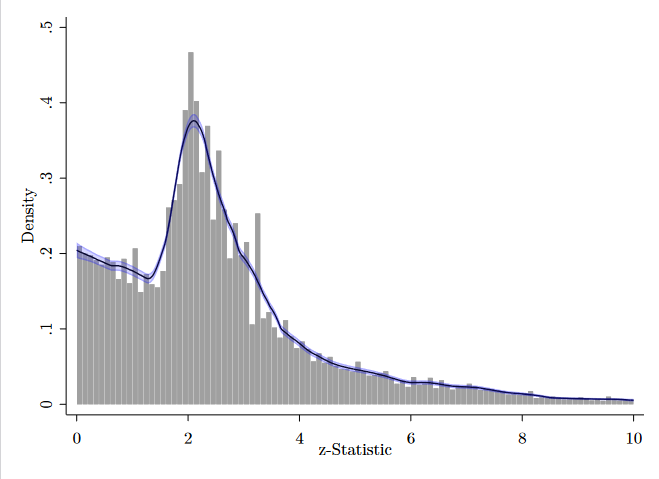
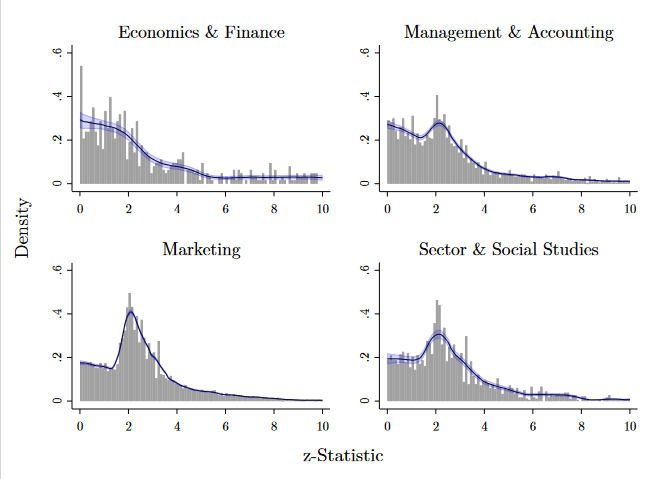
The authors analyze the universe of hypothesis tests from MTurk papers published in all journals categorized as either 4 or 4* in the 2018 edition of the Association of Business School’s Academic Journal Guide between 2010 and 2020, around 23,000 in total. Their findings suggest that the distribution of test statistics (see figure below) from MTurk exhibits patterns consistent with the presence of considerable p-hacking and publication bias.

It exhibits a pronounced global and local maximum around a z-statistic value of 1.96, corresponding to the widely accepted threshold required for statistical significance at the 5% level, or a p-value of 0.05. This maximum is coupled with a shift of mass away from the marginally statistically insignificant interval, indicative of p-hacking.


This pattern of test statistics is persistent over time and roughly as present in papers published in elite (rank 4*) and top (rank 4) journals.

The extent of the problem varies across the business, economics, management and marketing research fields (with marketing especially afflicted).

Underpowered studies with small sample sizes

The power of a statistical test is the probability of detecting an effect (rejecting the null hypothesis of no effect) if a true effect is present to detect. The appropriate choice of sample size, and therefore level of power, is a central element of experimental research design.

However, most MTurk studies use small sample sizes (with a median number of 249  subjects per experiment) without giving justification as to how a particular sample size was chosen. Cost does not seem to be the reason as the average cost of an additional data point (in the analyzed sample of studies) is 1.30 USD – and less than 1 USD in 70 percent of cases.

More rigorous attention to statistical practice needed

The authors describe their findings as “in one sense pessimistic and in another optimistic.” On the one hand, they find the credibility of results contained in the existing corpus of research using the MTurk platform to be substantially compromised: “If a reader were to pick at random a study from our sample, our analysis points to this result being unlikely to be replicable.”

On the other hand, the flaws they identify relate to the way in which MTurk experiments are conducted, and results selected for publication, by the research community, rather than flaws inherent to the platform itself. This distinction is important as it suggests that there is no reason – at least from this perspective – for researchers to discontinue to use MTurk and other similar platforms.

Instead, the authors call for more rigorous attention to statistical practice. In particular, the use of larger samples to provide appropriately powered experiments should become more common – which seems feasible, given that this is an area of research where data points can be purchased on the cheap.

Filed Under: Research Tagged With: Amazon Mechanical Turk, crowd sourcing, online platforms, p-hacking, publication bias, research credibility, statistical power

Who is more productive from home?

August 23, 2022 by Mark Fallak

The COVID-19 pandemic generated a sharp increase in the number of remote jobs. The future of teleworking ultimately depends on its impact on workers’ productivity and well-being, yet the effect of remote working on productivity is not well understood: Some studies report an overall improvement in productivity whereas others document the opposite.

An explanation for this mixed evidence may lie in the transmission channels linking teleworking and productivity. In addition to direct mechanisms, such as the quality of ICT infrastructure or the change in managerial oversight, teleworking can affect productivity through well-being. On the one hand, remote work grants workers a larger autonomy, positively contributing to job satisfaction. It also reduces stress and fatigue associated with commuting. On the other hand, isolation and difficulties to separate work and private life can have the opposite effect. A recent study by the German trade union federation highlights both sides of the coin.

Overall, the balance of these pros and cons can greatly vary across individuals. The existing literature emphasizes the importance of gender and occupation for the productivity of teleworking, but a large share of this heterogeneity remains unexplained.

Conscientious workers are more productive when working from home

A new IZA discussion paper by Nicolas Gavoille and Mihails Hazans investigates the link between personality traits and workers’ productivity when working from home. The authors exploit a survey that provides measures of the “Big Five” personality traits for more than 1700 individuals in Latvia who worked only or mostly from home during the COVID-19 pandemic.

The results indicate that personality traits do matter for productivity in a remote work setup. In particular, conscientiousness plays an important positive role for productivity in teleworking and the willingness to work from home in the post-pandemic period. These relationships are statistically significant but also economically meaningful: Controlling for a battery of factors, the difference in probability to report a higher productivity from home than in office between individuals at the 75th percentile of the Conscientiousness score and those at the 25th percentile is 8.4 percentage points. This is a relatively large change given the average probability of 31%.

This important role of conscientiousness is in line with many previous studies documenting positive correlation between conscientiousness and key labor market outcomes. Similarly, Openness to Experience is also positively correlated with the productivity measure and willingness to work remotely post-pandemic.

Concerns about adverse self-selection seem unfounded

These results suggest that pro-teleworking employers will observe selection on personality traits into their workforce. Given that conscientiousness is desirable to all employers, while openness to experience is desirable at least to employers in growing and/or innovative firms and organizations, this selection is positive from the employer perspective, mitigating employers’ concern about adverse self-selection in flexible working arrangements.

Observing that highly conscientious workers are more willing to work from home, where they are more productive, suggests that firms do not need to exert a very strict control on their employees choosing to telework. This finding contrasts with the results of an earlier IZA paper from Belgium, claiming that individuals with a higher level of conscientiousness find job offers allowing for work remotely less attractive. The authors of the new study suggest that conscientious workers who already have (positive) experience with remote work may have found some of their prejudices overthrown.

In addition, their study uncovers a negative relationship between Extraversion and preference for teleworking, suggesting that employers practicing remote work should invest in socialization measures to compensate the negative effect of teleworking on well-being of more extravert workers.

Overall, the findings of this study suggest that a one-size-fits-all policy is unlikely to maximize firms’ productivity nor workers’ satisfaction. Individual workers’ characteristics are indispensable when estimating firm-level ability in switching to remote work.

Filed Under: Research Tagged With: personality, productivity, remote work

Measurement of incomes, living costs and standards of living

August 16, 2022 by Mark Fallak

A central concern for economic policymakers around the world is the standard of living enjoyed by their country’s population. Living standards depend on many factors, including workers’ wages and hours, the availability of jobs, living costs, and the adequacy of social insurance programs and the social safety net. Living standards for those at the bottom of the income distribution are a particular concern.

While many studies focus on cross-country differences in living standards, nominal incomes often vary significantly across geographic areas within countries. Whether geographic differences in nominal income translate into geographic differences in living standards, however, depends on the variation across areas in living costs and local amenities. Over the past two years, the COVID-19 pandemic has raised new concerns about living standards, particularly for less skilled workers and workers in the developing world.

The 5th IZA workshop on labor statistics, organized by Katharine Abraham and Susan Houseman, featured 11 papers and a keynote address delivered by Bruce Meyer of the University of Chicago that explored a variety of questions related to the measurement of incomes, living costs and standards of living. Findings from several of the papers are highlighted below; the full set of papers is listed on the workshop program.

Poverty measurement

One important fact about poverty is that poor households often experience substantial within-year income and consumption volatility. In their paper titled “Poverty at High Frequency,” Joshua Merfeld and Jonathan Morduch show that a substantial fraction of the population in rural South Indian villages whose annual consumption expenditures place them above the poverty line experience months during the year with consumption expenditures below that level. Headcount poverty based on the share of months villagers spend in poverty is 26% higher than implied by conventional annual measures.

This finding has important implications regarding both the value of high-frequency data collection and the targeting of anti-poverty resources, which the authors argue could have greater impact if allocated disproportionately during months when consumption and income are relatively low rather than evenly throughout the year.

In most countries, poverty measurement relies on data collected through household surveys. In their paper titled “Errors in Reporting and Imputation of Government Benefits and Their Implications,” Pablo Celhay, Bruce Meyer and Nikolas Mittag document that household survey respondents in the United States significantly underreport receipt of welfare and food stamp benefits.

Their analysis makes use of data from three large Census Bureau surveys—the Current Population Survey, the American Community Survey and the Survey of Income and Program Participation—linked to administrative data for the state of New York. Imputed values for the benefit receipt variables are even more likely to be wrong than self-reported values. Because reporting and imputation errors are not random, they lead to distortions not only in the level but also in the pattern of benefit receipt.

The paper makes clear the need for improvements in the collection of data on participation in public assistance programs, whether through improvements to the questions on household surveys or expanded access to administrative data.

Geography of living standards

In his keynote address, based on a paper titled “Does Geographically Adjusting Poverty Thresholds Improve Poverty Measurement and Program Targeting?” co-authored with Derek Wu and Brian Curran, Bruce Meyer considered whether poverty thresholds should be adjusted to take account of differences in prices across geographic areas. He argued against make such adjustments based on evidence that those classified as poor only when a geographic price adjustment is applied may be less disadvantaged than those classified as poor only when a uniform poverty threshold is applied.

His assessment of relative disadvantage rested on measures of material hardship, appliances owned, home quality issues, food security, public services, health, education, assets, permanent income and mortality. In nine out of these ten domains, he argued, geographic price adjustments led to counting relatively less disadvantaged people as poor. Meyer’s presentation led to a lively discussion, with discussant David Johnson noting several reasons to be cautious about accepting Meyer’s conclusions at face value.

COVID and living standards

The COVID pandemic clearly has had an impact on living standards around the world. The final paper on the workshop program, “Households in Transit: COVID-19 and the Changing Measurement of Welfare,” by Laura Caron and Erwin Tiongson, raises an interesting measurement question related to the definition of household consumption.

During the early pandemic period, households that were able to shift from in-person work to working from home saved on commuting costs. Using data for the country of Georgia, the study shows that higher income households benefited disproportionately from this shift. Conventional consumption statistics, however, would have treated their drop in commuting costs as a reduction in consumption.

The authors argue that, accounting correctly for changes in commuting costs, high-income households fared relatively better during the pandemic—and low-income households relatively less well—than implied by standard expenditure-based measures.

Filed Under: IZA News Tagged With: cost of living, IZA workshop, labor statistics, measurement, standard of living

Children benefit from longer parental leave

July 25, 2022 by Mark Fallak

Most young children in Western societies spend a considerable amount of time in institutional care. But because of different parental leave policies and different preferences among parents, the age at which children enter institutional care ranges from anywhere between shortly after birth to several years later. Though early psychological studies and attachment theory suggest that separating a young child from their primary caregiver may affect their development, little causal evidence exists on whether the duration of parental leave influences child development and well-being in the long run.

In a recent IZA discussion paper, Mikkel Aagaard Houmark, Cecilie Marie Løchte Jørgensen, Ida Lykke Kristiansen, and Miriam Gensowski investigate this by exploiting the implementation of a reform in Denmark that increased paid parental leave from 24 to 46 weeks. Using a nearly universal survey of the well-being of elementary school children, the authors construct different measures of socio-emotional skills. These are distinct from the cognitive skills (e.g., IQ and school performance) more commonly studied in the economic literature, but are equally important for a happy, healthy and wealthy life.

The authors find that children of mothers who took longer leave because of the reform have better outcomes measured at adolescence (grades 7 and 8). For each additional month of leave, the children have 4.7 percent higher well-being, 3.5 percent higher conscientiousness, and 2.8 percent higher emotional stability. In addition to these self-reported improvements, the children also have 2.7 percent fewer days of school absence.

Consistent with a theoretical model that they develop, the authors go on to show that the children who benefit the most from an increase in parental leave are those who would otherwise have entered daycare at a very early age. Not only do these children report significantly higher socio-emotional skills and well-being – they also have less school absence and receive better grades from their teachers.

Finally, the authors show that the children who benefit the most from additional parental leave are those who tend to be worse off on all their measures. This means that the increase in parental leave also reduces socioeconomic inequality in child development.

Together, these findings show that parental leave policies can affect both the level and distribution of a range of educationally relevant child outcomes. This study from Denmark thus provides a more positive assessment of longer parental leave than an earlier IZA paper from Norway and a study from France, both of which found parental leave extensions (though more generous extensions than those analyzed in Denmark) to run counter the intended social policy goals.

Filed Under: Research Tagged With: adolescence, early childhood, parental leave, personality, skill formation, socio-emotional skills, well-being

Cutting disability insurance benefits may come at a cost

July 8, 2022 by Mark Fallak

The share of working-age adults receiving long-term disability insurance (DI) benefits has increased rapidly over the last few decades and DI programs currently account for over 10% of social spending in OECD countries. This development has led to a search for effective policies that help reduce the public cost of disability insurance.

One way that policy makers try to limit the take-up of DI benefits and incentivize work is setting earnings limits: Once beneficiaries earn above a certain level, they lose their benefits. The rationale behind earnings limits is the presence of asymmetric information: As the government cannot observe applicants’ true health status or work capacity, it must rely on a screening mechanism. The screening mechanism is supposed to ensure that only workers who are unable to earn above a certain level will apply for benefits, while potential applicants with higher working capacity will find it advantageous to forego benefits and remain employed instead.

While a tight earnings limit might thus be a suitable screening device that keeps entry into the program low, it may also create strong work disincentives for benefit recipients. This may especially be the case in labor markets with high earning risks where the benefit provides a stable source of income for recipients.  When setting the earnings limit, policy makers thus face a tradeoff between the selection (or screening) effect of the earnings limit and the labor supply effect.

Selection and labor supply effects

In a recent IZA Discussion Paper, Judit Krekó, Daniel Prinz and Andrea Weber first formalize this idea in a theoretical framework that explains what happens if the government decreases the earnings limit in the DI program. In this case, the set of workers who apply for benefits shrinks as only less-productive workers will prefer benefit receipt and limited work.

At the same time, another effect is at play: Conditional on receiving benefits, a lower earnings limit means that beneficiaries will set their labor supply lower in order to remain eligible for benefits. The authors call these two effects of changing the earnings limit the selection and labor supply effects. At the optimal earnings limit, the selection effect and labor supply effects of moving the earnings limit will balance each other out for the marginal entrant. For policy design it is thus important to estimate these effects empirically.

Reform in Hungary

In the second part of the paper, the authors study a reform that reduced the earnings limit form 80% of the pre-disability wage to 80% of the minimum wage in Hungary’s Regular Social Assistance (RSA) program for the moderately disabled. Importantly, the reform only applied to new entrants taking up benefits as of January 1st 2008, while it remained the same for beneficiaries who were already approved.

The paper exploits this policy change to understand how selection into the program and labor supply once in the program changed. To this end, the study compares the evolution of various measures of labor supply relative to the start of benefit receipt among beneficiaries who enter before (“old entrants”) and after (“new entrants”) the reform date.

Empirical findings

The empirical analysis results in three main findings. First, the authors find that the decrease in the earnings limit only had a small impact on selection into the program. There is no evidence of decreased program entry rates. But consistent with the screening mechanism, individuals who entered the program after the reform had worse pre-entry labor market outcomes than beneficiaries who entered earlier.

Second, though exit from DI benefits is not common even among the moderately disabled beneficiaries, a further margin that could have been potentially affected by the earnings limit is the probability of staying on the program. There is no evidence that new entrants were more likely to exit the program than old entrants.

Third, it is found that individuals who entered the program after the earnings limit was reduced had meaningfully lower labor supply post-entry. While new entrants were as likely to be employed as old entrants, they worked less conditional on being employed. This labor supply response is driven by beneficiaries with higher pre-disability earnings, who were most affected by the change in the earnings limit.

Forth, to examine the impact of the lowered earnings limit on beneficiary health, the authors consider mortality, an imperfect measure of health. Their results suggest no change in mortality which means that the primary effect of the reduction of the earnings limit on beneficiaries was through reduced work.

Policy implications

Overall, the results suggest that decreasing the earnings limit only led to a moderate improvement in screening efficiency. This evidence is consistent with a scenario where the earnings limit and benefit level before the reform were already sufficiently low to deter potential entrants who are well-positioned to find higher-paying jobs in the labor market.

At the same time, the reform substantially distorted the labor supply of program participants. Viewed through the lens of the model, the empirical findings suggest that the overall impact of the reform on efficiency and welfare was negative. The authors conclude that the reform failed to yield sizable cost savings from benefit expenditures for the government, but left moderately disabled individuals with lower earnings, resulting in lower tax revenues in turn. At the given benefit level, a higher earnings limit would therefore be optimal.

Filed Under: Research Tagged With: disability insurance, Hungary, labor supply

Increased wage transparency in job postings has no effect on gender pay gap

July 1, 2022 by Mark Fallak

The gender pay gap has gradually narrowed over the last decades, with the remaining gap due in part to gender differences in occupation, industry, and firms. Several recent studies confirm that differential sorting between men and women into high-paying firms is a major contributor to the gender pay gap in various countries.

Pay transparency has recently received significant attention as a policy tool to narrow the gender wage gap. These efforts presume that female workers, who tend to earn lower wages, are unaware of these differences and will choose different jobs or bargain more if wage transparency increases. Most of the existing transparency laws require firms to reveal wages or compile wage reports about the current employees. This helps coworkers to compare their pay but the data are often less accessible to outsiders.

In a new IZA Discussion Paper, Omar Bamieh and Lennart Ziegler study an alternative policy that requires firms to provide at least a lower bound for wages already in their job ads. Linking Austrian vacancy data to information on eventual hires, they show that such wage postings do not change the probability of women working in higher-paid jobs.

Since the gender wage gap is precisely estimated and remains constant during the period of observation, even smaller reform effects can be ruled out. Further analyses of job-to-job transitions show that a lack of worker mobility cannot rationalize the null effect. Many job seekers find new employment at firms and in occupations that differ in pay from their previous job. The authors interpret the absence of effects as evidence that missing wage transparency is not the root of persistent gender differences in the labor market.

It seems that financial gains from switching to a better-paid job may not outweigh preferences for a specific employer or occupation. Previous studies show that other non-pecuniary amenities such as flexible working hours or short commuting times are more important for female workers, especially if additional child care responsibilities exist. Hiring discrimination of employers might additionally limit a shift towards better-paid jobs even when preferences change due to increased transparency.

Filed Under: Research Tagged With: Austria, gender pay gap, job search, wage transparency

  • Previous Page
  • Page 1
  • …
  • Page 12
  • Page 13
  • Page 14
  • Page 15
  • Page 16
  • …
  • Page 30
  • Next Page

Primary Sidebar

© 2013–2025 Deutsche Post STIFTUNGImprint | Privacy PolicyIZA