• Skip to primary navigation
  • Skip to content
  • Skip to primary sidebar

IZA Newsroom

IZA – Institute of Labor Economics

  • Home
  • Archive
  • Press Lounge
  • DE
  • EN

Suddenly a stay-at-home dad?

December 23, 2020 by Mark Fallak

In most developed countries, men on average contribute less to domestic unpaid work than women. Although this so-called “gender care gap” can explain phenomena like the motherhood penalty and gender inequality in the labor market in general, there still is no clear evidence on its origins and drivers. This is why policy makers all around the world are still puzzled about how fathers’ involvement in domestic production can be increased in order to enable women, especially mothers, to enter or remain in the labor market.

A number of European countries introduced father quotas to their parental leave schemes to encourage fathers to consider domestic work as an outside option. However, earlier research shows that there is only a rather small overall long-term effect on paternal engagement beyond the short-term paternity leave take-up. A major disadvantage of the research on paternal leave-taking is that it affects a very small and select group of men and might thus not be representative of most fathers.

Therefore, researchers and policy makers are especially interested in the broad effects of short-term shifts of domestic responsibilities in households affected by the COVID-19 pandemic, for example by working-from-home requirements as well as increases in unemployment. Because more women are employed in critical occupations, this might disproportionately affect men. However, investigating the long-term effects of these shocks is a dream of the future.

A recent IZA discussion paper by Juliane Hennecke and Astrid Pape provides novel evidence on the short- and long-run effects of a sudden shock on paternal domestic availability, through a job loss, on the allocation of domestic work within couples. Using German survey data, the authors find that paternal child care and housework significantly increase on weekdays in the short run but no similar shifts can be identified on weekends.

Effects are positive and persistent for fathers who remain unemployed and are especially pronounced if the female partner works. Nevertheless, in the long run, re-employment reverses the effects, and re-employed fathers spend significantly less time on child care and housework than before the job loss due to new professional challenges. In addition, the authors also find significant changes for female partners as well as for the cumulative household time investments and the outsourcing of tasks.

The authors conclude that paternal availability can induce changes within families to a more equal division of tasks and a reduction in outsourcing, but a strong reversal of these arrangements in the case of re-employment. There is no indication of long-term changes in comparative advantages, gender role attitudes, and emotional bonds in the affected families.

This provides important policy implications as it indicates that overcoming existing external barriers to increased paternal involvement, such as societal gender norms, workplace practices and expectations, may be preferable to short-term impulses, such as parental leave quotas, which are likely to have few long-term consequences even if their take-up were to increase.

Filed Under: Research Tagged With: childcare, fathers, gender care gap, household, mothers, parents, unemployment

Measuring individual-level poverty in developing countries

December 18, 2020 by Mark Fallak

In developing countries, households are typically large and can include several generations and many children. In large families, individuals are allocated a smaller share of the household budget, but they tend to benefit from scale economies in terms of joint consumption. Quantifying this trade-off is necessary to compare individuals’ well-being across households and may be critical for the correct measurement of poverty and inequality.

In a recent IZA paper, Rossella Calvi, Jacob Penglase, Denni Tommasi, and Alexander Wolf shed new light on this trade-off. First, they develop a new approach to identify the intra-household allocation of resources and scale economies in a collective household model. They then apply their approach to construct estimates of individual consumption for Bangladesh and Mexico.

Country differences

In Bangladesh, they find a modest amount of consumption sharing, suggesting that ignoring economies of scale is not likely to lead to a large degree of error in individual consumption estimates. By contrast, they estimate significant economies of scale in Mexico. The model estimates also indicate that women in Mexican families are allocated a larger fraction of household resources relative to women in Bangladesh. In both countries, children command the smallest share of household resources, but their disadvantage is more pronounced in Bangladesh.

The authors compute country-specific poverty rates that are adjusted for scale economies and intra-household inequality. They find that standard equivalence scales widely overstate scale economies (and hence understate poverty). They also show that ignoring scale economies may lead to an overestimation of poverty rates. Still, the extent to which this is the case depends on the degree of joint consumption in different contexts and how far from the poverty line households are.

Filed Under: Research Tagged With: Bangladesh, consumption, Development, economies of scale, households, Mexico, poverty

Brexit referendum vote caused an increase in hate crime

December 14, 2020 by Mark Fallak

The campaign ahead of the Brexit referendum brought immigration to the forefront of the public debate. The referendum result, much like Trump’s election in 2016, was a surprise. It defied both the betting markets and the polls. The true extent of society’s private anti-immigration sentiment was now public.

There was a documented rise in hate crime after the Brexit referendum result. The reported spike in racist or religious abuse incidents in England and Wales within the first month since the referendum has been attributed to the vote itself. While these changes coincided with the referendum, they could have been correlated with the vote itself, rather than triggered by it. Specifically, it is possible that other economic and political factors resulted in both the Brexit vote and the changes in hate crime incidents. The vote may have also led to increased reporting of hate crimes by victims and witnesses or better recording by the police. Both trends could have been further amplified by (social) media reporting.

Hate crime as a breakdown of social norms

A recent IZA Discussion Paper by Joel Carr, Joanna Clifton-Sprigg, Jonathan James, Sunčica Vujić examines the impact of the Brexit referendum result on an observable and measured breakdown in social norms – that of committing racial and religious hate crime.

Given that the event was national, identifying control groups is not obvious in this case. In order to isolate the causal effect, the paper uses racial and religious hate crime as the treatment group and other crime categories as the control group. The idea is that the Brexit vote was unlikely to impact other crimes such as burglary, shoplifting or drug use but had a direct impact on racial and religious hate crime.

The paper finds a 15-25% rise in recorded hate crime as a result of the Brexit referendum vote. This effect is concentrated in the first quarter after the referendum (July to September 2016). Specifically, the impact is largest and most significant in the first month after the referendum (July 2016). Thereafter, the paper does not find a bigger increase in hate crimes relative to other crimes. This suggests that social norms can change quickly, but this change might not be long lasting.

Hate crime larger in areas that voted to leave the EU

The estimates reveal a larger relative increase in hate crimes in areas that voted to leave the EU compared to areas that voted to remain. This suggests that when the private anti-immigration sentiment was made public by the referendum, areas where more people agreed with this sentiment now had the norm updated. As a result, they were more likely to express the anti-immigrant views by committing hate crime.

The paper also provides suggestive evidence that media (traditional and social) played a role in increasing hate crime, although these effects are rather small. The paper further finds evidence that there was an increase in the probability of reporting hate crimes, having been a victim after the referendum. There were also changes to the outcomes of recorded crimes that could reflect police effort or changing police behavior.

However, the magnitude of these effects and the types of crimes affected by these changes indicate that only a small part of the observed racial and religious hate crimes increase post-referendum can be explained by a change in either victim or police reporting behaviors. Similarly, the paper shows evidence against the argument that changes in the perception of the victims resulted in these large increases in racial and religious hate crimes.

Filed Under: Research Tagged With: Brexit, crime, hate, immigration, social norms, UK

How working-time flexibility affects workers’ productivity in a routine job

December 4, 2020 by Mark Fallak

The Covid-19 pandemic has fast-tracked the adoption of flexible work modalities by employers around the word. In particular, teleworking has proven itself as an important scheme of ensuring business continuity, increased productivity, and better work-life balance.

However, teleworking is only one form of job flexibility. It is mainly based on replacing the workplace with the home, while maintaining demanding characteristics in schedules and expected results. Also, teleworking is supported only for a limited number of jobs. Recent research estimates that the proportion of jobs that can be carried out from home are few, ranging from 6% in Ghana to 34% in the United States.

Pros and cons of flexible work arrangements

Teleworking also raises some concerns. By reducing interactions among workers and between workers and supervisors, there is a risk of reduced productivity, particularly in jobs where interactions are necessary. Similarly, working from home could increase distractions for workers. Finally, blurring the boundaries between work and home could lead to increased working hours and, consequently, increased employee stress levels and fatigue. In sum, teleworking affects productivity by modifying two key dimensions at the same time: the workplace and the working time schedule.

Other types of flexible work arrangements are related to schedule flexibility, such as being able to decide when to start and stop working, and the total time spent on the job – i.e. working part time. If workers value such arrangements, they are willing to work for lower wages in exchange for such flexibility. Alternatively, when keeping pay constant, the option of such autonomy may boost a worker’s productivity either by increasing their motivation or stimulating reciprocal behavior.

A key question regarding such flexible working arrangements is why firms do not offer them more often. A possible answer is that employers may worry that giving workers more freedom will cause them to work less or to reduce their level of effort. Some studies have demonstrated a net productivity-enhancing effect of work-schedule and workplace flexibility for non-routine tasks and jobs that require little coordination through interactions; yet productivity may decline for routine tasks. However, causal evidence is still scarce, especially with respect to work-schedule flexibility.

The findings are more mixed and the causal evidence even more limited for part-time work. Compared to other forms of flexibility, part-time workers could increase their productivity by suffering from less fatigue than their full-time colleagues or by allowing the more intensive use of capital. However, high fixed start-up costs imply that part-time workers may be less productive than their full-time counterparts, because the latter incur such costs for any number of hours worked. Moreover, part-time workers may be less committed to their career goals, and the returns on training may be lower.

Field experiment in Colombia

A recent IZA study by Marie Boltz, Bart Cockx, Ana Maria Diaz, Luz Magdalena Salas aims to provide causal evidence of the effects on productivity in a routine temporary job of two of the three flexible working arrangements described above: (1) working part-time and (2) being able to decide when to start and stop working within the work week. The researchers carried out a field experiment in Bogotá, Colombia’s capital city.

“Flexible work schemes can enhance productivity in two ways, they can either increase the attractiveness of the job such that intrinsically more productive workers self-select into it, or they incentivize workers to exert more effort or time to working,” says Marie Boltz. The authors aim to capture both sources and disentangle the effect into these components in a natural environment.

In order to capture the consequence of self-selection, the field experiment began from the moment the job ads for a three-week position as data entry operators were posted. The vacancy was advertised without reference to the contract environment. Applicants provided standard resume information and performed an online test in which they had to carry out similar data entry tasks as the job to which they were applying. This allowed the researchers to construct an ex ante measure of productivity and to disentangle the sorting effects on productivity from the ex post motivational effects.

Flexible contracts increase productivity by up to 50 percent

The findings suggest that an employer can increase a worker’s overall productivity by nearly 50 percent by offering a full-time flexible contract rather than a full-time non-flexible one. About 40 percent of this overall effect is attributed to attracting more productive workers. The remaining 60 percent is attributed to a motivational effect that is almost completely driven by the fact that full-time flexible workers take fewer breaks than those with non-flexible contracts. This results in a 10-percentage-point increase in effectiveness relative to contractual working time.

The paper also finds that part-time flexible and non-flexible contracts can enhance total productivity, but these effects are not significant at conventional levels. However, part-time workers, with or without a flexible time arrangement, spend 15 percentage points less time taking breaks in the workplace relative to contractual time than the reference group, and this effect is highly significant. This does not show up in the global effect on productivity because these part-time workers make more mistakes, or are more frequently absent from work.

The authors’ finding that working-time flexibility can substantially enhance productivity in a routine data entry task is new. Prior studies have argued that flexibility is especially valuable in non-routine jobs, but that the impact on productivity in routine jobs may be negative. Another contribution to the literature is that this field experiment began during the recruitment process, which allows the researchers to jointly evaluate the total productivity effect of flexible work arrangements that is induced both by attracting more productive workers and by motivating them to exert more effort.

Filed Under: Research Tagged With: autonomy, Colombia, field experiment, flexibility, part-time, productivity, routine, working time

Video resumes increase callback rates

November 24, 2020 by Mark Fallak

Video resumes are becoming increasingly popular and can be hosted directly on internet platforms or can be referenced through a hyperlink when uploading a resume to a potential employer. Video resumes allow job seekers to showcase their abilities beyond the capabilities of traditional paper resumes and allow prospective employers to see and hear applicants, and get a feel for how applicants present themselves.

In a recent IZA discussion paper, Charles Bellemare, Marion Goussé, Guy Lacroix and Steeve Marchand investigate the impact of using video resumes on callback rates for low to middle-skill jobs. Using a large scale field experiment, they randomly sent applications to 2021 private firms posting vacancies across the Canadian province of Québec. A subset of these applications included a link inviting firms to view a video resume. The study targeted secretary-receptionist positions advertised on standard job search engines. A professional actress was hired to personify a potential candidate in the video resumes. The researchers recorded detailed viewing activities from potential employers (number of views, duration, rewind/forward, etc.) as well as callbacks either by e-mail or voice message.

A potential downside of video resumes is that they reveal otherwise concealed information that is not to the liking of an employer, such as race, gender, obesity, or disability. To test the latter case, a subset of the applications disclosed a disability requiring the use of a wheelchair. This was achieved by filming the actress sitting in a wheelchair. The disability was mentioned explicitly in the cover letter in cases where the resumes did not mention a video. The videos used both a narrow and a wide frame, with only the latter showing the wheelchair.

The wide-frame video shows whether the applicant is sitting in a regular chair or a wheelchair.

Disabled workers benefit equally, but discrimination persists

The analysis finds that the unemployed can greatly benefit from a well-designed promotional video. More importantly, workers with a visible disability benefit just as much: Callback rates increase from 45% to 55.3% for able-bodied applicants, and from 19.9% to 27.4% for disabled applicants. Still, disabled applicants are found to be discriminated against as they are half as likely to be invited to a formal interview, even when firms are accessible for wheelchairs (an important aspect that previous studies on discrimination have not taken into account).

To the extent video resumes are beneficial to disabled applicants, they could be a cost-effective alternative to government-sponsored training and job assistance programs, which over the past decades have had limited success in helping disadvantaged individuals find employment.

Should disability be revealed in job applications?

Based on previous corresponding studies, it can be argued that hiding a disability (or any other trait firms may discriminate upon) yields higher callback rates. At first glance, the results of this study support this argument – callback rates are highest when the applicant uses a video resume without revealing a disability. However, correspondence studies capture only the first part of the recruitment process, but say very little about outcomes of follow-up job interviews on site.

Since video resumes allow prospective employers to see and hear applicants, the authors conjecture this may lead to better matches at the interview stage and increase interview performance and outcomes. This service should be all the more relevant for persons with disabilities as they face higher mobility costs to commute to work and to undertake interviews. Video resumes represent an efficient way for them to quickly identify firms willing and able to recruit and hire persons with disabilities. Moreover, they can better approach formal on-site job interviews knowing the firm they visit is aware and very likely willing to accommodate their disability.

Public funding of video resumes may pay for itself

The non-profit organization the authors partnered with for this project currently charges approximately 300$ to produce a video CV. In comparison, social welfare benefits for single adults with and without disabilities in Québec are currently 690$ and 1088$, respectively. A back-of-the-envelope calculation suggests that publicly funding the production of video resumes in the current labor market would pay for itself if video usage accelerates exits from unemployment by two weeks. This calculation ignores income taxes, which would further increase returns to funding this service.

As a pre-screening of candidates reduces search costs, the authors expect that a wide adoption of video resumes would improve labor market efficiency, which could increase demand and reduce unemployment. However, they also caution that a more widespread use may penalize non-users – or diminish the advantage over traditional applications once the novelty effect of video resumes subsides. Depending on the relative strengths of these opposing forces, the gap in callback rates found in the experiment may thus either widen or close over time.

Filed Under: Research Tagged With: correspondence study, disability, discrimination, hiring, job application, video resume

Vacancy postings reflect trend towards working from home

November 20, 2020 by Mark Fallak

In many countries, the COVID-19 crisis led to a sharp increase in working from home. According to a Eurofound survey conducted in April, 37 percent of workers across the EU started to telework due to the pandemic. At 41 percent, Austria is among the EU countries with the largest proportion of workers who switched to remote work arrangements. A recent IZA paper by Omar Bamieh and Lennart Ziegler examines to what extent this is reflected in job ads. The project was financially supported through the IZA Coronavirus Emergency Research Thrust.

The researchers analyzed data from largest Austrian job board, which – in contrast to administrative data – shows immediate changes in labor demand during the crisis and includes information on various relevant job characteristics such as teleworking options, required work experience, and posted wages. In terms of absolute numbers, vacancy postings declined by one-third in the post-lockdown months (April through June 2020) compared to the previous year – down from 75,000 to 50,000.

Posted wage offers in the remaining job ads were 0.2 percentage points lower than before the crisis. While the initial lockdown largely affected low- and medium-educated workers, the study shows that the decrease in vacancies affected all levels of education to a similar extent.

Do new vacancy postings reflect the trend towards working from home? Indeed, for the group of higher-educated workers, references to teleworking increased by up to one-fourth compared to the month before the crisis. Given that the estimated impact persists throughout June, the authors interpret the results as an actual organizational change, which may have long-lasting effects. In line with this interpretation, they do not find any evidence of a relative increase in occupations which are commonly associated with telework.

The results thus suggest that the pandemic could accelerate the already existing shift towards home-based work. As the authors point out, some firms might have realized that telework is a feasible option and that more jobs can be done from home than was previously thought. This raises the larger question to what extent physical presence at the workplace will still be required in the years to come.

Filed Under: Research Tagged With: Austria, COVID-19, hiring, job ads, labor demand, remote work, telework, vacancy

How was the U.S. presidential election affected by the COVID-19 pandemic?

November 16, 2020 by Lars Meierwisch

New confirmed cases of the coronavirus in the U.S. have climbed to an all-time high, with polls showing the public health crisis was a top concern for many Americans. Unsurprisingly, the pandemic dominated the agenda during the 2020 U.S. Presidential election, shifting the political narrative and President Trump’s re-election prospects.

A new IZA study by Leonardo Baccini, Abel Brodeur and Stephen Weymouth explores the effect of the COVID-19 pandemic on the 2020 U.S. presidential election. The researchers ask whether and, if so, by how much Trump’s electoral support was reduced in localities hit harder by the pandemic.

“This is a challenging task since political identity may influence behavior in ways that may affect COVID-19 incidence as well as support for Trump,” says Abel Brodeur. The researchers attempt to rectify the flaws of correlational analyses by controlling for a large number of COVID-19-related controls and exploiting as an instrumental variable the share of workers employed in meat-processing factories, which is highly correlated to COVID-19 cases per capita.

Negative impact on Trump’s vote share compared to 2016

They find that COVID-19 cases negatively affected Trump’s vote share in 2020 in comparison to 2016. Their conservative estimates suggest that a county with 100 more COVID cases per 10,000 people (as compared to others in the same state) reduced its Trump vote share from 2016 to 2020 by an additional 0.13 percentage points on average. A simple counterfactual analysis suggests that Trump would have won the presidential election with 5% fewer COVID-19 cases.

The researchers also find potentially important effect heterogeneity. They provide evidence that the effect of COVID-19 appears strongest in urban counties, in swing states, and in states that Trump won in 2016. Of note, they find no evidence that COVID-19 affected the number of votes cast in 2020 compared to 2016.

Perceptions and preferences

At least two explanations are consistent with these findings. First, voters may have electorally sanctioned President Trump for how he handled the pandemic, which has been largely at odds with the approach of every other leader in developed countries, and is widely viewed to have contributed to the large numbers of infections and deaths in the US. Second, some voters may have switched from Trump to Biden due to changes in preferences triggered by the pandemic and the recession. In particular, a severe public health threat and major economic losses may have shifted preferences in favor of an expansion of the social safety net, including healthcare and unemployment insurance programs.

Another potential explanation for the negative effect of COVID-19 cases on Trump’s vote share in 2020 in comparison to 2016 is the economy. While they cannot rule entirely this explanation, they find no empirical evidence supporting the idea that counties with a larger increase in the unemployment rate during the pandemic sanctioned Trump.

Filed Under: Research Tagged With: Biden, COVID-19, Trump, U.S. elections

School re-openings after summer breaks in Germany did not increase SARS-CoV-2 cases

October 13, 2020 by Mark Fallak

School closures have been among the most common non-pharmaceutical interventions to slow down the spread of the novel coronavirus. According to UNESCO estimates over 60% of the world’s student population have been affected. Experts estimate the economic and social costs of school closures to reach up to US$ 15 trillion of lifetime income. Despite these costs, policymakers remain hesitant to comprehensively re-open schools. Regular media reports about local outbreaks and quarantining of school cohorts spread the fear of creating new infection hot spots in schools.

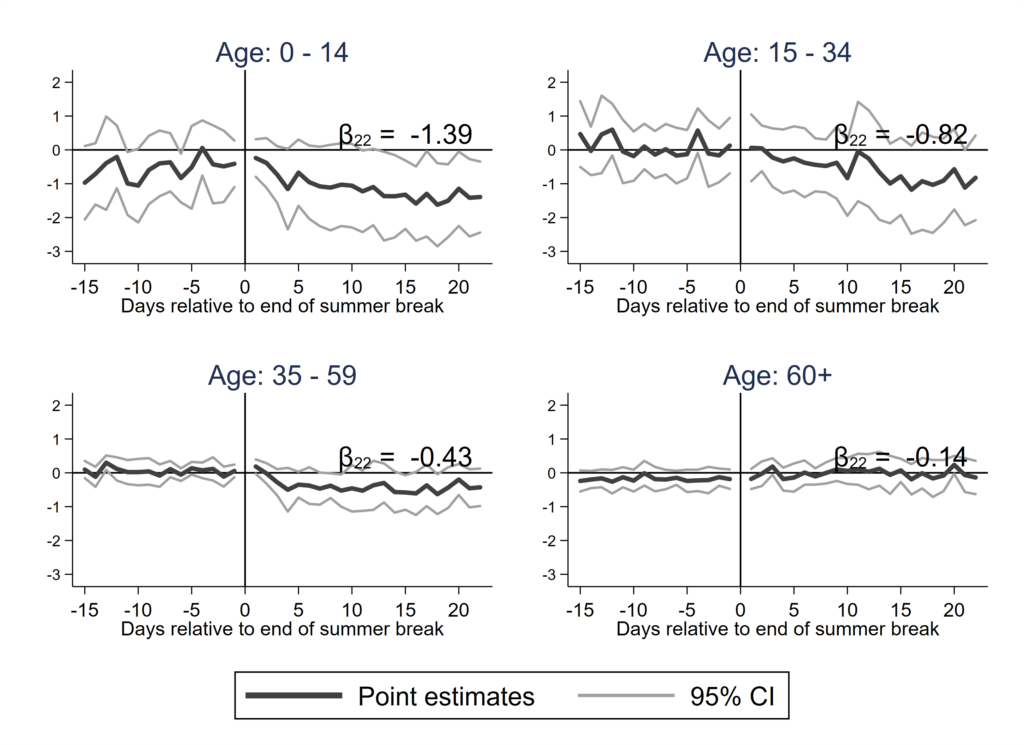
A new IZA study by Ingo Isphording, Marc Lipfert, and Nico Pestel suggests that this fear might be unwarranted – at least under certain circumstances. The researchers exploit as a “natural experiment” the schedule of staggered school summer breaks across German states to estimate the effect of the end of summer breaks on newly confirmed cases of SARS-CoV-2 infections. Methodologically, they apply a so-called event study analysis that compares the daily difference in county-level case numbers between states where summer breaks end with those states where schools are still closed and re-open later.

The figure below highlights their results. Each point on the thick black line corresponds to a change of the difference between counties in “opening” states and states that do not (yet) experience the end of summer break, relative to the first day after the end of summer break. The “flat trend” before the end of summer breaks shows that differences did not vary before school re-openings. Differences emerge only after the end of school breaks. This pattern corroborates the researchers’ assumption to actually estimating a causal effect of the end of summer breaks.

After summer breaks, relative case numbers even went down

After the end of summer breaks, relative numbers of newly confirmed case numbers gradually decrease in re-opening states relative to those not (yet) re-opening. The effect is sizeable: Three weeks after the summer break, the difference accounts for 0.55 fewer cases per 100,000 inhabitants per day – about 27 percent of a typical difference between two daily counts before the end of summer breaks.  The effect is concentrated among age groups of school-aged children and their parents. At-risk groups aged 60+ are not affected.

“This result certainly ran counter our own priors,” says Ingo Isphording. As the authors themselves, politicians and the broader public were very concerned about the school re-openings which were a common topic in media debates. The authors thus corroborated their findings with a large number of different specifications, yet in none they find a positive effect of the school re-openings on new confirmed cases.

Taking a closer look at the underlying situation the results are based on, the authors present several mechanisms that could explain the lack of the expected positive effect of the school re-openings.  School re-openings happened during a time of low overall infection rates. Schools applied strict hygiene measures, including mask wearing, teaching in small fixed groups, and rapid testing and quarantining of classes where a student or teacher has tested positive. Thus, the analyzed school re-openings were likely not the flip side of the coin of comprehensive school closures during a phase of exponential growth in case numbers in March and April. Finally, the authors argue that school re-openings increased precautions as symptomatic children were rapidly quarantined. “When the consequence of a running nose is that your kid cannot go to school for some days, you think twice of letting your kid play in closed quarters with others,” says Ingo Isphording.

The results bear implications for policymakers in countries where schools are yet to be re-opened. It shows that in a situation where schools re-open under strict hygiene measures, case numbers do not necessarily increase after school re-openings, despite large media attention to single arising cases. “200 kids in quarantine might make a good newspaper headline, but they just show that our system of containing the spread in schools actually works,” says Isphording.

Freely available rapid testing for teachers and students as well as decentralized quarantine and containment measures appear to be sufficient – in a situation of low community spread – to keep the pandemic under control and simultaneously allow for universal in-class teaching. Given the high immediate and longer-run human capital costs of school closures, the results might help to re-evaluate the cost-benefit considerations of moving back to on-site schooling, and closing schools in response to newly rising numbers. Yet, in doing so, the context of the estimation of a situation of low community spread and the restricted time horizon of three weeks after the school re-openings has to be kept in mind.

Filed Under: Research Tagged With: Bildung, COVID-19, Schule

Future earnings gap due to COVID-19 school closures

October 7, 2020 by Mark Fallak

When children lose out on education, they lose out on future opportunities, including economic benefits, with far-reaching impact on their lives. Like so many aspects of this pandemic, this impact on children and young people seems more likely to take the form of a long crisis rather than a short, sharp shock. Nor is the economic impact of lost learning confined at the individual level. There will be significant consequences for national and global economies as well.

In mid-April, UNESCO reported 192 countries had closed all schools and universities, affecting 1.5 billion children and young people. It is difficult to predict how long schools will remain closed, how severely learning is being limited, and how much this will affect those who are already at a disadvantage. We do not yet know enough about how the pandemic will unfold. But we do know that learning is being lost, and losses will not likely be evenly distributed.

A recent IZA discussion paper by George Psacharopoulos, Victoria Collis, Harry A. Patrinos, Emiliana Vegas offers an initial projection of lost earnings that will result from the current school closures. The researchers began by assuming that every additional year of schooling equates to 8 percent in additional future earnings. They then assumed a period of four months of closures to estimate the loss in marginal future earnings. Real closure periods will vary based on the trajectory of the pandemic and policy choices. However, emerging information from countries including the U.S. suggest four months to be a reasonable estimate.

Third, the researchers assumed that only 10 percent of students would suffer a loss of learning. This conservative adjustment accounts for the range of online and distance learning that has been made available during closures. The emerging evidence is that these resources are in practice more readily available to students in high income countries than others.

Finally, the authors estimate total earnings losses for today’s students assuming a range of labor force participation rates between 70 and 100 percent.

Earnings gaps at the individual level and worldwide

Applied to the worldwide economy, the model projects a future earnings gap of over $US 11,000 at the individual level, or between $10 and $15 trillion (depending on the labor force participation rate) for the whole global cohort. In high-income countries, the projected individual earnings gap is $21,000, or between $3 and $5 trillion for the whole cohort.

In low-income countries, the projected individual earnings gap is $2,800, or between $252 billion and $360 billion (depending on the labor force participation rate) for the whole cohort. In a context of already low wages, depressed growth forecasts, and high rates of poverty, this gap suggests a potentially devastating economic loss for this group of nations.

In middle-income countries, projected individual losses are $6,800, or between $4 and $7 trillion (depending on the labor force participation rate) for the whole cohort. More than 1 billion of the 1.5 billion students affected by closures live in middle-income countries.

Lost GDP due to COVID-19

In terms of GDP, projected losses range from 43-61 percent (depending on the labor force participation rate) in low-income countries, to 15-22 percent in middle-income countries, to 6-9 percent in high-income countries. Taking the weighted average by population for the three regions provides a world estimate of a staggering 12-18 percent in lost GDP due to COVID-19.

By education level, post-secondary school graduates stand to lose $725 a year in present value terms, and almost $18,000 over a lifetime. Secondary school graduates will lose $363 a year and almost $9,000 over a lifetime, while those with less than secondary will lose $272 a year and $6,700 over a lifetime. But since most students around the world are in primary—at 49 percent—or secondary school—at 39 percent—then in terms of aggregate losses, they will be much higher at the lower levels of education, between $6.5 trillion and $9 trillion.

Larger impact on low-wage earners

The earnings losses will hurt those with lower levels of schooling more, as they are likely to move many people to a level of income where it is difficult to meet basic needs. The proportionate impact on a low-wage earner is, therefore, greater in absolute terms as it will affect his or her ability to achieve food security, affordable housing, and so on, compared with a relatively high-wage earner.

In presenting these findings, the researchers emphasize their status as the start, rather than the culmination, of an analytical process. There are complicating considerations, including the uneven quality of learning, differences in provision of effective distance learning, and other pressures that will come to bear on some children, such as the need to find work to help support their families. This paper is offered as a starting point to assist governments in making increasingly informed choices about school closures, and to start a debate on controlling and mitigating the economic downward spiral that COVID-19 is already generating.

Filed Under: Research Tagged With: COVID-19, earnings, education, schooling, wages

From pandemic shock into recession

September 30, 2020 by Mark Fallak

The pandemic-related restrictions on economic activity resulted in a massive reduction in working hours in March and April 2020. Only the key professions and those jobs that could be done from home were largely spared. Once the strict corona rules were relaxed, the sectors that were particularly affected recovered relatively quickly, while other sectors recorded a significant drop in hours. This is shown in a new study by economists from ECONtribute and IZA, based on detailed Dutch data.

The early stages of the crisis in March saw a massive drop in working hours, especially in the food service industry (minus 15 hours per week) and in the cultural and tourism sector (minus nine hours). In the key sector of health and social care, the decline in hours was much smaller at 2.5 hours. As Figure 1a illustrates, the change in working hours depended largely on the extent to which the activity could be relocated to home. For example, the average working time in the financial and business services sector remained almost unchanged with a slight minus of just under two hours.

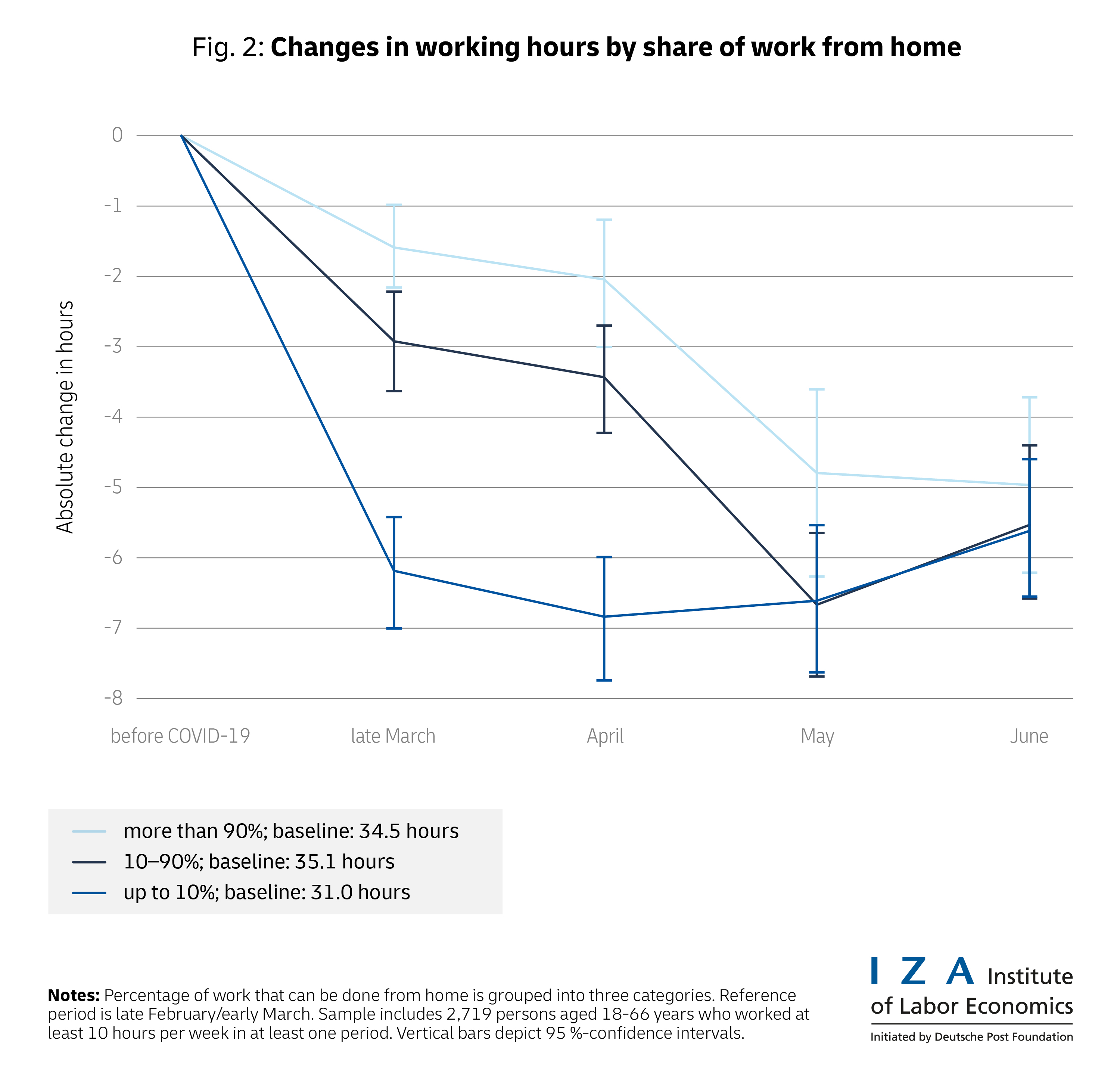
In June, the picture is partially reversed (Figure 1b): The number of working hours in the food service industry increased significantly again, more than halving the gap to pre-crisis levels. At the same time, there was a more than twice as strong decline in hours in fields with high levels of home working, such as in financial and business services. The researchers attribute this finding to the fact that the “character” of the recession has changed: After the first “pandemic shock” with strong industry-specific slumps due to government restrictions and the immediate effects of the virus, a general decline in demand set in that impacted the entire economy. This also meant that the “home working advantage” was no longer relevant: Figure 2 shows how the gap between low and high levels of home working closes between March and June.

The authors conclude that the short-time work regulations made a decisive contribution to enabling companies to adjust working hours flexibly without causing waves of redundancies. There were also hardly any shifts in income distribution, although low-income earners were much more affected by the reduction in hours. “This is where the government programs have a beneficial short-term effect. However, they are of little help when it comes to long-term changes in demand and can even be harmful,” says Hans-Martin von Gaudecker, ECONtribute Professor of Applied Microeconomics at the University of Bonn and head of the IZA research team Structural Policy Evaluation.

The study is based on the work of the CoViD-19 Impact Lab, in which von Gaudecker, together with his research team from Bonn and the Dutch University of Tilburg, analyzes the effects of the corona pandemic and its countermeasures. The aim is to quickly generate helpful data in the current crisis and make it available to the public. More in-depth analyses will follow in the medium term.

Data based on the Dutch LISS panel

The data was collected using the Dutch LISS panel (Longitudinal Internet Studies for the Social Sciences), which, for more than ten years, has regularly surveyed 4,500 households on a variety of topics. The households are representative of the Dutch population and answer the questionnaires online. For this data set, LISS participants aged 16 and over were interviewed in four survey waves in late March, April, May and June. 6,650 people completed at least one questionnaire in full.

Filed Under: Research Tagged With: COVID-19, recession, working hours

  • Previous Page
  • Page 1
  • …
  • Page 15
  • Page 16
  • Page 17
  • Page 18
  • Page 19
  • …
  • Page 69
  • Next Page

Primary Sidebar

© 2013–2025 Deutsche Post STIFTUNGImprint | Privacy PolicyIZA